

How inclusive practices and innovative research are shaping the future of golf accessibility.

Golf might not be the first sport that comes to mind for people with visual impairments. Yet, unlike many other interactive or contact sports, golf offers a unique opportunity for inclusion. New research has revealed that with the right support, golf is a game where people of all abilities can play together. For the golf industry, this represents not only a moral imperative but a significant business opportunity.

Understanding the market
The research project, led by Dr Jess Macbeth (University of Lancashire) and Dr John Fry (University Centre Myerscough), revealed the latent demand for golf by people with visual impairments, by highlighting the profound benefits of participation.

Survey respondents reported how golf positively impacted their overall health and wellbeing. Ninety-six percent said golf improved their physical health, 93 percent their mental health, and 97 percent their overall social life. Golf is adaptable, it does not rely on fast reactions or constant physical contact, and fosters social communities, thus making it an ideal option for those with sight loss.

One player summed it up: “It gives me a reason to get up in the morning and has enabled me to be a much more positive person”. Another reflected, “after 16 years of not playing, I have found a new enthusiasm and zest to compete again without feeling I was disturbing playing partners.”
These comments underline golf’s potential to transform lives. For many, the sport helps them accept sight loss, reduce isolation and regain confidence.
The research sample was predominantly older (81 percent aged 55-plus) and male (96 percent). Two-thirds were golf club members and 63 percent had played before acquiring sight loss. However, 30 percent were new to the sport, showing golf’s appeal beyond traditional demographics.
Barriers to participation
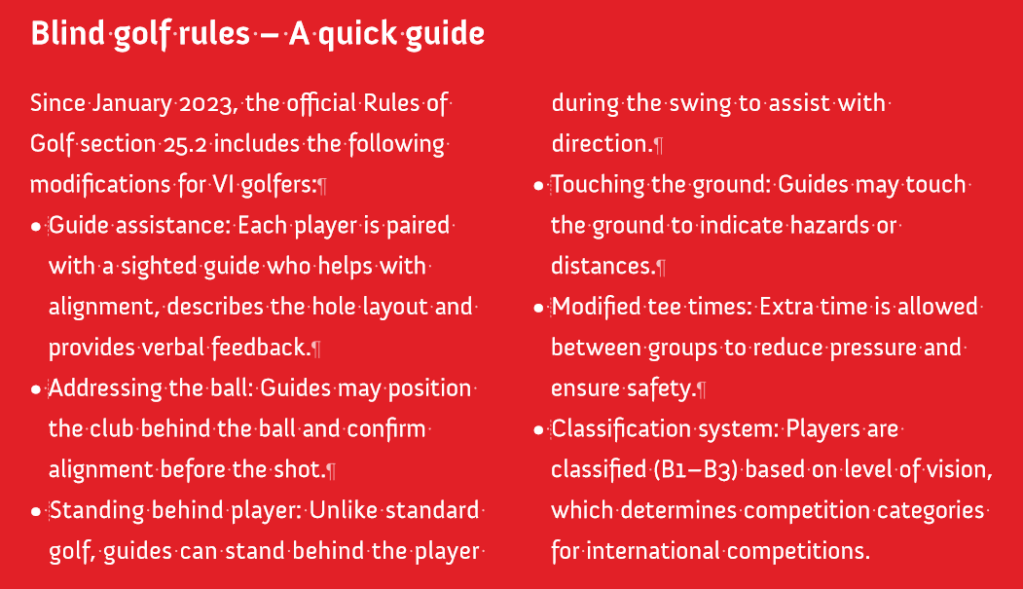
Demand is clear: 85 percent of respondents want to play more golf. However, despite this enthusiasm significant obstacles remain. The most pressing is finding a guide, where 81 percent of respondents identified this as a challenge. Guides assist with alignment, describe course layouts and provide feedback.
Yet, reliance on others creates a paradox: players value independence but cannot play safely without support – this is a difficult balance to strike. Golf clubs could recruit willing members to a volunteer guide scheme, provide basic training for the role, help break down barriers between members, and offer a rewarding experience for all involved.
The research reveals attitudinal issues persist in certain areas of the golf industry, with 48 percent citing negative perceptions and 44 percent noting a lack of awareness. One golfer recalled: “I approached a local golf club with a view to joining. It was clear there was no understanding of VI golf. The panel seemed surprised that someone with impaired vision could play.”
Cost (48 percent) and confidence (33 percent) also feature, compounded by practical concerns about sight deterioration (59 percent). While coach knowledge and role models scored lower (22 and seven percent respectively), they remain areas for improvement.

Facilitators and success stories
Support networks are vital. Family and friends (85 percent) and charities like England and Wales Blind Golf (EWBG) (85 percent) play a key role. Andy Gilford, from EWBG, talks firsthand about how golf “gives people a community to join whilst making friendships through player and guide interaction, and also being able to talk with people on the same sight loss journey” adding that “the sport really can help anyone, by bringing people together and overcoming loneliness, anxiety and other symptoms which all ages can face”.
Motivation and enjoyment (81 percent) also drive participation. One respondent shared: “Blind golf brings people together. I would not have the friends across the world I have today if not for the sport. It’s given me something to be proud of while battling mental health and depression.”
Golf professionals and coaches contribute too, though only 37 percent of respondents cited them as enablers. This suggests scope for greater industry engagement through training and outreach.
Technology offers exciting possibilities. Two-thirds of respondents had used Toptracer ranges and found them helpful. Enhancements such as audio options and improved screen design could further boost accessibility. For clubs, investing in such technology is not just inclusive – it’s commercially smart, attracting new customers and diversifying revenue streams.
 Dr Jess Macbeth
The business case for inclusion
Inclusive golf is good business. The visually impaired community represents a growing market with strong demand for participation. Clubs that embrace accessibility can expand membership, enhance reputation, and unlock funding opportunities.
Moreover, inclusive programmes foster loyalty. Visually impaired golfers often become passionate advocates for clubs that welcome them, creating positive word-of-mouth and strengthening community ties.
There are plenty of opportunities for the golf industry to seize, such as: integrating disability awareness into staff and member forums, offering guide recruitment and basic training, auditing facilities for accessibility, partnering with sight loss charities and blind golf associations, and marketing campaigns to challenge stereotypes and showcase success stories.
 Dr John Fry
A vision for the future
Golf’s values of integrity and respect align perfectly with inclusion. By embracing visually impaired players, the sport can reaffirm its commitment to diversity and innovation. As Dr John Fry notes: “Accessibility is not just about ramps and signage — it’s about empathy and education.”
This research makes one thing clear: visually impaired golfers are eager to play. The question is whether the industry will seize the opportunity.
For more information contact Dr Jess Macbeth on jlmacbeth@lancashire.ac.uk or Dr John Fry on jfry@myerscough.ac.uk
England & Wales Blind Golf can be contacted on enquiries@ewblindgolf.co.uk


