
It’s become a running joke among my regular golfing group. Each spring, when we head out for the first round of the season, I confidently declare said year to be “my year.”
It’s a fresh start, a chance to improve my game, perhaps shoot my lowest round yet.
And golf being golf, there’s always something that needs work. One of the most challenging parts of this game is getting all the parts to jive at once. There might be a round or two, or even a stretch of a couple of glorious weeks (I am looking at you, July 2022), when everything is clicking. But most of us spend more time coulda-woulda-shoulda-ing about our rounds than celebrating them.
Even the pros struggle to get their game firing on all cylinders. It’s just not typically as dramatic because their misses are much, much better than the average duffer’s.
Listen closely to any post-round interview, and you’re bound to hear the player assessing not only what went right, but also what he or she struggled with that day. And even the world’s best are not immune.
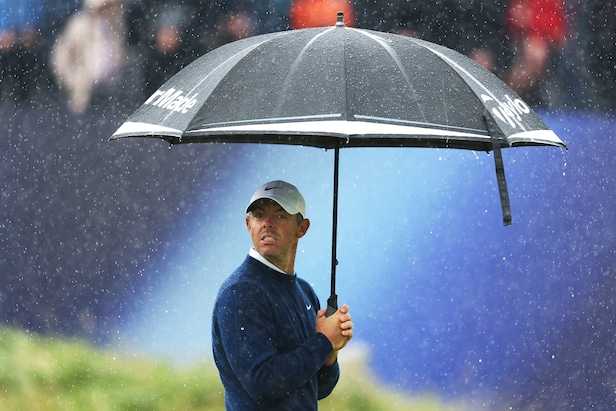
Take Rory McIlroy, for example. This year, the No. 2 golfer completed the Career Grand Slam by finally claiming his green jacket at the Masters in April. He also won The Players Championship for a second time in March. But McIlroy still knew he struggled with driving accuracy, finishing near the bottom of the fairway accuracy rankings despite his elite distance and overall ball-striking.
“Awful … drove the ball terribly … when I hit more fairways, I give myself more chances; I just need to hit more fairways,” he said following the first round of the BMW Championship.
World No. 1 Scottie Scheffler’s struggles with his putter were well-documented. Then he made changes: a putting coach, a new putter, and later, a new grip. His putting in 2025 went from a relative weakness to an elite strength, gaining significant strokes on the field.
Sometimes, you know what you need to work on. You can identify the problem and attack it. Sometimes, it’s an injury that sidelines you or sets you back. Like many golfers, I can relate to this, having tried to play through an elbow injury for much of 2024 and 2025.
What’s even more frustrating is when multiple parts of your game fail you at once and there’s no tangible explanation. This happened to me. My game started to fail me long before my first real round of the season. I was practicing indoors on a simulator in January, and got the shanks. They followed me onto the course and continued to haunt me on and off (mostly on) through July.
Everything started to feel “off.” Was something wrong with my grip? Was I standing too close to the ball? Where was my weight supposed to be?
I took a couple lessons to go back to basics. When those didn’t help, I took to the internet. I’m not a technical player, but suddenly I was overthinking every little thing. What might have started as a physical problem was now a full-blown mental block.
It was like I had suddenly forgotten how to play this game I had played for 30 years.
And if you’re a Wisconsin golfer, you know how cruel that timing feels, spending months staring at snowbanks, waiting for spring, only to emerge from winter hibernation and realize your swing didn’t survive the offseason.
Yet it wasn’t all bad; the golf gods gave me just enough decent rounds amid the duds to keep me coming back. But just when I thought I’d made it to the other side safely, something else would go wrong the next time out.
And then suddenly, this fall, it all clicked back into place. Despite receiving numerous tips all year long, I distinctly remember receiving the one tip that finally worked before an early October round at Mee-Kwon. It wasn’t a complex swing thought; it was just a small reminder on weight shift. On the very first tee, I braced myself for another disaster … and instead flushed my drive right down the middle. I almost laughed out loud. From then on, I enjoyed the rest of the season much more.
Which brings me back to the question: Why is this game we love so much so utterly difficult? Why do we constantly struggle to improve? Why do we ruminate on bad rounds and stew over bad shots?
In a viral interview before the Open Championship this summer, Scottie Scheffler himself wrestled with similar questions. Here’s a player at the absolute pinnacle of the sport – the world’s best – questioning why he needs to win so badly when the feeling fades quickly. He reflected on his struggle with finding deep fulfillment in winning tournaments, noting that accomplishments offer fleeting joy but not lasting satisfaction.
“We work so hard for such little moments. I’m kind of sicko; I love putting in the work. I love getting to practice. I love getting to live out my dreams. But at the end of the day, sometimes I just don’t understand the point,” he said.
If Scottie Scheffler – who wins major championships and gets paid millions to play – can’t quite articulate why we chase this maddening game, what hope do the rest of us have?
Not much, apparently. And yet despite having shanked my way through half the year, and spent the other half questioning my sanity, last week I found myself trying to book a tee time somewhere, anywhere, in late December just because the snow has melted, and I can’t stay away.
Maybe the answer isn’t in understanding why, but in accepting that we can’t help ourselves.
This game isn’t my livelihood. I’m not trying to win tournaments or even beat my playing partners. But I keep coming back, keep declaring each spring will be my year, keep believing it despite all evidence to the contrary.
Maybe that’s the point. Or maybe there is no point, and that’s okay too.
Either way, 2026 is going to be my year.