

Sport never stops. Heroes swap places with villains, years merge then blur, and things of crippling importance fade to ephemera. We keep churning the humdrum in the hope of turning it into lasting gold. And occasionally there is a generational event when hard-bitten cynics get bitten by a better bug, and something that starts as normal ends by shedding sport of all its guile and greed. April 13 was one of those.
This was not any given Sunday but the culmination of a 30-year quest and a decade of perceived failures. Winning the Masters is a brilliant achievement, but let’s face it, someone does it every year. Rory McIlroy’s triumph separated itself from the gold leaf of the honours board because of the flipside. A stellar player with four majors, his disappointments had spawned a perennial “but”, and his career had become reminiscent of the last line of The Great Gatsby — “so we beat on, boats against the current, borne back ceaselessly into the past”.
Squandering the 2024 US Open to Bryson DeChambeau meant a golfer regarded as one of the very best had, by this spring, not won a major for 11 long years. The Masters would also give him the career grand slam, something only five others had ever achieved, but April 13 was extraordinary because it was a microcosm of a career, a warts-and-all exposé that proved there is no UK sportsperson who can be so brilliant and so bruised.
The scars from Pinehurst and 2011 Augusta meltdown
On the 70th of 72 holes at the US Open at Pinehurst No2, McIlroy missed from 2ft 6in. On the 72nd he missed again, from 3ft 9in. DeChambeau seized on that to play a magnificent bunker shot, snatch the trophy and glad-hand half of North Carolina. Cameras in the scorers’ hut caught McIlroy at his most broken as he made a quick exit.

McIlroy let the US Open slip away during the final round at Pinehurst
CJ GUNTHER/EPA
There was a pile-on of psychobabble. His own psychologist, a septuagenarian master of aphorisms called Bob Rotella, claimed he was over it in no time. “The reason is he hit that putt on the last hole exactly where he wanted to and at the speed he wanted to. He just couldn’t believe how much it broke. The way we talk about it is, ‘I made it in my mind’. He doesn’t see the world the way the rest of the world sees it. The rest of the world is only about results.” It sounded slightly kooky, too neat for an emotional player with an obsession, but Rotella reminded McIlroy that Jack Nicklaus had been a serial runner-up as well as an 18-times major winner.
Shane Lowry watched what happened at Pinehurst and sighed. “It was heartbreaking,” he told me. “Even if I wasn’t a friend, it would have been because you wouldn’t wish that on your own worst enemy. I think his game is as good as it’s ever been. It’s just up to him whether he can break down that barrier.”
Augusta in April was still dealing with the aftermath of Hurricane Helene. So many trees had fallen around the course that Sir Nick Faldo suggested the wind could play a part. Jon Rahm said the new vista meant he had considered a high cut over the cabins on the 10th.
Only Henry Cotton, Julius Boros, Hale Irwin, Ben Crenshaw and Tiger Woods had gone so long between major wins. They were all in their 40s. By contrast, the 35-year-old McIlroy’s drought had coincided with what many felt should be his pomp. Other sports offered no solace. Lewis Hamilton went six years between F1 crowns. Arthur Ashe went five between tennis grand-slam titles but that was half a century ago. McIlroy had won twice in 2025 and had addressed a glitch in his swing, but Augusta National was his haunted mansion.

McIlroy took a while to come to terms with his collapse on the final day of the 2011 Masters
TIM DOMINICK/THE STATE/MCT VIA GETTY IMAGES
The media centre off Washington Road is a sort of southern palace borrowed from a Tennessee Williams play. There are rocking chairs on the porch, waiter service in the Bartlett Lounge, a panoramic view of the driving range and a huge media theatre.
McIlroy’s pre-tournament interview there is always the best attended. Answers are usually expansive, always honest. “At a certain point in someone’s life, someone doesn’t want to fall in love because they don’t want to get their heart broken,” he said. “I think, instinctively as human beings, we hold back sometimes because of the fear of getting hurt, whether that’s a conscious or subconscious decision, and I was doing that on the golf course a little bit for a few years.” It was a sporting truth proved by athletes who hedge their bets and refuse to hit the front in Olympic finals. This year McIlroy was ready to get his heart broken.
It helped that Scottie Scheffler, the world’s best player, was still working his way back after cutting his hand on a wine glass while making pasta, but time was not on McIlroy’s side. After his meltdown in 2011 when he saw a four-stroke Sunday lead disappear, he had felt a victory was inevitable. “It will be pretty tough for me for the next few days, but I will get over it,” he said breezily. That had been 5,114 days ago.
Three rollercoaster rounds
McIlroy started well and was four under after 13 holes. And then he chipped back onto the green on the 15th and his ball kept on rolling, beyond the hole and down the bank into the water. The momentum killer was followed by a second double bogey on the 17th. Back to where he started, he was seven shots behind Justin Rose, who led after 18 holes. “Vulnerable & frazzled — is it over?” asked one headline in The Times that would age poorly. If he was going to win from here, though, it would be suitably Rory-esque.
The everlasting addiction of golf is in its capriciousness and McIlroy bounced back with a round of 66 to end Friday just two behind Rose and one behind DeChambeau. The prospect of a duel with DeChambeau, the man who had inflicted such slashing wounds at Pinehurst, was delicious. “I rode my luck a bit on 13, 14 and 15 and thankfully got away with it,” McIlroy said.
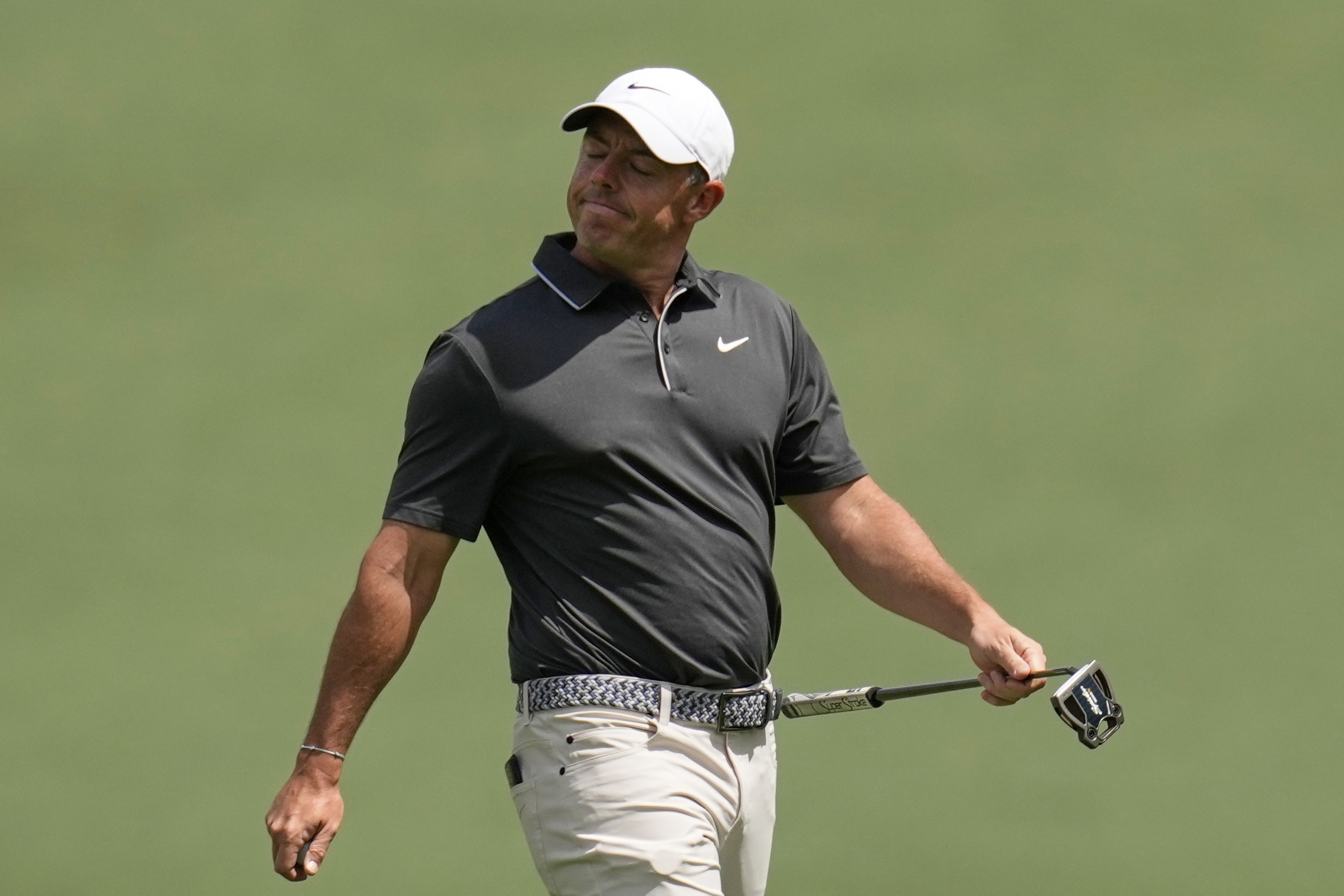
McIlroy endured a mixed opening at Augusta before playing himself back into contention with a second round of 66
DAVID J. PHILLIP/AP
McIlroy started round three with six threes, the first man ever to do that, and was soon in the lead. It had been a remarkable game within the game, but DeChambeau played out of a fairway bunker on the 18th and then holed out from 50 feet to sit just two shots behind. McIlroy said he would go home, watch Bridgerton and read his notes that include “all the cliched mantras that you’ve heard before”. Rose, some seven shots adrift, was seemingly out of the reckoning.
Big moment finally arrives — after more late drama
There was a rare buzz that morning. The lead was slender. Would DeChambeau intimidate, irritate in the final group? “I’m not going to shy away from it,” McIlroy said. “Situations like this are the reason I get up and work hard. These are the pairings I want to be in.”
Memories: in 2015 he said it was “unthinkable” that he would not complete the grand slam in his career; in 2017 he said his craving turned him into a “complete prick” before the Masters; in 2021 he had his worst opening round at Augusta and struck his father, Gerry, on the back of his leg with an errant shot. “I should ask him for an autographed glove,” McIlroy Sr quipped.
At Augusta players walk out of the whitewashed clubhouse, past the old oak tree, the traditional meeting point due to the ban on phones on the course, and through a cordon of fans to the putting green. McIlroy emerged first and stared straight ahead. DeChambeau followed, all smiles and handshakes. After the opening hole, which McIlroy three-putted, they were level. On the second McIlroy found the bunker, and when groans had softened to shock, DeChambeau led.
The originality of sport meant the anticipated face-off petered out. Back-to-back birdies put McIlroy in command. On the 7th he was in trouble but found a window out of the trees, hitting a branch but laughing at the happy result.
With reports needing to be filed as the last putt drops, the Masters is always a challenge for UK journalists, but McIlroy was helping and scribes began to write. After ten holes he led by four. Finally. Rose, though, was knocking in a 57ft putt and had caught DeChambeau after only 12 holes. In 2017 Rose lost a Masters play-off to Sergio García so another redemption song was prepped.
McIlroy got lucky on the entry to Amen Corner, but he duffed his chip on the 13th and found the water. A fourth double bogey. Soon after, Rose rolled in another birdie on the 16th and they were level. Ludvig Aberg had also risen into contention.
On the 14th McIlroy lost the “unassailable” lead, and demons and ghosts did the Monster Mash on his scrambled brain. It was happening again. Like the US Open in 2024, the Open in 2022, the Masters in 2011. Journalists hit delete. “He’s bloody choking,” cried one naysayer. Then Rose missed an eight-foot putt on the 17th and there was a three-way tie at the top. “Christ! Aberg is going to win this!”

McIlroy is helped into his Green Jacket by Scheffler
MIKE SEGAR/REUTERS
How McIlroy needed a perfect swing to declutter his mind. “Instant amnesia,” was one of McIlroy’s gifts, Rotella had told me, but how can you forget losing four shots in four holes with the grand slam sharpening into view? From the left fringe on the 15th, more water up ahead, pine branches dangling in front of him, he chanced it. He flashed a high draw that arced around the trees. In those few airborne seconds the fate of the Masters, the grand slam, even enduring reputation, hung in the balance. Did he have enough?
The confirmation roars meant he felt emboldened enough to punch the air with his putter as he approached the green. He then missed the putt and rubbed his face, but still had a birdie and a one-shot lead. Three holes left.
Rose would not wilt. On his final hole, he rolled in a 20ft putt to draw level again. McIlroy fluffed a birdie chance on the 16th. Aberg finally fell. “He needs one great shot,” Faldo said, and McIlroy played his 8-iron to four feet on the 17th. He got the birdie, but Faldo had been wrong. He needed more.
Sport can be mesmerising when broad-screen epics are reduced to brief moments. The equation was now simple. Four shots to end a decade of yearning. The first was good, a true drive down the middle. The second was saddled with the weight of his history and ended in a greenside bunker. He chipped out to leave six feet for everything. He pulled the putt. Gritted his teeth. His round of 73 and Rose’s 66 meant we headed back down the 18th for the play-off. Enter Harry Diamond, McIlroy’s friend and caddie who has received plenty of flak down the years. “Well, pal, we’d have taken this on Monday,” he said.
Rose played first and found the fairway. Ditto McIlroy. Rose’s approach, straight at the flag, left a decent birdie chance. McIlroy’s wedge got the right part of the bank and rolled back towards the hole, resting just four feet away. When Rose’s putt drifted right, here was a second chance, or maybe it was the third, fourth or fifth. This time. Down on his knees and elbows. A guttural roar. “A decade of emotion,” McIlroy said later. “Pure relief. There was not a lot of joy in the reaction.” Rose was ever magnanimous, the perfect foil for an imperfect day.
Other good things followed, the Irish Open and a rancorous Ryder Cup in which McIlroy was a lightning rod for American bile and Europe’s triumphant figurehead. There was a comedown too, a minor stand-off with the media, concern about Alan Shipnuck’s unauthorised biography due out next spring, but April 13 was the moment of the year. It was far from his greatest round, but it was easily his greatest, most gut-wrenching day. All out of heartache. For now.


