
Every golf course, I suppose, has an expiration date, but for most we’ll never know.
That’s why I made a point last month of playing the East Course at Yahara Hills in Madison while I still could.
I know the end is coming for that half of the popular public golf facility on Madison’s southeast side. In fact, I got a mulligan to allow me one more round — a chance to say my goodbyes, you might say — because only nine of the 18 holes were supposed to have opened this year as plans move forward to reduce Yahara Hills to 18 holes on the footprint of the current West Course.
As I pulled into the parking lot, I thought of how I never had the opportunity to say farewell to so many Wisconsin courses I have enjoyed throughout the years that are, well, no longer with us.
Rainbow Springs in Mukwonago. Decatur Lakes in Brodhead. Windwood in Watertown. Argue-Ment in New Glarus. Bay Ridge in Sister Bay. Ludden Lake in Mineral Point. St. John’s Military in Delafield. Olympia/Olde Highlander in Oconomowoc. The Green Golf Center in Middleton. And going way back to my days growing up in Wisconsin Rapids, Pagoda in Nekoosa.

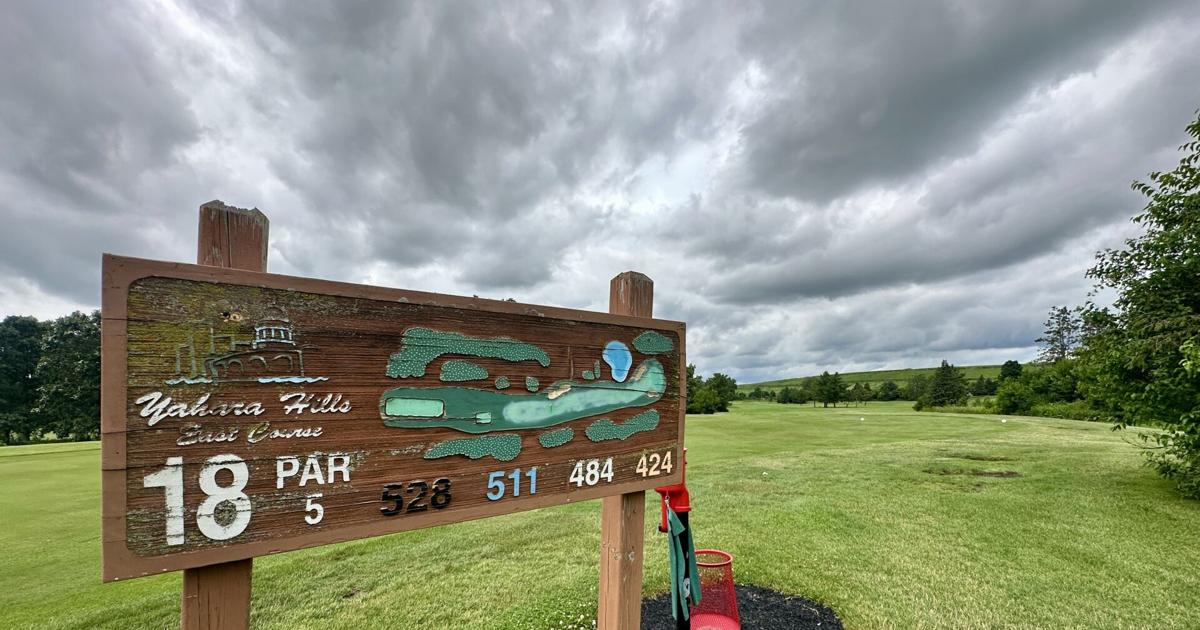
The tee sign on the par-4 ninth hole on the East Course at Yahara Hills GC in Madison has seen its better days but it will not likely see any use after the 2025 golf season.
Wisconsin.Golf photo / ROB HERNANDEZ
And those are just the ones I played. In recent years, Wisconsin has also lost South Hills GC near Racine, Maplecrest CC near Kenosha, Highland Ridge GC in De Pere, Shorewood GC on the UW-Green Bay campus and 18 of the 36 holes at Silver Spring CC in Menomonee Falls.
Many have succumbed to commercial buildings. Some sit idle. Others gave way to highways. A few have been turned into wildlife sanctuaries. Most have become housing developments.
As for Yahara Hills East? Its future will be as a “sustainability campus,” the first step in replacing the Dane County Landfill across Highways 12/18 that will reportedly reach the end of its life by 2030.
In 2022, the city sold 230 acres of land on the east end of Yahara Hills to Dane County. It plans to use 83 acres for a new landfill and the rest for open space and a business park.
The great irony, I discovered, in Yahara Hills East becoming what – once upon a time – would’ve been called a dump is that I don’t remember the course being in better shape. And that’s saying something, since it received two inches of rain overnight the day I played it.
The bunkers, which are not being maintained, appear to be the only maintenance concession made in the decision to extend the course’s life by a year. Most tee signs were preserved for Yahara East’s encore season, albeit considerably weathered and several nearly illegible.
But I wasn’t there to play the U.S. Open. I was there, mostly, to take an 18-hole walk down memory lane over an East Course that has carved a unique legacy over its 57-year history.
A shelter area with bathrooms near the eighth and 17th tee boxes on the East Course at Yahara Hills GC in Madison has been stripped of its paint in anticipation of demolition after the 2025 season.
Wisconsin.Golf photo / ROB HERNANDEZ
Of course, its greatest claim to fame was playing host to the inaugural U.S. Women’s Public Links Championship in 1977. There was a lot going on in Wisconsin that week (namely a state workers’ strike in downtown Madison and the Greater Milwaukee Open at Tuckaway Country Club in Franklin), but Kelly Fuiks, 19, of Phoenix, pulled out a 1-up victory over Kathy Williams, 17, of La Crescent, Minn., who had made a 60-foot birdie putt on the par-3, 166-yard 17th hole before Fuiks prevailed with a par on the same 18th green where I finished my round.
Former Arizona State University golfer Kelly Fuiks receives the trophy after winning the inaugural U.S. Women’s Public Links Championship at Yahara Hills in 1977.
USGA file photo
Fuiks, an Arizona State University golfer at the time, would go on to marry noted golf instructor David Leadbetter and have three children – one of them, daughter Hally, currently works as a content creator for Golf Digest and CBS Sports. Williams would go on to win a school-record 17 times at the University of Minnesota and, after a brief LPGA Tour career, serve as Gophers coach before moving to the Chicago area where she is still a teaching professional.
Throughout my 28 years covering golf at the Wisconsin State Journal in Madison, though, it seemed as if Yahara Hills always lived in the shadows of other courses in the Madison area.
Odana Hills GC, its sister course which opened in 1957 as West Side GC and received its current name in 1961, had a better location and, despite being just 11 years older, a richer history. So did the three established private clubs – Maple Bluff, Nakoma and Blackhawk.
Yet, looking back at its nearly six decades, the East Course leaves behind quite a legacy.
One year after the USGA came to the East Course, the NCAA ran the 1978 Division I men’s cross country championships there on a bone-chilling November morning in sub-20-degree weather on a snow-covered 10,000-meter course. Oregon’s Alberto Salazar, who would go on to win three New York City Marathons and the 1982 Boston Marathon, upset two-time defending champion Heny Rono of Washington State, who would become a three-time NCAA champion in 1979.
When it comes to golf, Yahara Hills has a long history of generously making its two courses available for tournament play. Certainly, the East Course has played a prominent role in that.
From high school regionals and sectionals to junior tournaments to city tournaments to public links championships at all levels, seldom did a summer go by without a stop at one or both of Yahara’s layouts.
Wisconsin State Golf Hall of Famer Jim Schuman’s 63, shot during the final round of the 1984 Madison Men’s City Championship, stands as the course record on the East Course at Yahara Hills GC in Madison.
Wisconsin.Golf photo / ROB HERNANDEZ
Jim Schuman’s scorecard from his course-record 63 on the East Course still sits in the trophy case of Yahara Hills’ modest clubhouse. That came in the final round of the 1984 Madison City Championship – three years before I came on the beat – when Schuman, then a 20-year-old junior at the University of Florida, made 10 birdies to shoot 9-under-par for the day and 14-under for the week in the 72-hole tournament that visits a different course every day. He beat fellow future Wisconsin State Golf Hall of Famer Dave Spengler Jr. by a whopping 14 strokes.
Once I took charge of our golf coverage, most of my time at Yahara Hills East through the years was spent covering the mammoth Wisconsin PGA Junior Championship each June over the bulk of its 27-year run there. More than 300 junior golfers would play 18 holes on each of Yahara Hills’ two courses each year.
During the first round of the first WPGA Junior that I covered in 1989, then WPGA executive director Tony Coleman encouraged me to write about the only competitor in the 11-and-under division. Nick Gilliam, 10, of Green Bay shot a respectable 85 in his 18-hole competition to earn the title and, 11 years later, he would win the NCAA Division I championship for the Florida Gators.
The final day of that WPGA Junior also proved to be memorable when Lodi golfer Kirk Wieland birdied the final hole to shoot 70 and edge Delavan’s Chris Neiger by one stroke. Last month, I walked much of the back nine at Brown Deer Park GC in Milwaukee with Wieland as his son, Kade, used a final-round 70 of his own to win the 2025 WPGA Junior Championship by four strokes.
The final two WPGA Juniors at Yahara Hills in 2011 and 2012 were also special for a different reason. Those were the two my oldest daughter played at the start of her junior golf career, no doubt with her dad somewhere nearby with a greater appreciation than most for how that event – on those two courses at Yahara Hills – launched the careers of so many young golfers.
Coincidentally, that event left Yahara Hills after the City of Madison made the decision later that year to sever its contracts with the four PGA of America professionals who combined had more than 100 years of experience running the four city courses. They were to have been replaced by seasonal employees, with the concessions, merchandise, driving range and cart rental revenue that once went to the professionals used for improving the clubhouses and other facilities.
Workers check the water table levels after an overnight rain, paying no attention as I tee off on the 10th hole of the East Course at Yahara Hills GC in Madison. The area they are checking is one of many areas staked for that purpose ahead of a 2026 conversion to a sustainability campus and, later, a landfill.
Wisconsin.Golf photo / ROB HERNANDEZ
Six years later, the City of Madison paid Mark Rechlicz (Yahara Hills), Tom Benson (Odana Hills), Rob Muranyi (Monona) and Bill Scheer (Glenway) more than $1.2 million in a court settlement for failing to show good cause for not renewing their contracts in 2012. I no longer have as deep an interest in the management of Madison’s city courses – or, my more critical golfing friends will contend, lack thereof – as I did when I lived there, but seeing a Yahara Hills clubhouse that looks virtually the same as it did in 1989 tells me the city’s plans never took hold and the loss of Yahara Hills East after this year is another in a pattern of curious decisions.
It was hard not to be bitter as I made my way around Yahara Hills East for what will likely be the final time — barring more delays in the transition to its “sustainability” future that gave us this mulligan. But I drove through a downpour to get to the course and, because of the abundance of rain that week, I virtually had the course to myself once I got there, which gave me ample time and space to appreciate what Yahara Hills East had become and what it meant to so many.
How could it get any better than that?
Besides, it’s not like Yahara Hills is going away altogether. Work continues on a $2.5 million redesign of the West Course to expand tee box options, add trees and restore native grass, giving wishful thinkers in Madison’s golf population the hope that less will indeed be more.
I wish I could be so confident.
One last photo with the flag on the 18th green after what will likely be my final round on the East Course at Yahara Hills GC in Madison.
Wisconsin.Golf photo / ROB HERNANDEZ
A 2023 report in the State Journal indicated the city did not entertain a more ambitious redesign because its lease on part of the land on which the West Course sits will expire in 2042. “Our investment needs to last at least 20 years,” Lisa Laschinger, currently the city’s interim parks superintendent, told the newspaper. “We know that it’s not likely to have to last 50 years.”
I’ll be 76 by the time the lease runs out. I’d consider myself lucky to have a chance to play one final round on the West Course and stir up memories as pleasant as the ones the East Course has provided for nearly 60 years.