It was December 1992, and the first chapters in the legend of Tiger Woods were being written. Already he had won countless AJGA titles, claimed two of an unprecedented three straight U.S. Junior Amateurs and, as a high school junior, played in his first U.S. Amateur where, in the second round of stroke-play qualifying, he scorched around Muirfield Village in a bogey-free 66.
Yes, while Woods was yet to become a man, he was still very much the man in the world of junior and amateur golf. (Oh, and earlier that year, he also teed it up for the first time in a PGA Tour event at the Nissan Los Angeles Open.)
Which is why what took place at the Orange Bowl Junior International Championship in Coral Gables, Fla.,—on Tiger’s 17th birthday to boot—stuck in his craw for some time to come. Woods didn’t make a habit of losing when facing his peers—taught at an early age to be a cold-blooded golf assassin. Now he had fallen to someone he had never heard of.
While Woods skulked, his father Earl deemed the three-shot defeat a useful experience for his gifted son, describing it as “a good lesson for Tiger.”
And it was a confidence booster for the 17-year-old from Africa who beat him.
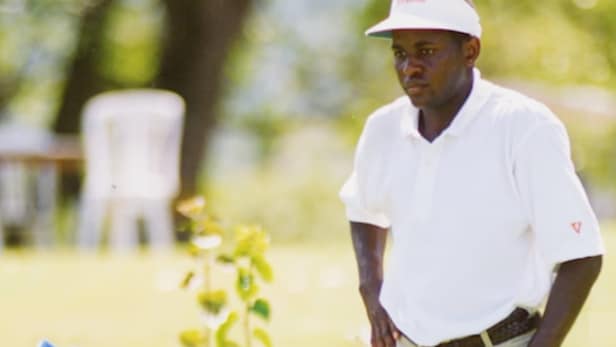
LEWIS CHITENGWA might be the greatest player the golf world never got the chance to see compete. He was born in Harare, Zimbabwe on Jan. 25, 1975. His father, Lewis Muridzo, worked at the city’s Wingate Country Club, and taught all five of his children, sisters Helga and Rhoda and brothers, Elias and Farai, to play.
But Lewis, the middle child, was the one.
Like Woods, Chitengwa was a natural from the moment he grabbed his first cut-down club. By the time he was 15, when he won the first of three consecutive Zimbabwe Amateurs, Chitengwa was already on the radar of several college golf coaches in America.
Mike Moraghan was one. Like most of his contemporaries across the country, the head man at the University of Virginia had attempting to persuade Woods to choose his school but, as most suitors found, he drew a blank. With Woods destined for Stanford, Moraghan tuned to what he considered the next best option in the college class of 1998: Chitengwa.
The UVa coach had been alerted to the youngster by recommendations from golf coaches Wally Armstrong and David Leadbetter, then working with World No. 1 Nick Faldo, and set about stealing a march on the competition. “They carried a lot of weight,” Moraghan says, “and it confirmed to me that I had to pursue this kid.”
In a world no Internet or cell phones, the problem was finding Chitengwa. Not only did he live 8,000 miles away in Africa, but his family did not have a landline at their Harare home.
What Moraghan did know, however, was that a talent as rare as Chitengwa was worth the effort. With an aggressive approach to the game and a lengthy, languid swing, Lewis was deceptively long off the tee. Moreover, he was blessed with a short game that could extricate him from the most improbable of situations. Indeed, anyone who did see him play knew he was the real deal, and by the time he was 18, Chitengwa has already played on five different continents, representing Zimbabwe in junior and senior events.
Morgahan’s perseverance paid off. Eventually he tracked Chitengwa down and established a standing phone call to an office in Harare every Thursday at 11 a.m. “Zim time” (4 a.m. in Virginia). “So every week I’d set my alarm and get up in the middle of the night to phone Lewis,” he recalls. “They were wonderful conversations.”
Moraghan wasn’t the only one tracking Chitengwa.
In the U.S., fellow Zimbabwean Nick Price also had been following Chitengwa’s progress. Price, who would go on to win three majors and reach World No. 1 at his peak, had known Chitengwa’s father for many years as their paths crossed on the country’s golf circuit. As Lewis’ stock rose, Price made a point of playing with him the next time he returned home.
“I just thought he was just such a wonderful young man,” Price says. “He had great manners, his etiquette on the golf course was outstanding. He could take a ribbing and give it back, too.”

Chitengwa was the first Black golfer to win the South Africa Amateur before becoming an All-American at Virginia.
For Price, however, it was imperative for Chitengwa to be given the opportunity to make progress, not least as he was a Black player following in the footsteps of an all-white cast of successful Zimbabwean golfers like himself, Mark McNulty and Tony Johnstone. Later, Price joined forces with compatriot Alan Rae to sponsor the teenager, but not before Chitengwa had opted to compete in the 1993 South African Amateur.
It was a decision that surprised Moraghan. “Apartheid was still being enforced back then, and I remember asking him what they would make of a skinny Black kid from Zimbabwe going there and winning their national championship,” he recalls. “He just laughed.”
Chitengwa’s father had no such worries. “I just told him to go there and prove a point,” says Lewis Murdizo. “And he did.”
When Chitengwa arrived at East London Golf Club, he was informed by tournament officials that he couldn’t use the clubhouse and, assuming he was a caddie, pointed him in the direction of the entrance reserved for them instead. Organizers even questioned his handicap, telling him he didn’t meet the required standard to take part.
They had no reason to be concerned.
From the start, Chitengwa proved a class apart, shooting a 67 in his first round and breezing through stroke play before defeating future PGA Tour winner Rory Sabattini in the match-play semifinals and Hugo Lombard in the final to become the first Black winner of the national championship.
“Lifting that trophy was such a great feeling of accomplishment and personal satisfaction,” Chitengwa later wrote in a college project, characterizing it as “the greatest day of my life and a dream come true.”
It wasn’t until the British Amateur in May 1993 that Moraghan finally met Chitengwa face-to-face. Having won in South Africa, Chitengwa qualified to play at Northern Ireland’s Royal Portrush. Keen to seal the deal, Moraghan flew across the Atlantic to meet him.
While Chitengwa missed the cut, he also received an invite to play in the Waterford Scratch Cup, in the southeast of Ireland, and Moraghan followed him down. “I watched him play there, and then we did the deal in a pub in Waterford,” Moraghan recalls. “But then, as I discovered, most deals in Ireland are done in pubs.”
Chitengwa arrived at UVa in fall 1994, just as Woods was starting school at Stanford on the West Coast. “I remember telling people that it was an exciting time for college golf and minorities in particular,” Moraghan says.
Studious but gregarious, Chitengwa took to college life instantly, enjoying his chosen discipline of African-American studies and forming a rare bond with his fellow golfers. “He was absolutely beloved by his teammates,” Moraghan says. “Yes, people respected his talent, but he was just so reliable as a person and so caring. He had a great sense of humor, too.”
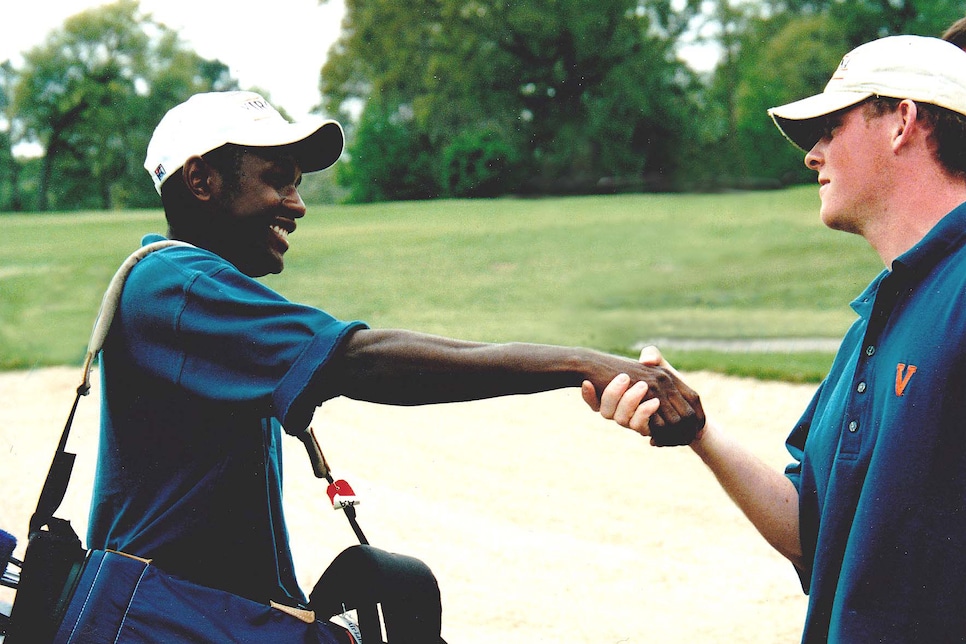
Lewis Chitengwa enjoyed playing golf at Virginia with fellow Cavalier and 2000 U.S. Amateur runner-up James Driscoll.

Virginia coach Mike Moraghan knew he has a special player in Chitengwa.

Lewis made the cover of the UVa men’s golf media guide in 1996.
Occasionally, Chitengwa would seek Moraghan’s reassurance as he worried about his family back home, struggling to make ends meet in Robert Mugabe’s Zimbabwe, but it didn’t show in his golf game. He was named the ACC freshman of the year and became a two-time All-American while with the Cavaliers. He also won two college tournaments, tied for first in another and, in 1996, finished seventh at the NCAA Championship, which was the best performance by a UVa golfer in more than 50 years.
And while Woods won the individual crown that year at The Honors Course, Chitengwa, weighing just 150 pounds, at least outdrove him the National Long Drive Contest to take that title.
The lynchpin of Moraghan’s team, Chitengwa spent four productive years at UVa, graduating in 1998 with a BA and becoming the family’s first college graduate.
But his pro career didn’t quite start the way he had planned. As the only black African-born player on any of the U.S. tours, Chitengwa struggled to adapt and failed to make the second stage of the PGA Tour Q-School. When he did make some money, though, Chingenwa gave most of it away to charities in the United States or sent it back to his family in Zimbabwe to help his parents or with his brother’s schooling.
By 2001, Chitengwa had taken up a standing offer from Leadbetter for some coaching and was finding his feet in the pro ranks. After a mixed year on the Buy.com Tour, he had claimed two top-10 finishes in his rookie season on the Canadian Tour and was heading to the TELUS Edmonton Open in Alberta convinced he was about to enter the winner’s circle. “He even called me the day before the tournament and promised me he was going to win the tournament,” says his father. “He just seemed so confident.”
After a first-round 70, Chitengwa followed with a 67 on Friday, leaving him tied for 23rd, just five shots off the lead.
Brennan Webb was one of Chitengwa’s closest friends in the game and was also playing in Edmonton that week. “He was in really good spirits, and he was playing so well,” Webb says. “He would have certainly been in contention throughout that weekend, for sure.”
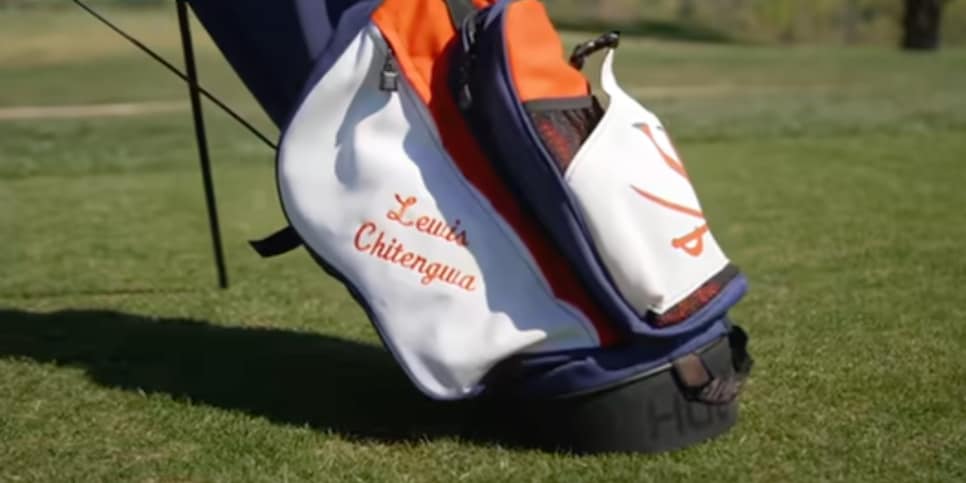
Lewis Chitengwa’s UVa golf bag.
That evening, Chitengwa attended the cut party and was back at his accommodation by 11 p.m. where he was hosted by Larry Chalmers and his wife, Shirley, Edmonton Country Club’s assistant General Manager. The couple had played golf at nearby Derrick Golf and Winter Club and returned home to find Lewis. “Everything was fine,” Larry Chalmers says. “He went to bed that night in our guest room in the basement.”
The following morning, at 6 a.m., Chalmers awoke to the sound of noise downstairs, only to find Chitengwa complaining he was unwell and that he had already called 911. An ambulance arrived in the driveway moments later.
Chalmers followed the ambulance to Misericordia Hospital. “The doctors told him that he had a low-level infection and that he should drink lots of orange juice and go home and rest up,” Chalmers says. “So I took him back to our house.”
With Shirley needed at the golf club and Larry heading to the golf course with her, Webb and his girlfriend went over to keep Chitengwa company. When he entered the house, Webb found Chitengwa stood over a sink, running his arms under cold water. “He said he couldn’t feel his arms,” Webb says. “So we tried to get him on the couch, but he couldn’t move. We ended laying him on the floor and calling the ambulance.”
When the medics arrived, Webb’s girlfriend rode in the back of the ambulance with Chitengwa while he followed in his car. “I’ll never forget the sight of him just looking at me with fear on his face. Obviously, he knew he wasn’t in a good place,” Webb says.
This time, Chitengwa was taken to the University of Alberta Hospital where doctors diagnosed meningococcaemia, a bacterial disease that rapidly infects the bloodstream and a virus that had that already resulted in four deaths in the area in the previous 18 months.
Nobody knows how Chitengwa contracted it. Like any viral infection, it can be passed by anything from a sneeze from a passer-by, a handshake or drinking from an unclean glass. Often, sufferers experience severe pain in their extremities with amputation of a limb one of the few ways to save a patient.
But by the time Larry and Shirley Chalmers made it to the hospital, it was too late. Chitengwa had slipped into a coma and died within an hour of his arrival at the hospital. He was 26.
Webb was in shock. “They just came out to the waiting room and let us know that he had passed,” he remembers. “It was awful.”
“We knew the doctor as he was a member at the country club, and he just said, ‘Sorry, he’s gone’,” says Larry Chalmers.
As this all played out, Moraghan was heading to Cincinnati, Ohio, for a family reunion when his cell phone rang. It was Chip Roy, one of Chitengwa’s teammates at Virginia and today a member of the U.S. House of Representatives from Texas. “I was driving when I got the call, and it was just horrendous,” Moraghan recalls. “It was such shocking news because the effect that Lewis had on my life and everyone’s life was extraordinary, really.
“For so many people I know, it was like losing a family member.”
When Webb returned to the Chalmers house the following day, still reeling, he began to flick through his friend’s belongings. “I was packing his stuff up and there were just stacks and stacks of correspondence that he had and was keeping track of, with notes of who he needed to write back to,” he says.
“That was Lewis. He just made everyone feel like they’re best, like they were the most important person to him.”
Like Webb, Moraghan was also a recipient of Chitengwa’s letters. “Whenever he was traveling or playing, he would always send postcards to people he knew right across the world. He was a prolific writer of letters,” he adds.
“He always made a huge effort to stay in touch with so many people.”
Then there was the issue of what to do next, as Chalmers recalls. “Brennan asked me, ‘What do we do now?’ You know, we have this young man, and we have to deal with the situation. So we called Alan Rae in Vancouver.”
Rae jetted in from his home in Vancouver and, together, they set about the task of repatriating Chitengwa’s body to Zimbabwe. Chalmers also wrote to Chitengwa’s parents, Lewis Sr., and mother, Josephine:
“Lewis was a fine young man with a promising future and his death is a tragedy … Shirley and I just want you to know that Lewis was not alone and we were with him and tried to be as helpful and comforting as we possibly could.”
Meanwhile, tournament organizers at the Edmonton Open decided the event would continue to its conclusion, with all players and staff wearing black ribbons during Sunday’s final round. Aaron Barber won the title. “When all is said and done, golf really doesn’t matter right now,” he told the press. “Something like this really put things in perspective … all of us are numb right now.”
For those who knew Chitengwa, there is a clear consensus he would have become a successful professional. “I have no doubt he would have eventually been on the PGA Tour,” Moraghan says.
“With Lewis’ game and the skill set that he had, he could have been a mainstay on the PGA Tour, for sure,” Webb adds.
Nick Price goes further. “I think he might have won majors.”
Back in Zimbabwe, there would be a week of mourning, where more than 500 members of the Shona tribe Chitengwa belonged to, gathered for a traditional ceremony before laying his body to rest.

Chitengwa’s life was remembered in a biography put together by his friend Alan Rae.
Soon, the Lewis Chitengwa Foundation would be launched while in 2015, Chitengwa was inducted into the Southern African Golf Hall of Fame. In 2022, UVa also launched a new annual tournament in his honor, the Lewis Chitengwa Memorial.
Shortly after his death, meanwhile, his co-sponsor Alan Rae created a coffee-table book, A Gentleman’s Game – The Life & Legacy of Lewis Chitengwa. Limited to just 100 copies, it included words from many of Chitengwa’s friends, family and fellow players, recalling just what he had meant to everyone that he encountered.
There was even a message from the young man he defeated at the Orange Bowl in 1992, Tiger Woods.
“He was a fighter, an absolute fighter and is somebody we’re all going to miss.”
This article was originally published on golfdigest.com