
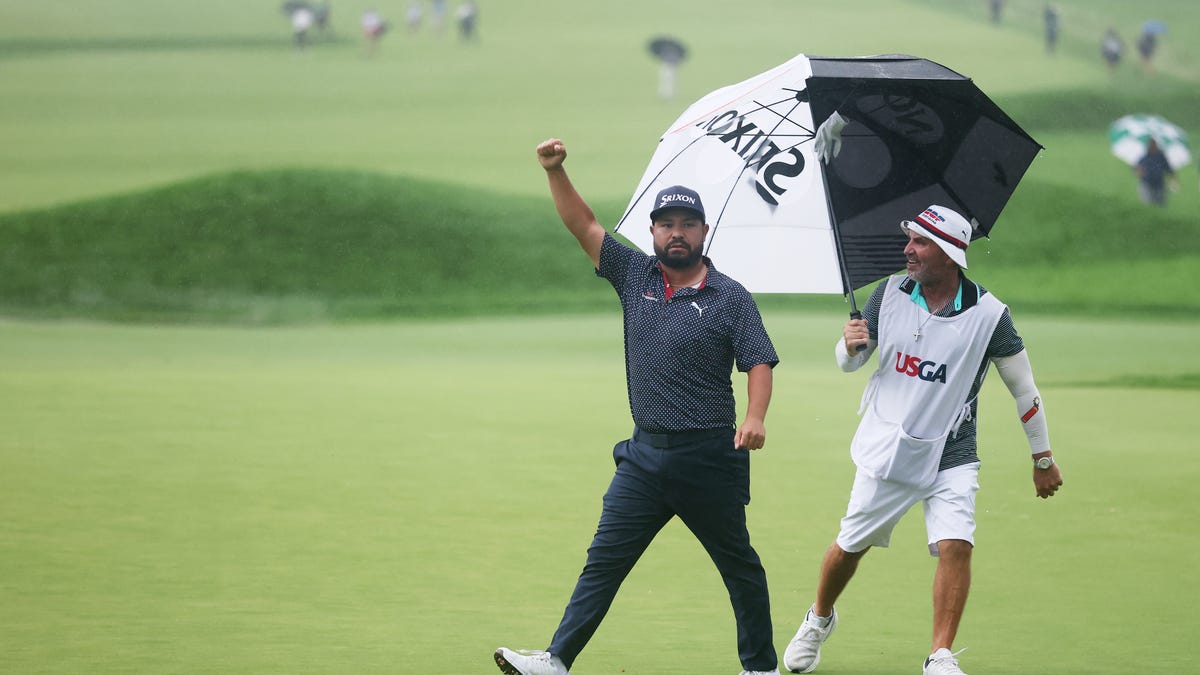
Less than four months after missing a putt that would have given Spaun his biggest win, he created a moment that will live forever at the U.S. Open.
There are golf shots that are great because they are perfectly struck, and there are golf shots that are great because the courage required to try them. Rare ones become something else entirely, transforming from shots into moments. You don’t need slow motion or a tracer to explain them. You just say the words and everyone instantly remembers and sees it in their mind. J.J. Spaun holing a 65-foot putt on the 72nd hole of the U.S. Open at Oakmont fits squarely in that category. It was wet, gray and the greens had softened just enough to make everything uncertain. Everyone at Oakmont felt about as comfortable as someone being told by the dentist that “you might feel a little pressure.”
Spaun had been knocked sideways earlier in the day, unraveled briefly, but reset during a rain delay and somehow put himself back into position on one of the hardest holes on the course. He didn’t need to make it. Two putts almost certainly would have done the job. But Spaun never looked at the scoreboard. He didn’t want the math. “I didn’t want to play defensive,” he said later. “I didn’t know if I had a two-shot lead. I didn’t want to do anything dumb trying to protect a three-putt or something.” So, he waited. Viktor Hovland rolled his putt first, and Spaun paid close attention. Not just to the break, but to the pace. “Viktor helped me a lot,” Spaun said. “I was more focused on how hard he was hitting it. I kind of knew the line already.”
Spaun has never been known as one of the game’s great putters. He’s fought it, tweaked it, trusted it, distrusted it and lived with it. The Tour has a long list of players who hit it great and putt it just well enough to survive. Spaun has often lived in that space, grinding out results while knowing the putter could just as easily betray him as save him. A few months earlier at TPC Sawgrass, it teased him. On the 72nd hole of the Players Championship, Spaun stood over another long putt with everything on the line. That one came up short. Close, but not close enough. He went on to lose to Rory McIlroy in a playoff the next day, walking away with the familiar ache of knowing he had been one roll away from the biggest win of his life. That’s why Oakmont mattered. It wasn’t just the shot; it was the context. Here was the same man, feeling the same nerves, holding the same putter, but trying to get a completely different ending.
About 8 feet from the hole, Spaun finally allowed himself to believe it might have a chance. “I kind of went up to the high side to see if it had a chance of going in,” he said. “And it was like going right in. I was just in shock, disbelief that it went in and it was over.” As the ball disappeared, the crowd erupted. Spaun bent over in disbelief. The U.S. Open was finished with a putt that almost no one could ever expect to make. Later, when asked to put it in perspective, Spaun didn’t talk about technique or mechanics. He talked about history. About the moments he’d watched growing up.
“You watch other people do it,” he said. “You see the Tiger chip, you see Nick Taylor’s putt, you see crazy moments. To have my own moment like that at this championship, I’ll never forget this moment for the rest of my life.” That’s the thing about the shot of the year. It isn’t always the most athletic or the most impossible. Sometimes it’s the one that answers a question that’s been hanging over a player for years. Can you trust it when it matters most? On a soaked Sunday at Oakmont, from 64 feet away, J.J. Spaun answered that question.


