Decades before simulator golf became ubiquitous, with screens popping up at country clubs, golf shops, driving ranges and bars across America, there was Golf-O-Mat.
Don Oates had a monopoly on indoor golf in Wisconsin in the 1960s and ‘70s, when he ran Golf-O-Mat in a leased building at 12501 W. Bluemound Road in Brookfield.
In the dead of winter, golfers came from miles around and paid $7 to play Pebble Beach, the Blue Monster at Doral and Congressional Country Club — the only courses available on Golf-O-Mat’s 10 screens.
“As far as I’m concerned, it was the only game in town,” said Scott Evans, who frequented Golf-O-Mat as a golf-obsessed teen and now is a retired PGA professional. “It was awesome. I absolutely loved that place.”
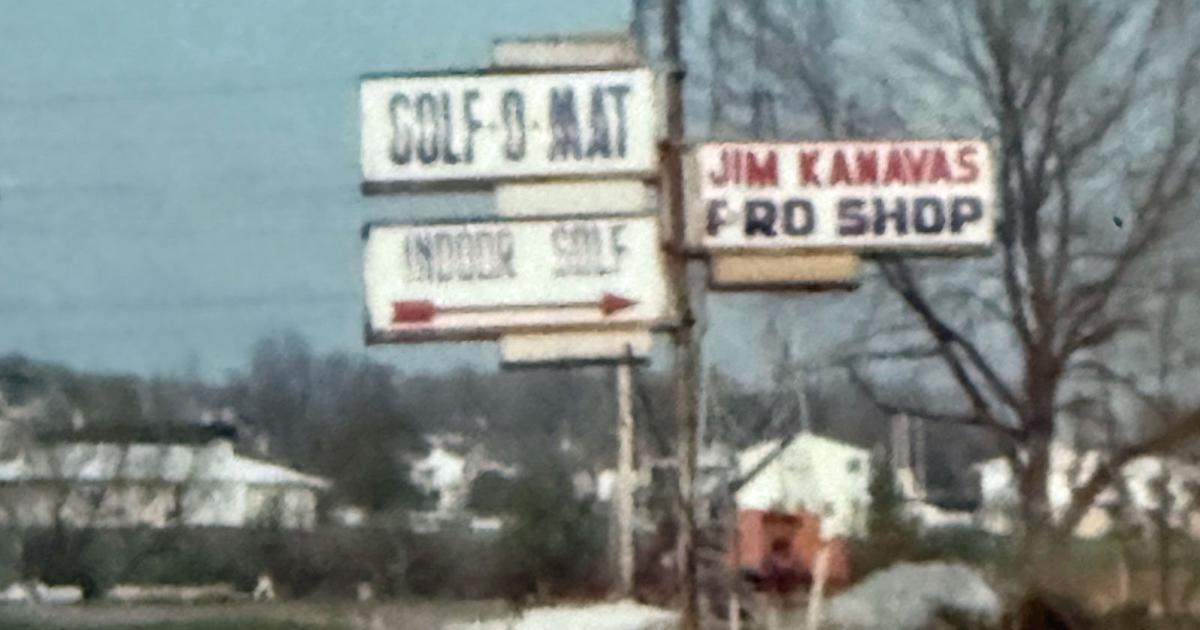
Golf-O-Mat photos?
Believe it or not, not even a Google search could produce any photos of the Golf-O-Mat of the 1960s and ’70s in Brookfield, Wisconsin. The blurry one above is the only one we could find. So here’s our callout to Wisconsin.Golf readers: Anyone out there have any photos they could send us? If so, email them to garydamatogolf@gmail.com.
In its heyday in the 1970s, there were about 25 Golfomat centers in the U.S. The official name was Golfomat, but Oates went with Golf-O-Mat for reasons unknown. The next-nearest center to Milwaukee was in Duluth, Minn.
“I didn’t know of any others,” said John Oates, Don’s son, who spent his formative years behind the counter at Golf-O-Mat or playing the courses with his friends. “I had never heard of any others.”
The origins of Golfomat are a bit vague. According to a 1971 story in Sports Illustrated, a scientist named Robert Hopp, who rarely played golf, invented the machine. But a 1987 piece in the Washington Post credited an electronics engineer named Arthur Charles Angelos with inventing Golfomat. Angelos was president of Golfomat Inc., the Alexandria, Va.-based manufacturer and distributor of the simulators. He died in 2000.
Regardless of who invented it, Golfomat technology was years ahead of its time. A slide projector displayed golf holes on a screen and the user stood about 20 feet from the screen and hit drives off rubber tees and iron shots off artificial turf with his or her own clubs and golf balls.
“A microphone picked up the sound of the ball (being struck by the club),” Oates said. “The screen had vertical light beams behind it. When the ball broke the light beams behind the screen, the elapsed time was what calculated the distance of the shot.
“I swear to God, it was accurate to within four or five yards. It was amazing. You could play your normal clubs right at the Golf-O-Mat.”
The courses weren’t the digital wonders produced by today’s sophisticated simulator software; rather, the holes were photographed in 10-yard increments and only from the middle of the fairway. After the ball was struck, the projector rapidly clicked frame-by-frame to the spot where the ball would have come to rest, and the golfer then picked a club and hit the next shot.
Unlike today’s simulators, on which putts are rolled into the screen, the stalls at Golf-O-Mat had artificial turf greens. Golfers putted from 5, 10 or 20 feet, depending on where their ball landed on the green.
“My dad designed all the greens and every couple of years he would change them,” Oates said. “He would do the plaster and mold the breaks and lay the mats down again.”
Because it was one of the few places in Wisconsin where golfers could hit balls indoors in the winter, Golf-O-Mat drew diehards from throughout the state and northern Illinois. The long, narrow, dimly lit building had a bit of a bowling alley vibe. Oates didn’t have a liquor license but allowed golfers to bring in coolers. Cigarette smoke hung thick in the air.
“We were loaded up with tee times from eight o’clock in the morning until probably three o’clock in the afternoon,” Oates said. “And there would be another crowd that came in after dinner. We would be there until 10, 11 o’clock at night.
“A lot of people would come in on their lunch breaks. Some of the executives up at Bishops Woods would come down and play 18 holes. People would bring coolers in. We just made sure they never overdid it.”
A Monday league attracted some of the best golfers in the area, including Les Wilson, the father of five-time PGA Tour winner Mark Wilson. Teaching pros Steve Friebert and Mark Hansen gave lessons at Golf-O-Mat.
“If you look at the technology, at the time we thought it was pretty fancy,” Hansen said. “There was no Wifi, no cell phones. The VHS recorder wasn’t even invented yet. People would come in and they were super-impressed because they’d never seen this technology. To have a microphone that could pick up the golf ball and have electric eyes behind the net and advance the film strip, this was like utopia.”
Once a month or so, Skip Kendall’s mother, Shirley, drove her son across town from Fox Point to Golf-O-Mat for lessons with Friebert. Kendall, who would go on to play on the PGA Tour, was not yet in high school.
“Honestly, I’d never seen anything like that before,” he said. “I think it was kind of ahead of its time, wasn’t it? This was probably mid-1970s for me. As a matter of fact, I remember it was the first time I ever played Pebble Beach.”
Years later, Kendall would play the real Pebble Beach in the U.S. Open.
Oates, who managed a trucking company, opened Golf-O-Mat with a partner in 1961 and closed the business in 1982. By then, the projectors were breaking down as fast as Oates could fix them. Also, he leased the building and never was able to make a profit because Golf-O-Mat was open only from October through March, when courses were closed.
“Whatever money he would save during the winter, he would spend on rent through the summer,” John Oates said. “He’d put a couple grand in the bank but it would all go into paying the rent in summer.”
After Golf-O-Mat closed, there was at least a 20-year gap before the advent of accessible screen golf and another 10 years before high-tech simulator golf really took off.
“Oh, it was a real long time,” Evans said. “When simulators started showing up, I told people, ‘This is not new.’ They’d say, ‘What do you mean?’ I’d say, ‘When I was in high school we could play Doral, Pebble Beach and Congressional.’ People would look at me like I had three eyeballs.”
Simulator golf, along with entertainment venues such as Topgolf and Luxe Golf Bays, are big business now. According to the National Golf Foundation, 6.2 million Americans played screen golf in 2024, with millions more playing in the Asian golf hotbeds of Japan and South Korea.
Software from companies such as Foresight Sports, Full Swing Golf and Golfzon provides immersive experiences with accurate club and ball metrics and stunning visuals.
Many golfers have installed simulators in their homes, offices or garages. Do-it-yourself kits start at about $5,000, with the more advanced simulator set-ups costing $20,000 or more.
But in Milwaukee in the 1960s and ‘70s, there was only one place to get your indoor golf fix: Golf-O-Mat.
“I think it’s a fascinating story,” Hansen said. “It’s unfortunate that they really couldn’t make a living at it, but it certainly was a fun place to hang out. I have very wonderful memories of that place.”