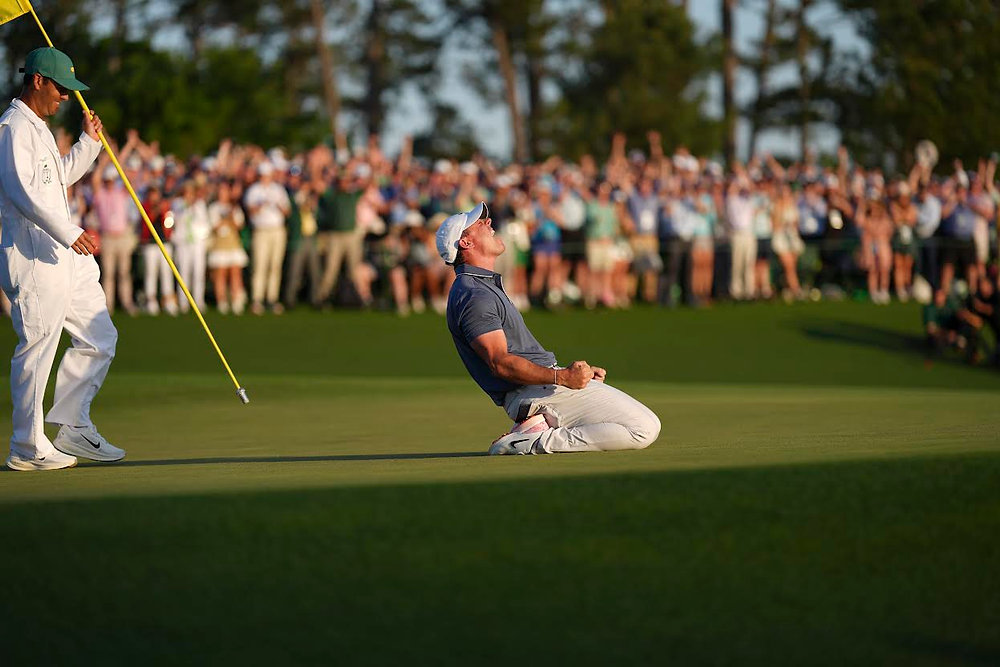

Rory McIlroy of Northern Ireland reacts after winning the playoff hole during the final round of the Masters Tournament at Augusta National Golf Club in Augusta, Ga., Sunday, April 13, 2025. (Doug Mills/The New York Times)
For golf, it was a name game in 2025. There were one-name phenoms like Rory, Scottie and Jeeno, with much talk of Keegan and a bit on Tiger on the course.
Around the events, there were new names that will have a big impact on everyone else, namely Brian Rolapp and Craig Kessler (who took over the PGA Tour and the LPGA from Jay Monahan and Mollie Marcoux Samaan, respectively).
And then there are the non-tour events that bring in the silly names, including the Range Goats (a team on LIV Golf) and Boston Common Golf (a team on the simulator-based TGL).
What all these names mean is that TV-produced golf may be in flux, but the excitement around the sport is taking it in directions fans hadn’t imagined a few years ago.
In the final round of the Masters in April, Rory McIlroy hitting a wedge into Rae’s Creek on the 13th hole from less than 100 yards was the type of shot under pressure that recreational golfers could identify with. But it caused golf fans to groan. It seemed to be the moment that would mark the one-time prodigy’s latest way to lose the tournament he needed for the career Grand Slam.
While he seemed set to choke away another opportunity to win the Masters — and add to his U.S. Open, PGA Championship and British Open victories — he steadied himself. Finished tied for first place, he won on the first playoff hole, against his Ryder Cup teammate Justin Rose.
It set a striking tone to the season that followed.
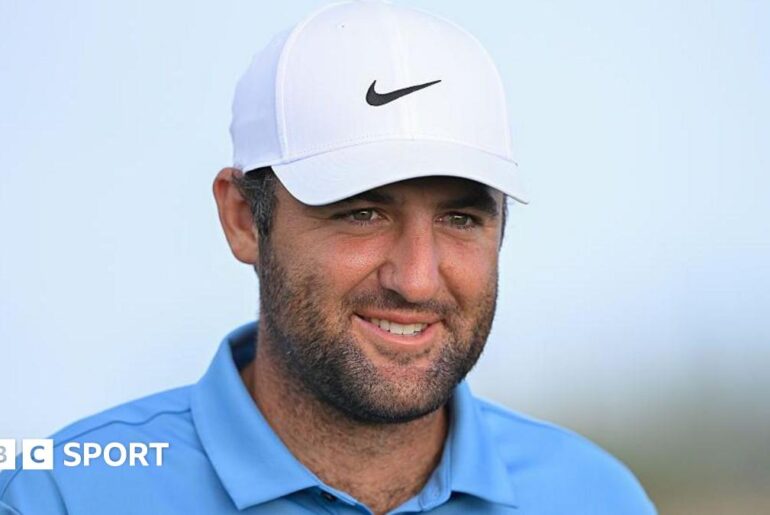
Not to be outdone in the record-setting department, Scottie Scheffler, the No. 1 ranked player in the world, won the PGA Championship, adding to his two Masters victories.
The next month, he won the British Open at Royal Portrush in Northern Ireland, beating the hometown favorite, Rory McIlroy, and putting himself just a U.S. Open victory away from his own career Grand Slam.
The U.S. Open was won by J.J. Spaun, who had been slowly making his way on the PGA Tour until he found himself tied with McIlroy at the Players Championship. He lost, but it jump-started his season. His U.S. Open win at Oakmont Country Club, considered among the toughest tests of golf in America, was punctuated by a 64-foot putt on the final hole with a weird looking, highly engineered putter that is now among the hottest putters in golf.
In the LPGA, Jeeno Thitikul ascended to the No. 1 spot this year. She did this by displacing Nelly Korda, who won an impressive seven times in 2024. But in winning the season-ending CME Group Tour Championship, Thitikul did something equally historic. She finished the year with a scoring average of 68.68, or roughly 4 shots under par for every single round, which beat the record set by LPGA great Annika Sorenstam in 2002.
For all this great play on the course, there’s been a good amount of uncertainty around the leadership of the PGA Tour and the LPGA Tour.
The PGA Tour has been trying to find its footing since LIV Golf, the league backed by Saudi Arabia’s Public Investment Fund, poached dozens of players for its start in June 2022. The following June, Monahan, the PGA Tour commissioner, and Yasir Al-Rumayyan, who runs the fund and backs LIV, announced they had reached a framework agreement for reunification.
Yet two years passed with little public progress. This June, Rolapp, who spent two decades working at the NFL, was named the PGA Tour’s chief executive, essentially pushing aside Monahan, who will step down at the end of the year.
Within weeks of taking over, Rolapp announced a Future Competition Committee. “I want to be aggressive,” he said on the Golf Channel during the season-ending Tour Championship in August. “Our goal is to make events that really matter. And to make events that really matter, you certainty have to have the most competitive golf you can get with the best players you can get.”
He added, “you probably need fewer rather than more” events. At the time, he said he hadn’t talked to the Public Investment Fund about reconciliation between LIV and the PGA Tour.
Kessler, on the other hand, hit the ground running. “Urgency is at the core of what we’re going to do,” he said in an interview this summer. “At the highest level, we’re trying to create an organization where all of our stakeholders say something magical is happening at the LPGA, and we need to be in now.”
The big difference between the two tours and what the commissioners can do comes down to money. The PGA Tour, which has been financially flush for decades, has received a private equity investment that could top $3 billion. The LPGA has struggled financially, even having to cancel an event at the start of the year when the sponsor failed to fulfill its financial commitment for the second year.
“We have to activate our sponsors in ways we haven’t activated them,” Kessler said. “We have to provide access to the youngest generation in terms of value and proximity.”
The other leadership focus this year came at the Ryder Cup. That event is organized by the PGA of America (in conjunction with Ryder Cup Europe), which made an out-of-the-box captain selection when it named Keegan Bradley, still a top-20 player, to be Team USA’s captain.
Much of the speculation leading up to him finalizing his team in August centered around whether he would pick himself as one of his six captain’s picks and be the first American playing captain since Arnold Palmer in 1963.
He did not. When it looked like Team USA was going to get truly shellacked by Team Europe after the second day, questions arose as to why he wasn’t out there playing. The Americans rallied on the final day, losing by two points. It was their first home loss since 2012.
When asked in December how he felt about the defeat, Bradley said: “The darkest time of my life. I don’t know how to describe it. Certainly in my career. It was just a tough time.”
So much of the change in the structure of professional golf was generated by the touring pros who left the PGA Tour for big money on LIV Golf. Three and a half years later, about a half dozen LIV players still contend in major championships, including Bryson DeChambeau, Jon Rahm and Tyrell Hatton.
Yet the league holds on, even as its stars age and slip in the golf rankings.
What the league, which plays shorter events and revels in blasting music during the competition, has done is spurred innovation in golf formats.
In January, the TGL, an indoor, simulator-based league backed by Tiger Woods and McIlroy, started. While the Nielsen ratings — about 500,000 viewers on average — are better than LIV Golf, which Golf magazine reported had 175,000 average viewers during final rounds, they are not about to challenge the PGA Tour, which averages 3.1 million final-round viewers. Still, TGL’s weeknight ratings were better than the college basketball games it replaced, ensuring a second season.
Looking ahead, the big question again revolves around Woods, who has been sidelined by back injuries. He turns 50 on Dec. 30, which makes him eligible for the Champions Tour and a run at a U.S. Senior Open.
When asked in December about events he’s going to play next year, he said, “Just let me get back to playing again, let me do that, and then I’ll kind of figure out what the schedule is going to be.”
The golf world can dream.