
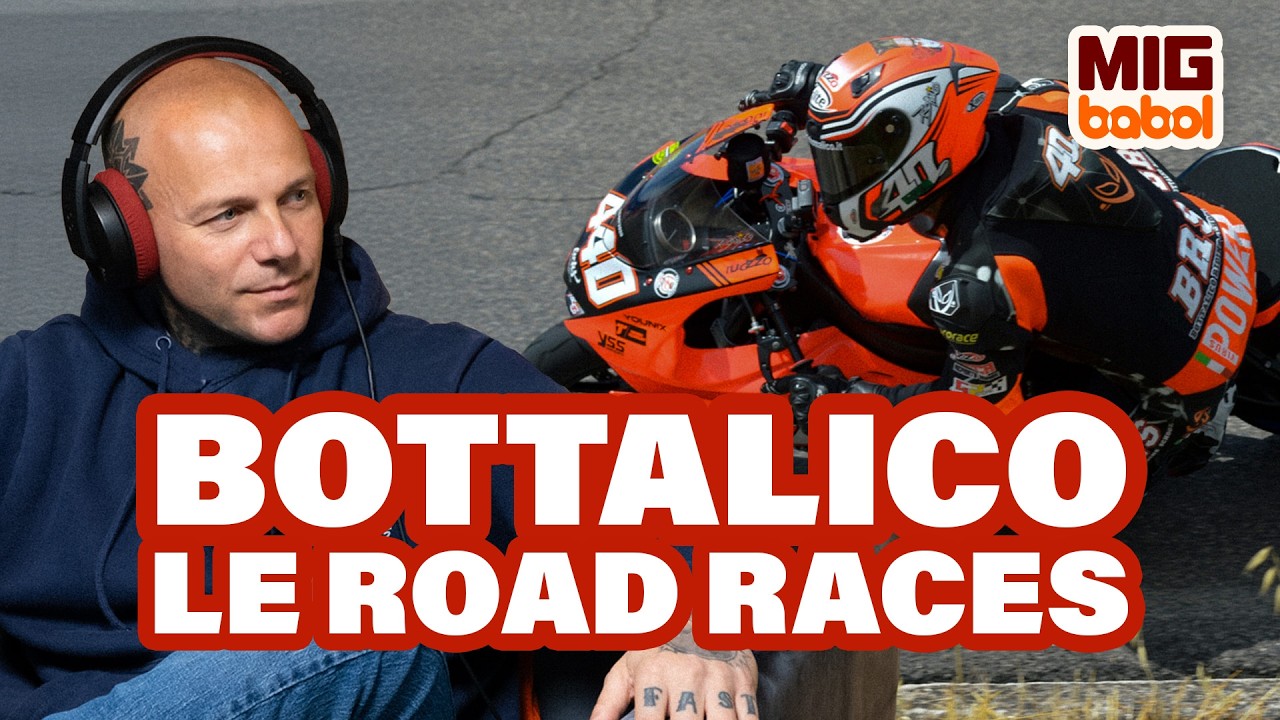
Oggi è con noi Maurizio Bottalico, vera icona delle Road Races! Uno che gioca continuamente con la paura, ma guardandola dritta negli occhi.
Quello delle gare su strada è un mondo poco raccontato nel nostro paese, fatto di coraggio e storie vissute nel modo più autentico. Un episodio pieno di adrenalina, con aneddoti fuori di testa e tanto amore per il motorsport.
Fateci sapere cosa ne pensate nei commenti!
Abbiamo due livelli di abbonamento:
1. “SUPPORTACI” dove puoi darci una mano con una piccola cifra simbolica.
2. “LONG LAP” dove potrai avere contenuti extra di questa intervista e delle altre interviste della seconda stagione.
ABBONATI a “LONG LAP” per avere accesso ai contenuti esclusivi! https://www.youtube.com/channel/UC6rMvMN5auRTqHlI2w5JO5w/join
ISCRIVITI al canale e attiva la campanella per non perderti nessuna nuova puntata: https://www.youtube.com/@MigBabol
Trovi il podcast disponibile anche su Spotify, Apple Podcast e Amazon music: https://open.spotify.com/show/6wJMteLPc7lHsbTdR3Sirphttps://podcasts.apple.com/gb/podcast/mig-babol/id1768973812https://music.amazon.it/podcasts/13e7fc0c-9081-4760-9292-78aa2b3c03f0/mig-babol
SEGUI MIG BABOL per contenuti aggiuntivi sui nostri profili social:
INSTAGRAM – https://www.instagram.com/migbabol/
TIKTOK – https://www.tiktok.com/@migbabolIl
Team di MIG BABOL:
Andrea Migno – Host
Filippo Carloni – Co-host
Samuele Andruccioli – Social Media
Nina Dubois – Regia e Social Media
_________
00:00 Intro
02:35 Dalla pista alla strada
07:00 Il primo tempo assoluto in tutte le categorie
08:38 La preparazione per una gara su strada
13:36 L’isola di Man, 60 km un solo giro
17:02 Il rischio e il posizionamento delle tabelle dei tempi
20:02 L’iter del TT
24:53 Correre sul bagnato
28:21 Il paddock e il pubblico
29:23 Fare tre categorie alla volta
33:44 I sorpassi e l’assenza di bandiere nere, gialle, blu
36:10 L’allenamento di un road racers
39:13 Allenare i ragazzi
40:54 Tecnica di guida per raggiungere il limite
45:03 Gran Premio di Macao
48:48 Il cappellaio matto
50:56 I costi del correre in strada rispetto alla pista
57:27 La famiglia
1:00:25 Il rapporto con Luca Salvadori
1:06:17 Saluti finali
Who are the riders who do these races? Because they’re seen as crazy at the TT. There, you see? People who don’t just don’t want to live, which is a bad image most people have of the riders who do these races, but that’s not the case. Hi everyone, and welcome back to Mig Bubble, the Racing podcast that talks about MotoGP and people related to this world. We’re here at VRS Studios as always, and obviously almost as always for the second season. On my right is my co-star Filippo Carloni Hfisci. Hi Phil, how are you? Good, good. Hi Andrea. Hi everyone. Hi Phil. People invisible to you. Fake. Yes. Well, first of all, Phil, we’ll want to remind all our followers, friends, and others, that it costs them nothing, but it’s of fundamental importance to us, and as all the greatest podcasters say, we invite you to subscribe, activate the bells, and be followers to the very end because, after all, with these small actions you will support our project. We bring new things, things [ __ ] as much as possible like today’s, or rather, as we did this year, we went a little further than the MotoGP Paddoc. Today is one of those days, I’m very curious because today we’re going a little bit to move towards Northern Europe, let’s say, mainly. Now you’ll find out why. with number 40, the first Road Races rider, and with number 40, Maurizio Bottalico. Bye bye bye bye bye. So first of all, the first question when you get to Mig Bubble is always the same, banal but not too much, and it’s: how are you? Well, I’d be better off warmer, but I’m not complaining. Neapolitan culture, let’s say, clearly makes you want to stay warm, I’d say. Yeah, it’s really making itself felt these days, right? True, it’s getting cold. But listen, I’d like to start first because we already mentioned something very interesting in the pre-show, but we’ll get to that. I’d like to start with your origins, but not before giving a little introduction. You’re a driver who, um, competes in road races, that is, hill climbs. You’ve also done Mane Island and everything, but you have to explain everything to us because today’s episode, let’s say, I’d like to focus on your character, your career, and obviously also on the landscape, the context in which you participate, namely road races. So tell us a little about your whole, let’s say, childhood, in inverted commas, clearly what you want to tell us and how you began your passion, where you started, and then we’ll go into everything later. So, as you already mentioned, I’m originally from Naples and moved to San Marino five years ago, because my partner is from San Marino. And I was born a huge motorcycle and road racing fan, basically because, come on, when I was a kid a few years ago—I’m 44—okay, let’s just say the motorcycle culture we had wasn’t really focused on the circuit, the track, also because there were very few facilities available for this sport, I mean, there were no racetracks. It’s true, it’s true. So, exactly. We were born on the street, with the classic races that are definitely not held. And from there, just jokingly, my father told me, instead of risking yourself on the street doing these stupid things, if you feel so good, let’s try it on the track and if that happens, you can keep going. Otherwise, if you don’t keep going because you’re not good, stop doing these things on the road. So I started on the track in ’97 and until 2018 I raced on circuits and yes, still competing in various championships both Italian and European, the CEV in various categories and then this passion that I had inside in the last few years was starting to make itself felt a lot. So the passion for Road Racing, you say? You raced on the track, but still you had this passion for road racing. Yes, until 2018 you never even did a hill climb, nothing, only track, right? Because anyway, when competing in championships, the team kind of didn’t let you go in for these things, maybe they were overlapping. I was busy, so come on, I was a bit far from this goal. Then in the last 2-3 years I started to push it out more and more and it was the winter of 2018 and I had an R6 that I was training with on the track and I said, “Mauri, But why don’t you sign up for the Italian championship?” Open the website, I signed up for the Italian championship, I had that bike, I said “Go without knowing practically anything about this world.” And so I showed up at the first race of the Italian hill climb championship at Chives, the Leccio Regello in Tuscany and with a friend of mine who was more like a companion than a mechanic and there I’m basically in the Italian championship. There are two heats, so you do race 1 and race 2 and I was third in race 1 and first in race 2 and I was second of the day in the standings. Great debut. Exactly. From there I said, “No, this is my world, I want to stay here and so I continued in the Italian championship.” But I was calculating, I was in the dark about everything. I didn’t know that a European championship existed, I knew that the Isle of Man existed, but I didn’t know how to get there, what process you had to follow. And so I continued in the Italian championship in the 600 class, which I then won on my debut in 2019, also doing the overall in my first year, or rather, so let me explain, in the Italian championship races there are two awards, the class one, so I competed in the 600, so I was awarded based on the result I achieved in the 600 classification and then there’s a separate classification, the overall which basically rewards the best overall time among all the categories. Okay? Generally, it’s always either the 600 or the 1000 that makes the overall and it’s a prestigious thing, I mean, there are many riders who maybe have been racing for many years who have never managed to do an overall. But why isn’t the Superbike always the fastest time? Because sometimes in the Italian championship there are some very twisty tracks where maybe a Superbike has more difficulty and so I also managed to do the overall in my first year of racing. But because one of the most interesting questions in my opinion is precisely this, that in the world of Rad Racing the lap counts more, Exactly, the overall title or the result of winning a championship or races? Because I know that the record time on the flying lap, on the single stage, has a big impact, a big weight. Yes, in the end, come on, all the riders aim for the overall title. Oh, okay. So it’s a very important thing in the environment, very prestigious. Well, when you get to make the overall title, you earn a bit of respect from everyone. Sure. Okay. But after the first weekend you did, after this first race, what’s the thing you liked the most? And I told you, “Ah, this is my path from now on.” But actually, the thing I liked the most was the fact that when I arrived, I was teased a bit because the track riders were seen a bit as the posh ones, while you know, the Road Racer, that’s what… well, after that, the cards were reshuffled a bit, and so this is something I liked a lot, also because I tried to bring anyway. 20 years of track racing in that world. I said, “Okay, what do I need to become a winner in this environment?” So I studied a lot, I trained a lot, and above all, I questioned myself first rather than thinking about the bike and the changes to make. And so, come on, it was, I mean, it was a real job and a journey for me in this world. Yeah, I get it, it’s cool. But what about preparation? What are the differences? To prepare for a hill climb compared to a Grand Prix on the racetrack? It’s the same thing. More or less, there are. But are you talking about a technical level or because both things are interesting. Both things. Even both things. So, I’ve always seen the races of the Italian championship or European championship that more or less in distance don’t go beyond 4 km like, eh, the old Supersport. Okay. In Supersport, you had a flying lap where you used a super soft tyre, and you didn’t have a second chance. That’s how it is in hill climbs. You have to be perfect in those 3 km and you have to know how to make the most of it. first centimeter to the last of the track. So I interpreted it like this right from the start on a physical level. Come on, anyway, coming from the track you’re used to a certain work, so I only made a few small changes to be a little more explosive, you know, rather than On the duration, but on a technical level, I had to work a lot because the riding style is also completely different because you always have something inside that acts as an obstacle, whether it’s a wall, a fence, or something. So you can’t lean out too far. You see, this is something I’d thought about a bit, but that’s exactly the reason. Basically, you always tend to stay a little more closed inside the bike and above all, don’t stick your head out too far because that’s the first thing you’d hit against an obstacle. So at the last point where you completely close your head, it goes back in, also to be able to look a little further ahead. Incredible. The beauty is all these dynamics, these changes compared to the track, you know. And technically, how do you prepare it? I mean, another curiosity is, what kind of bikes are road racing bikes? First of all , the categories there are and how the bikes are prepared, because in my mind, as I was saying, in MotoGP there are so many buttons, but also in superbikes mappings, brakes, engine and so on, so on. Instead, what are the regulations more or less? Anyway, what is the technical specifications of a TT bike and are there any modifications that need to be made to the bikes? Well, I make a substantial difference. The Italian championship and the European championship are in one category, a different matter. Exactly. Even within road racing, it’s a world apart. In the Italian and European championships, the same technical track regulations apply, so the bikes can be prepared the same way they are on a circuit. Obviously, over a 20-lap track race, you have plenty of time to modify the bike based on tire wear , so you go and change the electronics on the bike, the engine braking, whereas there, since it’s a one-off race, 3-4 km long, you don’t have time to modify anything, but basically the preparation is the same. Well, the tires used are the same as those on, say, Superbikes. In any case, in the race I used an X on the rear, so a very soft compound, if not the Q on some tracks, while the Isle of Man is a world apart. Yes, because we have a race that is made up of, in the case of the Milli, six laps, each lap is 60.7 km, let’s repeat that, 60.7 km of lap. Exactly. How many corners did I hear that with in an interview? Like 234 or 7, I don’t remember answering. It moves a bit at 198. At Turn 198. There you go in sectors, not corners and each sector is made up of 10-15 km, so everything is very different and there you struggle to use a technical package that can derive from a circuit because, eh, you can’t use a tire with a very soft compound because it doesn’t hold up. Exactly. So they use dual-compound rear tires, and basically, the base compound is one of a kind. A little stiffer. Exactly. And in the center, it has a stiff carcass because it has to withstand vibrations, jumps, asphalt that isn’t always perfect, and above all, durability. But two things: is the asphalt always the same throughout the lap ? There are different sections of asphalt, perhaps different between, I don’t know, maybe sector one has asphalt type X, and then moving forward, other types of asphalt are totally different, so many types of asphalt. There will also be ups and downs, and maybe there will be some difficulties with carburetion there too. Now there’s no carburetor, but the bike will respond differently depending on the heights of the turns. More than anything, you have to take engine temperature into account. That’s true, because how do you maintain it there? I mean, if it’s cold, you usually put on the tape, then if it’s too hot you remove it, but there, how do you keep it always at the same rpm? So, let’s say that basically it’s a race where you have to, um, embrace compromises, okay? So you’ll never be able to find a perfect condition in anything, be it suspension settings, electronics, or engine temperature. It’s always about making compromises and saying, “Okay, maybe I’ll sacrifice this thing more than the other.” Staying—yes, yes.—choose and stay close to the best possible compromise. That’s cool. This TT thing. But before, in fact, we were talking, and I want to go back and emphasize, precisely, that today’s episode is for us, eh, compelling because, precisely, I would like to bring a bit of this world here, I would like to make known and you said something that I think is quite strong, um, you said that people from outside seem to associate the Isle of Man and the TT riders, let’s say, with Madmen or in any case that life stinks for them, in quotation marks. Explain it to us better, precisely, given your point of view. So, on the one hand, I also understand this way of looking at this race, because a little before getting there, eh, I thought the same thing too, not that the riders who competed in that race stank, but that in any case you must be pretty crazy. So, from a certain point of view, come on, it’s very normal, you don’t have to be to do a race like that, but I can tell you that having done it, a driver who races in a race like that thinks much more and is much more calculating about risk than a driver who races on the track. Of course, because while on the circuit, if you have to try a deeper braking, you do it because you know you have an escape route there, no. There you have to calculate not only what you have to do to go fast, but at the same time you have to calculate the risk you can take by doing a certain maneuver, so you have to be a sort of computer. Of course, even more so, obviously. And during the race, how do you know—I mean, the lap is 20 km, right? 60. But how do you know if you’re doing well or badly? I mean, they only give you the table at the finish line, I presume. How do you know how the race is going? If you have to slow down, if you can, if you have to go faster? So, let’s say you always tend to go fast, not slow down, eh, because it’s difficult for you to have a race where you have such a gap. But such a gap in what sense? From the person in front of you. Okay. Um, but um, there’s the issue of the signs, but um, not everyone gives it, not all teams give it, not all drivers want it, but above all it’s not given on the starting straight, but it’s given at certain points along the track. Look, but in the same lap, they give it to you at several points. Yes, if you ask for it, you can have it at certain points, but not because that’s the point where the signs are given, because it’s the only point visible to the driver sufficiently without it. Okay, okay, okay. But okay, but between the same person. No, there are. No, no, you make an agreement with the team, so you have a couple of people in two points of the track that are slow and there you can still see the … because on the straight you go through sixth gear with the Superbike that practically touches the wall, let’s say you don’t look at the timetable even at that point, well, let’s say it’s better not. But also because I think it’s actually forbidden on the… Ah, actually. Yes. Um, so, I’d like to talk a little about the context of TT. So, categories, how many categories are there and which is your favorite, let’s say, the one you’d most like to compete in and which is the most ambitious? Well, basically this, I wanted to understand the categories a bit and also how everything is structured, because then it lasts a week, like the big two weeks, exactly. I’d like to understand how this whole event is structured, if you do the tests. Do you do the tests or do you go straight to the race? Well, explain to me, even before you leave home, what the process is, since you found out about it shortly before arriving, and what the whole process is to get there and start and do a TT? So, the process is to go through the Manx, which is basically another race—a different one, ask for it—that you won. By the way, Max, Francesco, you got two podiums, yes, second and third. Um, according to the rules, you have to do the MANX first, which is in these two weeks, right? It’s in August, okay? So, while the TT is between May and early June, the MANX is done the following August. So, exactly. And so, according to the rules, you get accepted into the MANX, you still go through a selection process first, it’s not like they get everyone. If you get accepted, you go on to do the MANSKS. So, there are two ways to access the TT. If you win one of the categories of the monx and the highest is the 600, the Supersport, or if you do a certain average lap, because there, um, the yardstick is the average that you do on the lap, like an average speed or time, like American races. Exactly, time more than anything else, the speed that you do. The time is then subordinated to the speed, so if you fall within a certain average then they let you proceed to the TT. Well, at the TT instead, as far as categories go, the highest is the 1000 which is divided into stock 1000 and super bike and then there’s the senior which is really the top, the most important one, where the organizers generally decide who makes the senior, there’s the Supersport, then the 600, then there are the Sidecars and there’s the Super Twin. Super Twin would be a category where 6.50 and 700 engines race. Exactly. Like, in that category of modern motorcycles, the R7 and the RS60 compete, but they’re still a bit more limited than the 650s. Engine, say the Kawasaki R6N, and there the Paton reigns supreme in that category, which is an Italian motorcycle. Okay. And it has a retro style, though. But I’ve seen it, it’s the one that’s really beautiful. But have you raced that bike over there? Yeah, it has, like, the air intake, it has that tailpiece like an old-fashioned bike. The retro style has two monos, not the central one, I repeat. Okay. They’re the Patons that made the 500s back in the day. That’s right. They were the ones, but in recent years, it was bought by SC Project. Oh, okay. So, it’s no longer owned by the Patons. There. Okay. But that’s a motorcycle approved for the I can buy it. Oh, okay. Yes, yes. There’s also a street version. It’s beautiful because, yeah. And that would be a 650 twin-cylinder. Exactly. Kawasaki R6N engine. Oh, okay. Let’s put it that way, it sounds like a bike for driving school that doesn’t run like a charm, but it’s actually a bike that can do 240 km/h on GPS. Okay. Okay. Oh no, no. Then you ‘re almost at the same speed as a supersport. Yes, because after that it becomes a little more agile, then if it reaches certain speeds, you still keep the average high and Okay, so you get there, you manage to enter the TT and then how do these two weeks of TT develop? So, you have the first week of free practice, okay? How many sessions, okay? Developed as you have 2 hours a day. Then there it depends a lot on the weather conditions because obviously being on the Isle of Man, you have this handicap in the sense that maybe you… well, generally the tests are in the late afternoon, just so you don’t want to do them at 11:00 in the morning when the sun is high? at 7:30 pm, come on. Well, all day waiting for 7:30 PM, then 5 minutes before it starts it starts raining. But then, in fact, I got curious: on 60 km there could very well be a stretch of sun. It’s a stretch that pours, absolutely . But in most cases you start in good conditions from Grandstend and when you go up to the mountain there’s fog. Eh, okay. But how do you do this? I mean, for example, you said you use Pirelli Sleek. I used Mseller. Exactly. Another question. Is there a single tire? No, at this point. Okay. There isn’t a single tire, but they are slicks. However, you can use slicks or treaded tires on the stock tires. Yes, on the stock tires you can use treaded tires. What’s the advantage or disadvantage? I mean, basically, slicks should be better, or am I wrong? Yes, but one chooses the grooved ones precisely because of the weather, maybe it’s a day like that, you know it could rain, maybe the grooved ones in the coldest spot can help you. Oh God, they use the grooved ones more in the stock bikes, but for example, this year I took part in the stock bikes and the Superbike with the same bike and I used the slicks. Okay. Yes. And okay. But if you start—as we said, you start with the slicks because it’s sunny—you get to a certain point and it rains, how do you deal with it, meaning you continue like that, trying to do as little damage as possible, then if you find dry ground, you rip, meaning you get there… So, actually, according to the rules, if it rains at the TT they cancel it. And in fact, this is a terrible question, meaning, do you race if it rains, no, no. The only question, however, is the TT, because Maao, for example, you race anyway. No, sorry, Macau also runs the Northwest and the other road races that they do in Ireland are run even if it rains, while at the TT it doesn’t, so if before the start of the trials or race, in any case the director takes a tour of the track, they see that in some places it is unusable because maybe it is very or too wet, the trials are cancelled, so But further question: if it is wet but not It’s raining, do they let you race or do they have to wait for it to dry out anyway? It depends on how wet it is. We had it this year, but last year too, we ran into some sections where the asphalt was wet with slicks. Yes. Oh, okay. Yeah, like a bar of soap, I mean. Okay, let’s continue with the TT format. I mean, you said two hours of free practice a day for a week from 7:30 PM onwards. It depends because some days they do it in the morning , or, I repeat, everything has to be structured based on the weather conditions. If you miss a day, they make you recover with a double session. They always tend to keep the riders safe, but try to get them to ride as much as possible. You know, Bon, when is the race of your own, since it will be more or less the same year anyway? You said at the end of May or June. Exactly. Dibo, I ‘d like to come up sometime, you know? Watching the race, for me, it has to be like the event itself, I mean, it really seems cool, right? I mean, watching videos like that, it seems like… Yes, yes. Organizationally, it’s a lot of stuff, eh? I mean, iconic, I mean, wonderful. Then the great thing is that the paddocs are free for everyone, I mean, they’re open, so you come in and find yourself among the riders. But there’s only, let’s say, in the paddoc, is it just in one spot or in the whole island around the entire circuit, let’s say, is it set up or something or is there just a bit of a base, let’s say. No, no, no, there’s only one paddoc, okay? Inside the paddoc there’s practically everything because the riders are there for 20 days anyway, so washing machines, dryers, bathrooms, there are even playgrounds for the kids, I mean, there’s a bit of everything. Cool, I mean, really. And if someone comes, I mean, maybe I’ll say, I’ll go to the island to watch the TT, can I go everywhere and then go see the riders on the island? Take it, go, ride it, do it. Yes, exactly. You can move around practically the entire circuit. It’s wonderful. You see them go by, I mean, on video jumps. Beautiful. Okay. A week’s testing based on the weather conditions and so on. Then after the following week, when everything starts, then there are the races. And during a day you also have two categories together, basically the—that is, the riders who do that race tend to do more categories precisely because since you do it once a year and since it’s very long and difficult, you try to be on the circuit as much as possible that time. This year I also did stock 1000, Super Bike, and Super Twin, and that’s something they do. Exactly . It’s something everyone does, so it becomes very complicated, physically but especially mentally, to manage race days because maybe you find yourself doing the six-lap Stock 1000 race and then you have the three-lap Super Twin race after two hours, so you do nine laps. Well, but the thing that would be quite complex for me is that with one bike you have some references, some study, then you move on to another. From the Superbike to the Super Twin, I feel like there’s a bit of a difference, so the whole process changes. Yes, it changes everything, the riding style, the references, the very feeling you have with the road and I’ll tell you, it’s better to move from a 1000 then to a twin, because once you get off the 1000… Exactly. You’re a little more relaxed, but it’s happened in some situations, even during practice, to say the least, that you start and in practice it’s even more accelerated because you get back in time for Di Padoc to put the bike down and get on the 1000 and go right away. It’s tough out there. Sure. But are two weeks enough to learn such a long track with all the categories? No, so the organizers’ estimates tell you that a driver starts to do his best, so he starts to feel comfortable on the circuit after the fourth year. Madonna, but after the fourth year, even doing more categories, Madonna, but now if you had to, I mean, if you had to do a lap from memory, you remember the whole track by now, yes. Yeah, yeah, damn. Ah, 60 km of 200 turns. It’s hard to remember. But really cool. You said after, I want, after that we’ll finish this format for a moment, then obviously we can have more questions. You said then the races start a second week, even three at a time, and how does it develop, let’s say? I mean, there’s a moment, I mean, there are one heat per day, they’re added together at the end, how do we say how is the result stipulated? So, you have two races for each category, so race 1 and race 2. Well, but the races are awarded individually, except for the Superbike, because they do race 1 and race 2. Super Bike would be the Senior, which is the one they do on the last day. Why is the Senior race run with the Superbike? Because not first, OK, Senior Superbike, which is the most prestigious and is run on the last day alone. The Second because all the veterans are there? Why is it called Senior? Because it’s the most, I mean, the most, I don’t know because not all riders have access to the Senior. And what do you have to do to get to the Senior? They decide. Oh, okay. Always based on the results, according to their evaluation criteria. To say this year, which was my first year at the TT, I thought I’d arrive as a Newcammer, so they’re the ones who go in their first year and they’re the ones who have to wear an orange bib to be recognized by the other riders. In reality, based on the results I’d achieved at the MANX, they didn’t consider me a Newcamer, so I automatically entered as a full rider and they even included me in the senior category. But you said no, but you didn’t do it. We didn’t do it because it was raining, it was canceled. Oh, okay, okay, okay. But instead, when you start, let’s say, from the startline, sometimes I see two riders start, sometimes alone. Oh, two riders start in free practice. Oh, okay. But in the race you start one at a time, one at a time. Spaced a certain number of seconds apart from each other and then on the track you find them again, you never overtake each other. Yes. So, this happens in the case of a newcomer because it’s obvious that the more you ride, the more you learn and the faster you go. Veterans, more or less their pace is the same, come on, they don’t make many overtakes, but in my case, to say yes, I mean, consider that they assign you the starting number. I had the number 57 in the 1000. Already after the trials they assigned me the number 34 because I had already done quite good averages, so they started me 34th and finished 27th. Okay, so come on, you do a lot of overtaking. But the management of the race, I’m inclined to say that maybe you also encounter some lapped riders, right? There are flag-wavers over 60 km, the flag-wavers are pretty thick. No, there’s no blue flag. Ah, there’s nothing. No, also because it’s a very long race, eh, I mean, things start to get mixed up, you know, you struggle even from the outside to follow the live timing. Oh, sure. The commissioner is there simply to make sure there’s no problem, a bike that stops, an accident. The race is managed only by the rider. No, damn it, but also by the flags. I’m saying it right now here in front of the Mig Bubble cameras, you’ll see me on the Isle of Man. I want to go and see so I can be sure to do it. Exactly. If I see it, I’d definitely go and do it, maybe I’ll convince myself, you’ll convince me once I see you, but it’s something that really inspires me, and for motorcycle enthusiasts, it’s one of those elite events in my opinion. Even on a motorcycle rally level, I think the rally itself is really cool, right? But I always say, it’s an experience that should be had in life, for those who like the motorcycle scene, because beyond the race, the island itself is beautiful and has so much tradition, very characteristic. But don’t imagine, I’d like to see it with my own eyes. But another question on a technical level as a rider, precisely, how do you train? I mean, because and then we also get to this point that you are a federal technician for the Italian Federation, so you help the kids, explain, yes, you will explain exactly what you will do with them, but for you on a technical level, how do you train? Because we had a chat a while ago at Misanino and you told me that we were there training with the ovals on a small circuit and you told me “Look, I don’t need these things, I mean, I really need other training.” What are the trainings of a road racer? So, basically, riding like this on a circuit is of little use to you because on the circuit you have that repeatability that you don’t have during a road race, because maybe on the second lap you can Changing some parts of the track makes it hard to reproduce the same things. Sure. Well, I do it mostly to stay on the bike and to train, but I also go out on the road a lot, so with a street bike I try to stay on the bike a lot, like doing 4-500 km of mountain passes only, without even knowing where I’m going. It’s cool to train your instincts, your vision, and then just to stay on the road. So if we see someone going like crazy on the wall playing the game, it’s you, always training within the limits of the team code. Yeah, yeah, yeah, yeah, yeah, sure. But if we see someone like Madonna, this one riding, maybe you could be. Yeah, yeah. I try to stay on the bike a lot, only stopping for gas, so just staying on the road, and then I watch the on-board videos a lot, a lot. Ostia. Yeah, I mean, I watch them every day, there’s not a day that I don’t watch the on-board videos again. But different all the same. Mine. Oh, yours, mine. Because unlike on the track, where you search for the right train, there you have to make your own reference, you have to create it yourself, because there can be a big difference in 60 km compared to another rider, and so it’s right that you make your own way. Okay? So I always look at my onboards, I mean, even now we’re talking, I ‘m retracing the lap in my mind, maybe some bits come to mind, it’s a loop that you have in your mind now, I mean, to say here I could have gone more, I could have slowed down later for these reasons, right? Just so I don’t forget it. Oh, I mean, yes, yes, for a semi-Yes, to excuse the term, a semi-mental obsession about that lap on the Manul TT island, I imagine. Yes, exactly. Yeah, it must be, but to really connect with something like that, you really have to always have it there. But instead, with the kids, exactly, parenthesis federation, let’s say, what do you work with? What do you do? How do you help them? So, I haven’t worked much this year because I haven’t been there much. I’ve had a lot of races this year, I’ve done 24, and then these are very long because I was away for almost a month just for the TT, okay? So, so many times, why does this happen? Because it’s a month when there are two weeks of racing, because you have to be there for a few days beforehand anyway, so you already get to the available days and you have to be there for about 20 days. Plus, I went up in the van, so it was a three-day trip there and three days back. Have you already done a month? Yes, yes, yes. And then it happened that after the TT, the following week, I had the European Championship race in Austria, so I went from the Isle of Man to Austria, did the European Championship race in Austria and then returned to Italy, so I was away for a month and therefore had few dates available. And two years ago , no. Last year, we did a project with the federation for children aged 7 to 9 with mini motorbikes and kids who had absolutely no experience whatsoever. We then took them to a racing track here in Cattolica, where they went through a training program. The hope was to then get some kids out there who would then start a sporting career. Of course, of course. I’d like to stay on the riding technique, because before, the other time you told me that you also have to always be ready for, let’s say, incidents that can happen, so you have to be careful that something is seen, that maybe something gets on the track. And then first, a very curious thing you said: I wanted to know about riding technique , how it evolves for the TT, in the sense that, as you said before, you shouldn’t lean too far out because maybe someone sees the video and says, “Ah, look, they don’t lean out.” But there’s a reasoning behind it, precisely, that you don’t do it because in the event that it touches somewhere, the head would be the first thing to hit. So, technically, how does riding evolve or what do you have to keep in mind to be effective in riding a TT? And the next question is, how do you find the limit? Because at track speed, to find the limit, let’s say, the number one rule is perhaps that you have to fall because you see the bigger ones, That is, they slip a lot, they fall a lot because they have to get really close to the limit, but in your field, perhaps the most important thing to avoid is falling. So, riding technique and reaching the limit. So, if you look at a rider who races at the TT, you’ll almost always see him on the bike, he’s barely bent over, on the ground, so much so that his knee rarely actually touches him. Um, having a very high average on a track like that, because you have to calculate—for example, this year I averaged 200 km/h with a 1000— obviously, um, the spaces get smaller, so the more you work, the slower you become, so you have to try as much as possible to be very fast in your movements and stay on the bike, also because otherwise you’d get very physically tired. And as I was saying before, then there’s the factor that if you lean out a lot and obviously inside, 90% of the track always has an obstacle, so you stay on the bike for a long time also to keep your head up and try to look as far ahead as possible because you still have to anticipate what you have to do with your eyes. And it’s less extreme, okay? Compared to a much less extreme circuit. Nice. And instead, reaching the limit, precisely, what’s your formula, what’s your way to at least get close to your limit? So, there, at least in my personal experience, the limit is calculated based on the perception of fear you have, like Kevin Fans, for example. Exactly. You, you know, while on the track you said something important, you look for the limit, sometimes you look for the fall because to understand what the limit is, you go beyond it. Yes, there you can’t do all that, so your limit is your perception of fear, which you have meter by meter, and from there you have the starting point to move forward. I mean, if it’s something you can feel at that moment, then you move it a little further. Of course. And then I imagine that no, no, no, no. I imagine that then, clearly, session after session, in any case year after year, I imagine that the first time the limit will be down here and the fear will be huge because I imagine doing the first lap of the Isle of Man, I imagine the rush of emotion that comes, then as you progress, I suppose everything will be very limiting, yes, very, very much so. But I’m curious about you, you also did the Macau Grand Prix, right? It seems the same to me, everyone talks about the TT, but the Macau Grand Prix seems much more [ __ ] and crazy. What’s that like? It’s much more similar to racing on a racetrack than the TT. How do you prepare for a Grand Prix like that? So, Macau is another road race, one of the most important ones that can be compared to the Northwest, the one held in Ireland. I repeat, the TT is a story in itself even compared to the others, while Macau can be compared to the Northwest because you start from the grid as if it were a track race. Exactly. And in any case, the fact that the track is 6 km long and is close to a circuit, the fact that, I repeat, you are together with the others, I immediately interpreted it as if it were a track race and I must say that in my opinion it was the right interpretation. In fact, these are races where the true Road Racer, the one who only does Road Race, who has no track experience, has a bit of difficulty. I mean, if you see the same rider at the TT or in Macau, yes. I’m not saying there’s a gulf, but you can see the difference. Well, so those who do Road Race have a bit of an advantage, but maybe they come from track racing, eh, but in any case they have Gardrails attached and it’s a very narrow track. Basically, yes. Yes. Eh, you have a strange feeling because beyond the fact that you’re closed in these gardrails which are all the same, yellow and black, the internal ones and the external ones, same height, same layout, so you have a lot of trouble seeing the exact crack of the bend. Oh. And what’s also so bad is the fact that for 80% of the track you’re closed in inside the skyscrapers, so you’re always in the shade, the sun doesn’t shine and your bike makes a deafening noise. At first I turned around because I thought someone was climbing on my helmet, but there was no one there. It was mine, eh, because it doesn’t come out. The sound? It’s devastating. But you obviously use plugs? Oh, okay. No, no, but it’s something that starts when you don’t even use plugs at the TT. The only time I used plugs was at the classic TT with the vintage bikes. Oh, because those are really loud. Holy shit. I mean, it was mind-blowing. I remember the team owner asking me, “On the first day of free practice, are you going to put plugs on?” I said, “No, I’ve never used them. Don’t worry, I’m not.” I stopped after two laps on one I raced with a Honda 350, I started to hear after about 3 hours. Oh, yes, yes. Because it really makes you feel awful. Yes. You do 60 km full throttle. Oh, like that with an exhaust like that, a double exhaust so short, so wide, open, completely open, and it opened my ears. Yeah, I mean, it’s incredible. Oh, no, but in fact I asked you on purpose because I said mi, I mean, I thought you used it that way by default, but instead you taught me that I got it, I got it, I got it. Really cool, really cool. Instead, I heard about it in some of your other interviews, and the Mad Hatter logo is precisely the image you recognize as this character, because I’ve heard it mentioned several times, but in the end I still haven’t found the reason or the explanation behind it. What’s the meaning, the reason? But actually, it’s a character that represents me as extravagant, dreamy, and it’s a character that was attributed to me by a girl who worked with me, Gaia, who was a photographer. Um, and one day she basically… well, that’s what this character was attributed to me. From there, I fell in love with it and I’ve always carried it with me, so it’s with me on my motorcycles, on my helmets. Initially, when I was racing in the Italian and European championships, I even had the hat that I wore on the podium. Now that you mention it, maybe I’ve seen some photos of him with the real hat. Yes, yes. Big, huh, and so I associated it with me. Big, big. But I’m having a doubt about training, motocross or other disciplines, the practices or just the ones I mentioned before, like cross, flat track or all the other things? No, no, because I’ve always thought cross especially is a discipline where if you don’t have the right technique and you do it knowing what you’re doing, you can easily get hurt. Yes, yes, yes, yes. So basically, it doesn’t drive me crazy, so not exactly. No, but then also technically, maybe, I mean, in the end, a sprinter does cross for the physical training, or maybe in your case you don’t even have that much to take from cross, I mean, in the end, I seem to understand that. I have another question, however, that I think is important: what are the costs compared to racing on the track? Are they lower? Are they higher? Sorry , I’m interrupting both of you to get on with this, in the budget bracket, in the sense of how a budget is structured, and let’s say what’s roughly the budget for a race, a championship, for the TT or otherwise, and equally so, if the salaries or whatever are there, if the riders are paid, is there a tour that’s expensive or a sport that isn’t just poorly paid. So, the sphere of, let’s say, budgets that you’re talking about in the road racing world, how does it develop? So, obviously, like in any sport, it depends on what goal you want to achieve, in the sense that if you want to have an excellent performance, you have to rely on a reference team, one of the top teams, and obviously the budget increases there, and it’s difficult to quantify because it also depends on what type of races you want to do during a season. But, come on, the costs aren’t as high as those of the track , of course. Also because we’re talking about a TT, it’s a track race, you’re dealing with a championship, so there are more races. Obviously, the cost is different, it’s not low, of course , because doing a TT with a top team and doing it well has its cost, and because the bikes are real superbikes, so we’re already starting from a basic cost, which is high, and tires are needed anyway. The cost is high there too. What about salaries, bonuses, prizes, what is the remuneration scheme for those who participate? But then the entries can come from various situations and circumstances, from sponsors, and from prizes, race prizes. In the case of the Isle of Man, there are also locals who give you, they even give you. Yes, yes, because it’s a very popular race there on the island and it happened to me personally, already in the first year, to receive money from the people who live there, but I mean, maybe they have small businesses or just passionate people who say, “I want to be in the automoto, so put this sticker on, I’ll give you money”? No, let’s say that basically there are a lot of wealthy people there. Half a tax haven, the Isle of Man, by the way, I think. Yes. And so add this, add that they are very passionate and live and feel this race a lot, they always tend to help the drivers a lot. It’s obvious that in the case of the big names who are better known, it’s much easier to get a contribution. But, I repeat, it happened to me too, but let’s say there’s some sort of foundation there that has the lists of riders and entrants, and locals go there, they open the list of entrants at random, I want to leave the money to this person. Okay, just for personal involvement in the project. One day I was called to the management, they said, “Go to the Mike Helwood Foundation. I went there, there was an envelope for me with the name of the person who left me this money inside, along with some stickers. If you want to put them on the bike, they’d be happy, of course you put them on.” The next day, a person came to the Paddoc who was basically this lady’s jack-of-all-trades. He asked me if he could please take a photo. I said of course, and he thanked me because I had put the stickers on the bike. Then I met him again on race day on the straight while I was waiting for the start. Well, he called me and said, “The lady thanks you for showing me the photos and she was really happy to see her name on the bike.” It was really cool, really involving the whole island in the riders, the teams, and this race. I mean, the whole island probably waits for those two weeks all year. Yeah, but they help you with everything, so this year, um, I had the Classic race, the race I did in August with the vintage bikes. um, I had the opportunity to have a house at my disposal, um, a lady who lives there on the island, um, she basically let me use her house, there were like six bedrooms to talk about and there was only me and my family to talk about. And she told me, when she said goodbye to me that I was leaving, she said, “Maurizio, you can come during the winter too, if you want to come for a holiday with your family, the house is available for you.” The house is up there in the winter now, maybe not, but it’s good for when you go to do the house. And he said to me, “Next year, just know that you have the house available .” What a show, what a show. Look, you’re trying to convince me badly. Definitely come and see. Practically in front of the Paddoc, I mean, in the morning I would leave the house, cross the street, and arrive at the paddoc like a god. What time does the day start? In a context like that. And instead, precisely, you mentioned your family, I wanted to address this aspect too. What do you always bring them with you? They are, I mean, they like how they experience yours, your profession, let’s say. Yes, so they’re always with me, um, for five years now. I’ve been with Elena, who lives here in San Marino and has missed very few races. So yes, also because she’s a motorcycle enthusiast, a racing enthusiast, so yeah, he’s lucky in that respect. Our two children were practically born surrounded by motorcycles, and they’re passionate about it too. Would you like them to become motorcyclists or not? Because often, motorcyclist dads, let’s say, are divided into two factions. Either the one who desperately wants his son or daughter to become new riders, or the one who genuinely hopes they’ll get bored and maybe never want to see motorcycles again? But really, I want them to do what they want. Of course. In the sense that if one day someone says to me, “Damn, I want to play soccer or golf, that’s fine with me; the important thing is that it’s his choice.” It’s obvious that since they were born inside the paddocks, they immediately breathed in that area and so it’s a constant me-me-me all day long. And how old are they? So, I have the first one who is 15 years old and lives in Naples, and then with Elena I have Iari who turns 4 in January. What day? January 11th. I’m on the 10th. Yeah, it’s about time soon. Yeah, and they’re 11 years old, so one is 11 and the other is 15. No, okay. 15. 15. 4 and then I have Joy, the last one, who is 9 months old. Oh, okay. And so no, I was still saying, I was thinking, I say, it’s almost time to start one. But did you name your son Joy? Yes, for him, just for him. No, so we actually really liked the name and wanted a four-letter name, eh, that isn’t a, you know, common name. Okay. Eh, no, it’s not exactly just for him, come on. Let’s say, let’s remember our friends Joy. We wanted to make a reference to Joy Dallop. Dunlop, who is one of the—I was looking at the first, the second with the most TT victories. After his son, after his son, grandson, him—OK, after his grandson, but still a key figure in the TT since forever. Yes, it’s a historic family. But instead, another question that perhaps you know better than me, but does it have anything to do with Dunlop tires? No, no, no, the very last name itself. Yes, yes. OK. And before that, we also discussed a general approach to these races, in the sense that one can participate in which championships, which ones are there on the world scene of these championships. And we said Mana Island is a race in itself, Northwest is a race in Ireland. In Ireland, yes. And Maao is a race in China. And then there are championships even at the Italian C level, there’s the Chieves, the Italian hillclimb championship , and there’s also a European one, okay? Which is where it takes place, clearly in Europe, I imagine. But what are the stages, more or less, and how many are there? Austria isn’t much. This year there were four: Italy, Austria, and Germany. Okay. Oh, and then there’s the IRC, but it’s still a closed circuit, so you start on the grid as if it were a track race, and by the way, one of the stages, the one in Germany, is also a stage of the IDM. Oh, okay. Oh, exactly, so the German Superbike championship is run on the road. Oh, it’s not a real road, so I say, uh, not. Yes, it’s classified as a road race championship, but there’s only one, among all the stages, that’s very close to a real racing event. But how many stages, I mean, how many races are there in the RRC? There should be five or six. Okay, always around Europe. Yes, exactly, I understand. And then, honestly, I didn’t want to end the episode, obviously also mentioning the good Luca, the good Luca Salvadori, with whom I saw you also had an excellent relationship. Honestly, I knew him, I knew him by sight. We even chatted a few times, but I didn’t know him very well personally. But I also wanted to know from you: had he also started to take up hill climbs by then? So, what was your relationship like with him? What advice did you exchange? Your feelings? Anything else that was good, and what feedback could you give us? So, what kind of feedback do you have on your relationship? So, let’s say I entered Luca’s life as a point of reference in these races, because he too had a great passion for this world and began to get to know it, and then later he got to know it more deeply. Exactly. Through me, because we initially spoke a lot, he’d tell me a lot of things because he was planning to start with the Italian championship and then, as a goal, get to the Isle of Man , and obviously he wanted to do it the right way, so we became very close. He took part in the Chieves championship, winning in 2024. Yes. Yeah, and that year I didn’t take part in the Italian championship because I was only competing in the European championship, but I was still there because I had my own team, so yeah, we had the chance to talk a lot and get to know each other outside of the driver, like Luca and Maurizio. Yeah, and I was able to really appreciate his value as a person, how dedicated he was to the things he did. How competent he was in the sector, even though it was a new sector for him, that is, he wanted to know everything, but he never overlooked anything and was A huge fan. Um, and then he really struck me. One time we were in Spoleto, off camera, obviously, he said, “Mauri, I have to ask you something, how the hell can you not be scared when you have three kids?” He said, “If I had to do this thing here as a dad, I’d never be able to go three seconds slower, I’d never be able to do it.” I mean, it’s something that would really hold me back. Come on, I was happy about this because we’d both opened up about something that didn’t concern motorcycles on the Isle of Man, and so it made me realize how much our relationship was starting to go beyond being opponents on the field, and there was also a great respect as people, and so it’s a memory that I hold dear, yes, dear with what I carry inside, you know, beyond the performance, which anyone similar could see through videos or through a race seen live. Yes, great. Me, yes. Luckily, this thing here was transmitted a little by the dedication, the expertise, the passion, and that’s what we still carry forward today, and it’s beautiful, cool. I’ve always been a little touched by these parentheses, but it seemed obviously appropriate to talk about it because I saw a great relationship that you’re confirming for me. We’ve reached the end, we’ve really dug into the intricacies of the TT and Road Racing, thanks to Maurizio, so where should I look there or here? How do you do it? Because you know that at Sky, like, in the studios, there’s no one filming. I mean, when they’re there doing Skyport 24, there’s like no one, it’s them and the cameras, all automated, with the lights above where they have to look. They’re completely alone, they have the computer with what they have to say underneath. Like van there, that is, from 12:30 to 12:30, Camicioli has to do a half-hour of Skipport 24, he arrives alone, there’s no almost macabre stuff. So, nothing, we’ve reached the end and thanks to good old Mauri we’ve delved into all the ins and outs of the TT, of Road Racing. We thank our friends at Warmapers for the questions, our friends from casi, all the followers, you who listen and follow us. I hope you enjoyed this episode. In my opinion, it’s incredibly cool. It convinced me to go see the TT and then who knows, to do it. So this is Mig Bubble, guys, see you soon. Maurizio Bottalig in the house. Bye, see you next time. Bye everyone.





29 Comments
Ci butti dentro anche qualcuno della Dakar?
Migno mi piacerebbe davvero vederti correre in questi campionati. Potresti dare un pò di visibilità, secondo me sarebbe davvero bello
Mig sei un mito! Che bella puntata, grande! È stato un piacere sentirvi , complimenti assoluti!
Bottalico😍
Si, ma… Mig… Cosa aspetti ad andare sull'isola? Mi sembra quasi impossibile che un pilota come te non sappia praticamente niente del TT! Solo il fatto che durante un giro di "rappresentanza" Valentino (ormai, diversi anni fa', ma Vale era all'apice della sua carriera) faceva fatica a stare dietro a Mino, che gli faceva da apripista,… Da motociclista, mi sarebbe venuto in mente: ma io li ci devo andare, e farmi almeno un giro con la mia moto (anche con le strade "aperte")!
Sì ma quel fishy deve studiare cazzo, ne spara una ad ogni intervista! Cioè non sa che michael Dunlop è nipote e non figlio di joey, eddai fai una puntata sull’argomento e non sai i fondamentali
Però, devo ammettere che non lo conoscevo ma è una gran bella persona e un grandissimo appassionato. Bella scoperta!
Figata pazzesca
contento di aver conosciuto questo mondo e maurizio grazie a luca 💛
puntata devastante
Vlog al tt mignooo
Grande Bottalico! Gli ho visto fare quest’anno un giro con una 848 a Misano (moto di 15 anni fa, non le astronavi di oggi) veramente assurdo! Gran manico! 👏🏻👏🏻👏🏻
Orgoglio del motociclismo campano , grande Maurizio 😉✌️
Grande intervista Migno! Moolto interessante, grazie a Maurizio Bottalico per i suoi racconti e le spiegazioni 👏👏👏👏
081💙
Grande Maurizio, mi ricordo quando si andava nei kartodromi in Campania è quando chiedevi chi va forte la risposta era sempre Bottalico il primo ad essere nominato
Chi li considera fuori di testa ,non ha proprio capito secondo me, intelligenza e lucidità in tutto quello che dice.
Lo ricordo quell'inverno, eri seduto sul divano del mio ufficio "voglio andare al TT ma prima c'è il Manx" che matto pensai e invece…😅❤
e qui mi gasate potentemente ❤
Dovreste intervistare il Bonny, Stefano bonetti più volte partecipe al tt, vincitore della north West 200 e vari campionati italiani e europei
seee limiti stradali.. hahahaha neanche solo stando in prima o col 50 cc ci si riesce 🙂
Grande Bottalico💪🏻💪🏻💪🏻
Mi torna in mente il grande e sempre presente Sir, Luca Salvadori❤❤❤
Il TT è solo per piloti veri comunque complimenti ancora
Grande Bottalico
Persona speciale , splendida (molto umana) e un gran Manico ( complimenti 👏🏻)❤
La vostra pagina palesemente di sinistra è vergognosa.
Che personaggio dio…!!! Grande Bottalicoo!! Continua così!! Un abbraccio 🥰😎
bottalico numero 1💪💪💪
Mi mandate il numero della signora che mette la casa a disposizione
voi siete il tramite tra la moto gp/ sbk e i clienti finali che scelgono le moto. Grandi , un saluto a Luca Salvadori dal cielo