
If you’ve ever had to hit a crucial shot under pressure, you’ve likely heard the popular golf adage: aim small, miss small.
Sure, it’s simple-and even a little cliché-but in a game where a fraction of an inch can be the difference between birdie and bogey, it feels like sage advice. But just because it sounds good doesn’t mean it’s true.
Advertisement
Does aiming at a smaller target actually guarantee a better miss? That’s the question Eric Alpenfels, a GOLF Top 100 Teacher, and Dr. Bob Christina of the University of North Carolina at Greensboro set out to answer.
To determine how target size affects performance on the course, they conducted studies across various shots: tee shots (driver, 3-wood), irons (9- and 6-iron), and short game (pitching, chipping and putting).
While all of the studies revealed a rather surprising conclusion, the results from the driving portion might be the most unexpected of all-and their findings could even help you hit more fairways.
Conclusion: aim big to hit more fairways
Contrary to the “aim small, miss small” belief, Alpenfels and Dr. Christina’s study proved that aiming at a larger target led to improved performance in driving accuracy and distance off the tee.
Advertisement
How they got there
To reach this conclusion, Alpenfels and Dr. Christina examined 32 right-handed male golfers, with an average age of 65. Players were split into two skill levels: low- and high-handicap golfers. The USGA indexes ranged from -1 to -11.8 for the low-handicap group and -13.4 to -30 for the high-handicap group.
A pre-study questionnaire revealed that like many of us, most of the players in the test preferred aiming at small targets off the tee and typically chose driver over a three-wood when given a choice.
To determine if small or large targets were more effective, each player hit 12 tee shots in total-six with driver and six with 3-wood-using their own clubs and the same ball for consistency. For each club, three shots were hit using a small target (0.30-meters wide) and three aimed at a large target (29.26-meters wide). Performance was measured by three data points: distance from the center of the fairway, fairways hit and total distance.
Advertisement
After analyzing the data, Alpenfels and Dr. Christina found that players performed better overall when aiming at a large target.
Instruction
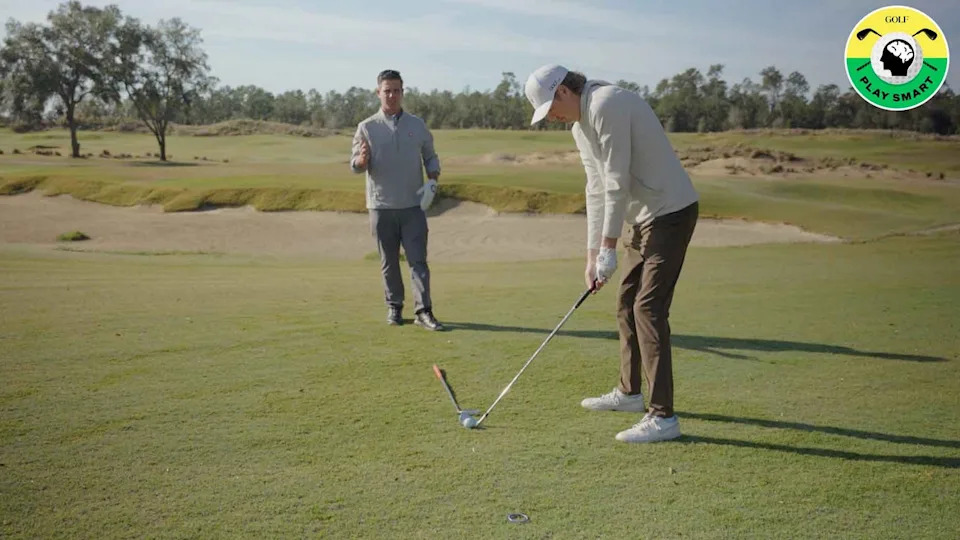
teaches watches as student lines up to hit golf shot
Average driving error (distance from the center of the fairway) was smaller when players focused on the larger target (12.39 m) than when using a small target (14.11 m). The number of fairways hit was also significantly higher when using a large target (64 fairways hit) when compared to using a small target (48 fairways hit).
Players also saw a small spike in driving distance-about 5 meters-when using a large target off the tee. The average driving distance when using a large target was 210 meters, while players average driving distance with a small target was about 205 meters.
Advertisement
With the data from this study, Alpenfels and Dr. Christina demonstrated that the old phrase “aim small, miss small” doesn’t hold up. In fact, they proved that ‘aiming big’ might just be the key to unlocking more accuracy and distance off the tee.
The post This common golf advice is killing your driving accuracy appeared first on Golf.