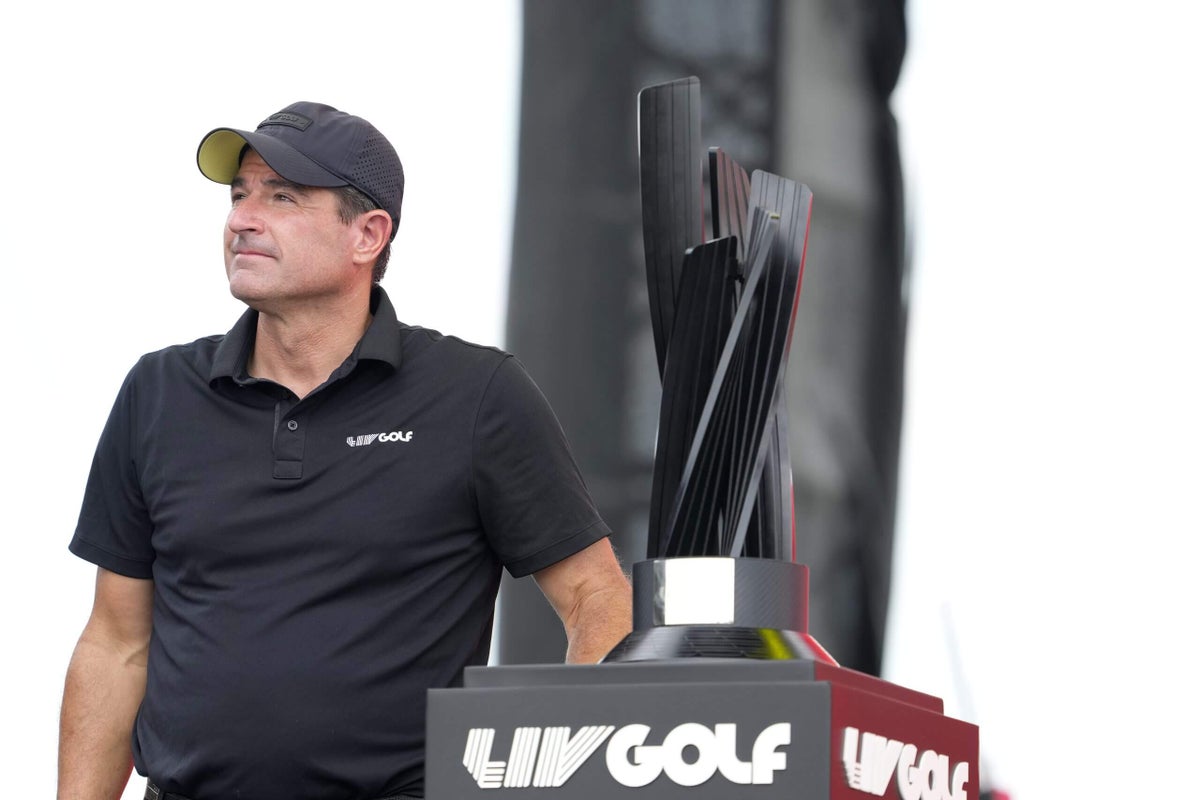
LIV Golf’s string of recent format changes — including moving from 54 to 72 holes — is increasing optimism that the start-up league could receive recognition in the Official World Golf Ranking system. Scott O’Neil, the league’s CEO, is hopeful about that outcome and bullish on a fast-approaching deadline: the start of the next LIV season in February.
“My hope is that this is walked down before the start of the season, and hopefully even sooner,” O’Neil told The Athletic Friday. “We’re having very constructive dialogue. I’ll leave it at that.”
Since LIV debuted in 2022 as an untraditional closed-circuit team golf league with three rounds and a shotgun start, it has failed to be awarded OWGR points for its events. That meant its best players began to sink in the standings, making it increasingly difficult to qualify for the four major championships. Several players have openly expressed that LIV, under original CEO Greg Norman, promised eventual recognition from the OWGR. But the league has not held up that end of the bargain during its four-year tenure.
O’Neil said that the OWGR committee, chaired by former Masters champion Trevor Immelman, did not specifically “request” a move to a more traditional 72-hole structure, but in discussions, the shift “has been well-received, for sure.”
The top players on LIV are largely in favor of moving from three rounds to four, O’Neil added, regardless of the progression toward OWGR points. Dustin Johnson, Bryson DeChambeau, Jon Rahm, Joaquin Niemann and Brooks Koepka have served on a competition committee to help advise O’Neil on league changes.
“What became increasingly clear as my time started to roll at LIV Golf was the better players want more golf. Period, end of sentence,” O’Neil said.
LIV Golf’s standing with the PIF
The Public Investment Fund of Saudi Arabia, the sovereign wealth fund that bankrolls LIV, is reportedly undergoing a restructuring of operations behind the scenes. The New York Times reported that many of the PIF’s projects are financially distressed and it is running low on funds for future investments.
After investing just under $5 billion across four years, LIV lost $1.4 billion in its business outside the U.S. alone. While revenues are increasing each year, those revenues remain small compared to the hundreds of millions spent. The Athletic reported in October that non-U.S. revenues hit £64.9m for LIV in 2024, up 75 percent in 2023, yet still a long way below the £553m paid out in costs.
“I definitely never speak for the PIF or for our chairman,” O’Neil said when asked about changes within the PIF and implications for the future of LIV Golf. “I can only say our board meetings are positive and uplifting. The support is very strong, and given the momentum we had, it’s a good time to be at LIV Golf.”
O’Neil says his metric for an evaluation of LIV’s business model is multi-dimensional.
“There are two ways to look at it. One is off the previous three years. And by that standard, we had an extraordinary year. Or you can measure it about where our expectations are for what this business can become. And there we’ve got some wood to chop, and some hill to climb,” he said.
Players now paying fines
For the better part of three years, LIV Golf has paid all fines from the DP World Tour, as the European tour sanctioned players for playing on LIV without proper releases. The Telegraph reported more than £15 million has come from the Saudi-backed league, even before adding the £8 million to £10 million in limbo as stars Rahm and Tyrrell Hatton await their appeals.
No more. As reported in July, players will be responsible for paying their own fines. O’Neil confirmed this move Friday.
“One of the reasons that that makes a lot of sense is so that the European tour and LIV Golf and the players now are aligned to hopefully sit at the table and figure out how to walk this down and act in the best interest of golf,” O’Neil said. “That’s a very good starting place.”
What remains unknown is what will come of Rahm’s and Hatton’s appeals, expected to be decided early next year. Per The Telegraph, Rahm’s manager wrote Rahm has no intention of paying fines. The potential impasse runs the risk of players such as Rahm and Hatton being ineligible for the Ryder Cup.
Communication with the PGA Tour
Golf’s great civil war was initiated under old leadership. For all intents and purposes, Norman and Jay Monahan are out of the picture. Instead, two new faces in their early 50s lead LIV and the PGA Tour, as Brian Rolapp became tour CEO in August.
O’Neil didn’t divulge any new information on potential negotiations or the actual dynamics between the two, but there appears to at least be a working dialogue. O’Neil has referred to Rolapp as a friend in the past.
“We both agreed we’re not gonna negotiate in the media,” O’Neil said. “We’re not gonna talk about things we talked about in the media, or even that we talked. So that’s the good news.”
Future LIV signings
For the second offseason in a row, LIV didn’t exactly bring in any blockbuster names. The days of causing shockwaves through golf with signings like Rahm, Koepka and DeChambeau have faded, and this winter, the lone two signings are journeymen Victor Perez and Laurie Canter. In fact, Canter is a re-signing, coming back to the league after being relegated in 2023 and playing the last two years on the DP World Tour.
While O’Neil is not claiming LIV doesn’t want to sign other big names, he boasted about the youth wave LIV has brought in the last few years. Behind 27-year-old Niemann, LIV has 23-and-under talents such as David Puig, Tom McKibbin and 2024 U.S. Amateur champ Josele Ballester.
“I’m much more interested in a player that has a trajectory,” he said.
“If we’re building a league of the future, if we’re building truly the world’s global golf league, we need young talent.”
O’Neil maintained LIV has the resources to pursue more big-name signings and claimed the league receives interest from outside players. The goal is depth, as LIV can boast having stars who won seven majors from 2020 to 2024 and some of the game’s “legends,” as he liked to call them. It just doesn’t have full fields that compete with the PGA Tour.
“If you compare the strength of field — which I have, our team has — across the PGA Tour and LIV Golf, for the first 25 players, it’s pretty, pretty close,” O’Neil said. “The next 25 is not as close, and so it’s incumbent upon us to make sure that we create enough pathways and that we’re given the opportunity to, without fine, suspensions, threats, so and so, that allows players the opportunity to come into this incredible league.”