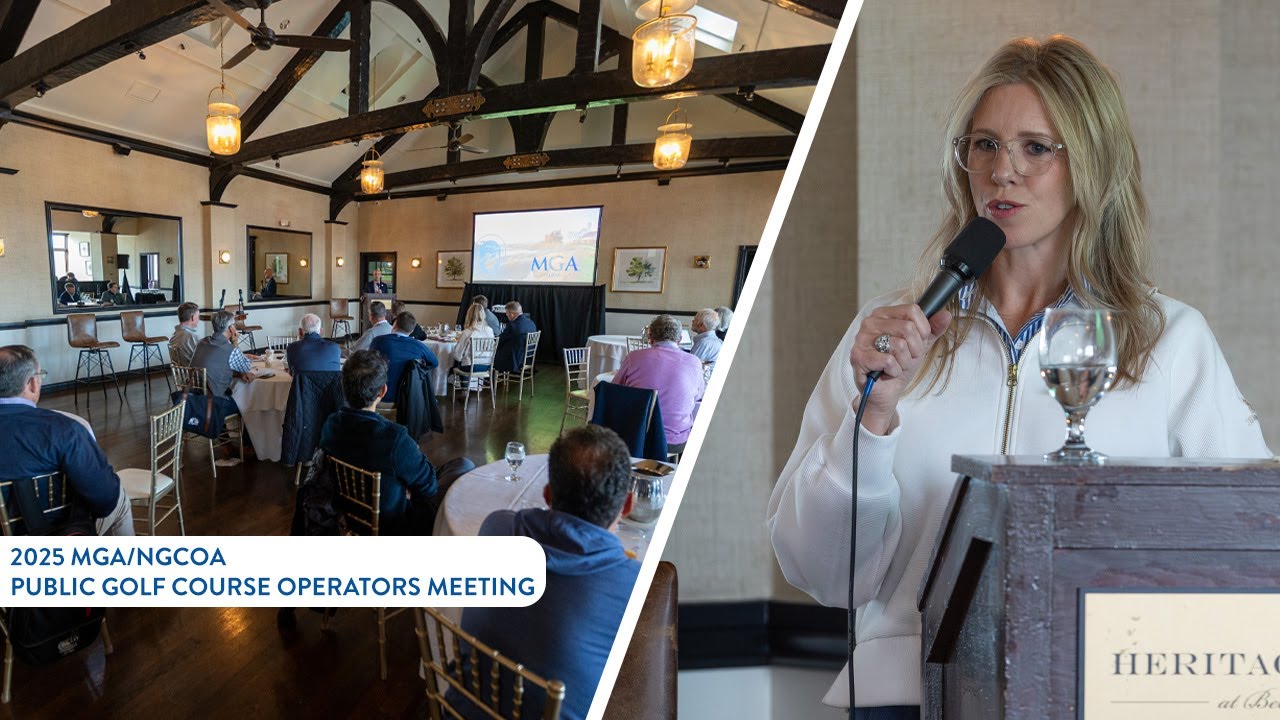
NGCOA Senior Director of Membership Rachel Carter provides an NGCOA update, plus welcomes Jennifer Caggiano (Attorney, Mackenzie Hughes LLP) to discuss an assumption of risk case, and Mike Suglich (Founding Partner, Greenlight Advisors) to talk about working with the NGCOA to promote collaboration and education of municipal golf course operators.
It is difficult sometimes for a national organization to feel connected with their members in the field. And so we have our directors of membership going across the country in different regions and spending time with owners and operators on the ground and collaborating with local associations like the wonderful Metropolitan Golf Association. Thank you, Nick, for your collaboration today. And we’re trying really to be the catalyst to have conversations just like we’re having today. So, as we round out our program, I want to give you a brief introduction of who the NGCO is and what is top of mind for us right now. As a national association, we have 14 affiliates across the country. So, that means that there’s several states, New York being one of them, that are not covered currently by an uh by an affiliate. But I do want to recognize one of our local regional guests executive directors, Ron Stanic. Ron, could you stand up? Ron is the executive director of the Pennsylvania Golf Course Owners Association and I really appreciate you being here today. We’re great partners and really enjoy working together. So, like I said, when we don’t have an affiliate that takes care of members in a particular state, our goal this year at the national level was to get local to get boots on the ground to come and sit with you to be a catalyst to bring you together with other owners and operators and to ask questions and have discussions like we’ve had today and like we’re about to have uh further into this afternoon. It’s a good time to be involved. I come from almost almost three decades. I know I don’t look near that old in golf operations. I’ve been with the NGCOA for three years and it’s a different experience on the association side, but I’m thoroughly enjoying it because I get to work with all the people like you in this room to really understand the business issues. I come from a familyun business as an um act kid growing up my own farm and my husband owns his own business. So, I know what it’s like when you’re the last one to get paid. Sometimes many of our members for the first time in 20 years are making money, right? We’ve been through the the highs and lows of this industry and the sometimes heartbreak that it might bring with the endless rain storms that impact the bottom line so much. But now golf is good. We’re enjoying it. We heard some of that from our panelists. I hope we’ll continue um talking about it and we are having new discussions, right? discussions of well, how are we going to continue to take care of the high demand? And I would just take this opportunity to share with you what I shared with the group out in Colorado uh just a few weeks ago when we think about the future of golf and making sure that clubs are still getting into the hands of new golfers that we have to evolve our own thinking of what golf looks like and that it isn’t always going to be for 4 and 1 half hours on 18. It’s going to be screen golf. It’s going to be short game golf, which is one of the growing segments of new golf courses, right? Resort short game courses. It’s going to be range experiences, and I use that purposely because it’s a different range than we’ve seen in the past. It’s going to be VR golf, right? It’s going to be all these different components, but it will still continue to be golf. And just like Sebie, who is so cool around the Thanksgiving dinner table here in a few weeks because he plays golf, golf is cool. And we needed to capitalize on it. and our owners who are operators and owners of golf courses. We hope that these conversations and the resources that we provide you at the NJCOA allow you to capitalize on that financially and that you can welcome a new age of golfer so that they have the experience that they see on Instagram and Tik Tok when they come to your facility if that’s the group that you’re trying to attract. So, there’s a lot going on in the space and we really pride ourselves that the NGCOA truly exists for you. We exist to support our members so they can thrive in their golf business. I gave everybody a packet when we came in today and I just wanted to go over real quick what’s in here. I gifted everybody today a copy of this white paper which is not available to people who are not NGC members. This is a white paper that we just produced and just released with a partner of ours like speed and it’s on a topic that I’m pretty sure everybody in this room wants to know more about driving demand revenue and retention across the golf journey. So, I like that you have the guts to share what you would do if you were a golf course owner in front of a room of golf course owners and operators. But it’s okay. I like it. It’s by an entrepreneur. And what I really like is I don’t think you right. We talk about um member for a day in GF. We talked about a couple weeks ago. We talked about the current loneliness pandemic that swept the United States. And like I shared with you as you were stretching, so you likely didn’t hear. It brought me back to Peter Ducker’s quote when he says, “The customer rarely buys what the business thinks it sells. They’re really not buying when they come to Tom’s Golf Club.” They might be buying high-end golf at home, but I sold golf club memberships for a long time. They’re buying belonging. They’re they’re buying community. They’re buying experience. And I think Tom touched on that when we talked about and some of us were talking about expanding the spaces for lingering a little bit longer. You know, Seth says you invite them and give them a reason to stay. So anyways, I hope that this is a good um resource for you and I hope you’ll enjoy that this is an exclusive normally only available for members, but it is a good example of what we do at NGC NGCA with some of our white papers. The other things in here um are going to be materials on member benefits and I’m going to touch on those as I go through my slides. I do want to get to my slides though because um we’ve got some presenters who are joining us remotely and they’re waiting in the waiting room. But real briefly, I want to give you just a note about our history. But the National Golf Foundation, I’m sorry, that is not who we are. The National Golf Course Owners Association was founded in 1971. We’re headquartered out of Charleston, South Carolina. I operate the West um office out in Denver, Colorado. And we are governed by a national board of directors. You can see some of those folks um pictured here. They are golf course owners and operators of government um quite government re organizations who sit on our board and um and they really help us to stay true to our mission to deliver resources that allow our members to thrive in their business. So I want to take you through today because I know we’re getting close to lunch. The four pillars that really guide us at the NGCOA and I’m going to start with advocacy. this flyer in here. Advocacy is really the crown jewel of the NGCOA as you hear our CEO Jay Karen say. And one of the pieces I included in your packet today is the handout that we took when we had over was it 600 meetings in May on Capitol Hill? Did anybody go to National Golf Day? So, every year the um American Golf Industry Coalition, of which the NGCOA is a board member of ascends onto Capitol Hill and we host meetings with representatives in the House and um and we talk to them exactly about what Tom talked about today. Why does it matter? Why does the business of golf matter? So we try to bring clarity to the issues of the business at both the uh state and federal level that impact your business. Sometimes we have to gather voices like when we use these and go to Capitol Hill as an industry and that’s why it’s important that every golf course in America belong to our trade association. And then sometimes advocacy looks like pushing back against market forces like this year for example when companies started scraping tea times from our individual owner operators and reselling them or not and one golf course owner was stuck with $3,000 in lost revenue because of no shows. Sometimes it looks like making sure that Google allows the owner to own the link to make tea times and doesn’t push it to a third party that maybe that course doesn’t want to work with. In the realm of advocacy, we’ll continue to see issues related to environmental headwinds like Tom talked about and we hope to play a bigger role in getting that message out. I think that hearing it was really important We had that presentation from Tom in the Empire Golf Alliance um on the agenda today. But what’s so important, you know, you said the five lawmakers, the the lawmakers in the five bureaus aren’t friendly to golf. The real impact of doing that study is only going to be seen if all of you take it back and implement it somehow, right? And so working together to brainstorm how you’re going to do that, whether it be through messaging through state golf day and messaging to the consumers, which the Empire Golf Alliance is about to do. And we’re going to help through a small donation today for anybody who joins not a member. We’re gonna give your full first year dues to help fund that campaign to consumers throughout the state of New York about the business of golf. I want to bring local some of the advocacy work that we’ve done and that brings me to our first presenter who’s joining us straight from her trip out west to Disneyland. Jennifer, can you hear us? Okay. Yeah, I can hear your joke. Wonderful. Well, thank you so much, Jennifer, for joining us. Jennifer is um was our was our attorney that we worked with um on an issue here in the state of New York. Is everybody familiar with the Casanobia golf club case with the air golf ball? Okay, Jennifer, you can’t see the crowd, but there are not a lot of hands raised, so we’re going to have to do a little bit of um education here. So, this is an example. Usually, the National Association doesn’t um always get involved in local sort of legal issues like this one. But the reason this one is one that we rallied the troops on and actually funded an amus brief was because we were concerned that the outcome of this case could impact the industry across the board. And so, Jennifer, I invited Jennifer here today to just share with us a little bit about what happened in that case at Kazanovia and why it mattered. Um, Jennifer, you want to set the table for us? Oh, yeah. Thanks, Rachel. Uh, thanks again for uh inviting me. I’m sorry I can’t attend in person, but as you mentioned, I just got back from the West Coast and uh travels been a little chaotic. Um, but happy to be here today. Uh, so yeah, I’m a partner at Mackenzie Hughes in Syracuse. uh and we defended the Casobia Golf Club and a lawsuit brought uh back in 2020 in the policy days of CO uh it took us 5 years to finally get a resolution uh but we did earlier this year. So um I’m happy to tell you folks about it. Uh and so the uh the basic premise is that um there’s premises liability in uh New York State that the courts recognize which is that a person uh if they’re injured uh on property then they can potentially sue the property owner or the operator uh for their injuries. Uh most of the time we think of those as slip and falls or something hitting you uh while you’re on the property. uh there is an exception to those and that is uh for recreational and sporting activities and uh and that includes a wide gamut of such sports and activities. So, we’re talking about basketball, uh, hockey, skiing, and of course, golf. And the exception to that is the assumption of the risk doctrine which is recognized long been recognized in New York uh as a shield to liability for defendants who are sued for injuries some plaintiffs may have sustained um at their uh at their golf course, at their event center, at their ski hill, whatever it may be. Um now the surgeon the risk option is not a blanket immunity. Um it does have kind of its own little intricacies. Um and it really specifically relates to each type of activity. For example, just because you get injured uh skiing doesn’t mean that uh the the uh mountain is shielded from liability. But what it means is did you get hurt in a way that is inherent to the nature of the sport? Uh so for skiing, you know, if you if you got hurt because the slope was icy or there was a mobile, uh those types of things are inherent in the nature of skiing and the mountain would be able to raise that assumption in the risk doctrine to say we can’t be sued for the injuries of plaintiffs because he got injured in the way that people tend to get injured for steam. Um and the reason that we that the courts recognize that is we want to encourage the public to use these facilities and we want these facilities to exist. Uh there is obviously a physical and and mental benefits to having these types of activities available and we don’t want to discourage uh entrepreneurs and business owners from operating um such types of activities. Uh now for golf uh most of us can probably recognize that the greatest risk uh other than the frustration to our mental health is that there is uh a risk of getting hit by a bad shot. Uh it’s a risk that has been um recognized by the state courts in New York uh as something that is inherent to the sport. Um what happened in 2020 what was a case involving my client uh the Kaisobia golf club which was operating a uh member member tournament and one of the members ended up getting injured. Uh now the golf club is a 100y year 100y old course. Uh it was designed by renowned Scottish uh golf architect Seymour Dunn. Some of you may be familiar with his work. Uh it’s a 9hole course uh certified to play 18 and it’s pretty much substantially been in the same condition for the 100 years it’s been in operation. Uh it was created by kind of the local towns people uh who said no we’ve got this little bit of land. It would be really nice to have a golf course here. And so the golf club was born out of that. Um flash forward to June of 2020. Uh we have this member of member tournament and the planes of David Killeski is a member of the golf club. Uh it’s it’s private club and he’s very familiar with the course. Uh he’s an avid golfer. He’s golfed around the country. Testifies he’s probably golfed over 500 times. Um and he is playing with a random partner and uh unfortunately sustains an injury from a bad shot. Um there’s two holes that are kind of in question uh at the course. I can try to share my screen here and give you guys a visual aid. Hopefully as you folks can see this. Um so this is an overhead shot uh full of holes uh three and seven which are the ones I issue. This is hole three. Uh this captures most of the T boxes uh and part of the fairway. Here’s the fairway and the green for hole seven. So you can see they’re uh adjacent holes which is very common as we all know. Um but Mr. Katleski had already played on the um on the third hole uh at least twice. Uh so we know he had played from both the green and red te’s and uh he had also played the seventh hole at least once uh maybe twice and so he was familiar with the layout of where the uh the TE’s were that day. uh on the date of the member member tournament. As you can see, there are multiple tea boxes here in the third hole. Uh the white TE’s were at Tox A, which as you can see is the farthest back. Um the quirky thing about this hole was that T- box A was not actually original to the course. Um it was installed about 10 years prior uh by the golf club to increase the difficulty of the course. Uh as you know dolphin uh 2020 was different than dolphin 1920 updates in technology uh human physiology you want to make the course a little more difficult um and this was how the way to make that hole more difficult was to you know increase the length of the uh of the of the hole. Um, so we added a T- box here at A, uh, which was still in line with T boxes B and C. And it’s a fairly straightforward uh, hole. The fairways directly in front. The green is directly in front. You can see everybody that’s in front of you. Uh, there are woods off to the right. Uh, and then there’s a um there’s a tough to see here, but there’s a lightning shed that’s kind of next to the BT box. So when your team opens a your view of the seventh hole uh is a little obstructed. Um should that matter our position was not really your intent is to hit the ball of course straight down uh the third fairway. Uh unfortunately for Mr. Hyleski uh as he was on the seventh hole uh he was looking for his ball. driving the golf cart with his partner. Uh looking for shots at seven fairway and he’s struck by an errant shot that came from Tox. Um might be able to top his overhead, but that’s a difficult kind of one million shot to make. Uh the ball striker uh at the AT box was a name a man by the name of Justin Hubard who testified he intended to hit ball straight. Unfortunately, it uh took a duck puck to the left, which as we know is basically line drive as it takes a 90° turn. Uh everybody in his party, the other three players, all yell four um even though they couldn’t see if someone was on seventh fairway. Um you know, just to be safe, we provide that courtesy. They all yelled four. Um eventually they came to learn that Mr. Pleski uh had been struck by the bad shot and was injured. Take that down. Uh so Mr. Kleski found an attorney. Uh they brought the case uh here uh in central New York in um Madison County which is about 20 minutes south of where I am in Syracuse. And we proceeded to litigate the case. Um we went through the discovery process. Uh all the participants were deposed. So that would be the four people that were playing with Mr. Kadeski and four people that were playing with wall striker. And um what did we learn? We learned that number one Chicago was an avid golfer familiar with the course and that he uh understood that dignified bad shot was a risk in golf. Uh we learned that the T box A that everyone had picked from was not original. It was installed by the golf club uh without any kind of internal or external review or analysis. Uh they didn’t hire a safety consultant. They didn’t bring in any type of uh architect or designer before they installed the T- box. Um, and we learned that there are of course parent shots that come off uh the third TE’s. Most of them slice off to the right of the woods. Um, but there are some shots that do travel over to the left hole or sometimes they hit that lightning shed that would be near the T box. Uh this is the first time anyone had really been seriously injured uh injured play between those those two holes. Uh Mr. Kleski testified that he didn’t know the T- box and had it ever existed until the day of the tournament and although we believe that string pulity we said okay uh fine but you you understood that it was there on the day of the tournament you were playing in a a shotgun style. So we understood that there was continuous play on all holes at all times. Um he testified that when he was approaching uh looking for his ball in the center of the fairway uh he wasn’t paying attention to the third hole. He was looking for his ball. He was in a golf ball cart. He was talking to his partner. Um so he was not overly concerned with where the players were on their ball. Uh once we completed uh the discovery portion, kind of get this out of the way. Mr. Hubard the ball striker, he was let out of the case a little earlier. uh because he testified that look, I I didn’t intend to hit him, uh I wasn’t negligent in my actions and that I didn’t act recklessly. He wasn’t in my intended path. And while New York was pretty clear that a bad shot is not going to shield the defendant from uh liability. Uh so great, you sort of cover uh that I say, well, I’ve got a judge’s decision acknowledging uh the case law about assumption of the risk. So I’m going to use that for my motion. under my motion on behalf of um the golf club uh to get this case dismissed. The allegations against my client workforce is a little different. It was more of an negligent design uh argument that the plaintiff had raised and in my motion we hired uh two experts, a u certified PJ uh who provided opinions that uh the operation of the tournament was in conformance with uh PGA and USGA standards. Um there was nothing uh negligent or in violation of any rules as far as how the tournament was played that day. And I also hired a golf course architect uh who provided opinions about golf course design. Uh which was as many of you may know is that there is no regulations for golf course design. There’s no rules. Uh and that’s what makes golf so great is the uniqueness of the course. all of you, each of your courses have different layouts and um things that make it unique that your uh that your guests and your um participants like and that’s part of the charm of golf as opposed to uh basketball or football where we have regulations as far as the field of play and where things are supposed to be. Um so our experiments explain that we don’t have that in golf. uh when courses are designed there are not rules that we have to follow as far as where the greens and the T’s and the fairways are supposed to be placed. We of course did design them with safety in mind but we can’t eliminate all hazards. Um ultimately what we tried to say to the court was uh this is an assumption of rural case. We have a individual who was injured by an errant shot uh and the case you know should be dismissed. Um, on the other side, the plaintiff raised the argument that, well, this is not assumption of the risk because what the course did in its design was to unreasonably increase the risk that Mr. Callison was going to be injured. Um, and unfortunately at the lowest level, uh, the judge agreed with PL motion and, um, we decided that, uh, this is not a case that we should be taking a trial. uh for multiple reasons. One being that juries are very unpredictable. Uh they tend to not necessarily follow what the law uh or the facts are. They kind of grab on to things that as the attorneys we may seem as see as relevant or unnecessary. Uh and and there’s a human element to this too. Mr. Palace, we unfortunately sustained pretty serious injuries and we didn’t want that to cloud uh the jury’s uh decision. So, uh, we decided we were going to appeal that decision. And that’s when I contacted, uh, Ronnie at Miles at MGC and said, “Hey, I’ve got a case here where I point to who is saying that what happened to me is not an assumption of the risk. In effect, uh, what they’re proposing uh, from their expert is that uh, a couple of things. One is that there should have been complete visibility on the course at all times. uh which is sounds ridiculous and and practice is ridiculous. Uh I’m also talking out of both sides of their mouth and that the se third hole should have had some type of netting or tree line uh to prevent balls from traveling from the third to the seventh hole which again sounds ridiculous and in practice is ridiculous. Um, and so I reached out to Ronnie and said, you know, these are the things that are at stake here. Um, and would you be interested in helping us with an anarchist brief? And, uh, Ronnie was very enthusiastic about doing so. Um, and, uh, we put him in touch with a local attorney here in Syracuse to write that anarchist brief. Um, for those of you not familiar what that means, is a means of the court. Um, you may hear it more in terms of the US Supreme Court cases where an agency who’s not actually a party has an interest in the outcome. uh submits a brief in support of the organization. Um so we submitted our briefing on behalf of the golf club and uh along with the advocates from NGCO to the third third department uh public division here in New York which sits in Albany. Uh there was an oral argument before panel of five judges and uh both uh we attended and the plaintiff uh council attended for that panel and a few months later the decision came down and it was favorable to us fortunately. Uh the court recognized it. This is an assumption of the issue. This is not this is a legal issue. It should not be determined by a jury and the case should be dismissed. Uh however, there was one wrinkle in the decision and that two judges uh consented and said uh look we’ve got an expert on the other side who’s saying something that’s counter to the golf coursees expert and that’s not something that the judge can uh wed that’s that’s a jury question and so they desented and said uh this case should go to trial. Um because of that uh because you had a split decision essentially the plaintiff was able to bring the case to the highest court in New York uh which is not a Supreme Court. It’s actually called the US and the New York Court of Appeals. Also it’s an opening. Uh and once again I reached out to Ronnie and said well we got a victory but we still have one more defense to make. Um and this is really the most important one because the court of appeals is the highest court in New York. uh they can change the law, make new law, and so if they find that they want to change the assumption of risk doctrine, they can and they can use this case as a way to do that. So, uh this was really important that we win at that level. Um and so again, I put NGC away in touch with another local council to submit another amuse brief uh who’s against our brief on behalf of the golf club. Again, another argument was held uh earlier this year and I’ll be before another panel of judges and uh this time uh we got a unanimous decision in our favor that the court again said nope, this is assumption of risk. Uh this is a case that’s clearly inherent risk in golf. There’s nothing the golf course did to uh unreasonably increase that risk past what is inherent to the sport. and uh the plaintiff’s piece is denied and and that was then and that was the final uh resolution of the case. It couldn’t go any further. Um reached out to Ronnie and gave him the good news and uh here I am today to speak with you guys about it and um I know a few people seem like they were familiar with it. I think it’s kind of made the rounds uh a little bit some folks that were down in Florida that heard about it. Um but it was definitely important uh kind of seminal piece in not just golf but also uh that assumption of risk doctrine. Thank you Jennifer. Thank you Jennifer. Jennifer. Thank you for that great uh summary of the issue. Could you just to to close these comments on this topic? What advice would you give to this room of golf course owners and operators so that they can protect themselves from, you know, other similar liability claims in the future? So, three questions, Rachel. Um, I found that uh the court and the lower court that denied our motions seemed to grab on to the fact that the addition of the TA box had been made without any type of review or analysis. Um, and even though our expert who’s a golf course uh designer said, you know, had I been contacted, I would have told him this is fine. Um, I think that may have been a crucial step that the lower court, again, that judge who denied my motion. He may have recognized that and said, well, okay, they took the step needed to make sure they weren’t unreasonably increasing the risk that someone could be hurt. So, you know, maybe that would have uh granted my motion at the lowest level and and potentially prevented these future appeals. Um, so I would say if you’re going to make any modifications that um make any substantive change to the course, uh, you may want to consult with, uh, a safety expert, um, a designer, architect, um, because the cost of them coming in may be worth it to avoid, you know, getting into litigation like we’re we were involved in with the Casobia Club. Thank you. Do you have any questions for Jennifer? Yes. Was the person who actually hit his involved in any litigation? Did you Jennifer, did you hear the question? The question was, did the person who actually hit him, was he involved in any litigation? So, he was so he was one of the initial defendants. Uh, he was let out of the case a little earlier than we were. uh because the allegations against him were that he was negligent or reckless in hitting this T-shot, which it sounds ridiculous as I say, but uh the court agree that uh because uh the ball striker testified that his intent was not to hit Mr. Katles, the plaintiff, it was to hit the ball straight down a fairway ahead of him. Uh that Mr. Katleski was not in his intended path, that uh there was no negligence or recklessness to be attributed to the ball striker. So he was let out of the case uh a little bit earlier. Um and then I thought I was would be able to use the logic the court provided in its decision dismissing a false striker um for my arguments uh that assumptions risk would apply. It didn’t work at the lowest level but it worked at the highest level. Any other questions? Jennifer, thank you very much to you and your team for your for all of your guidance and expertise on this. We really appreciate it. It was a big issue and we were just talking today about all these new golfers coming into the game and there are some Eric golf balls, you know, off the tea. So, anyways, thank you very much for being here. Appreciate your time. Thank you. I think Jennifer’s going to jump off. I’ve got one other presenter here. So, I’m going to keep going through our agenda, but I wanted to share that with you to show how a national association can even and is impacting issues at the local level, at the state level here in your backyard. Um, I’m going to come back to commercial programs because that’s really important, but I have we have Mike Suglitch on the um screen here. So, I’m going to jump over to education. This really blends I want this is one of our pillars but it kind of blends two of the pillars. It blends our education and resources that we provide to our members and it blends community. Raise your hand if you operate a municipal golf or government agency golf course. Do we have any of them in here? So we have a few. Um the NGCOA as I mentioned the name owners is in the name of association but over the last 50 years we’ve really evolved. We continue to service our core which is our golf force owner who’s involved also in operations. We also take care of and our home for art management companies and multi-force owners as well as resorts. And in the last two years have really doubled down the efforts um due to the the national board’s desires to really be a home base for municipal golf courses, municipal and government agency golf courses. So we developed what’s called the municipal and government agency golf course operators community. And that’s a community within our NGC8 community. Very active group. We have over 400 different municipal and governmental um golf course operators on a very active community online. And one of the services that we um provide for them which is also coming out in 2026 for nonmunicipal government agency just private uh companies uh is a benchmark study and we’re doing that with our great partner Mike Sudlich at Greenlight Advisors. Now, Mike, I’m going to warn you, you were the last presentation right before lunch and they’ve been sitting in here for hours. So, they’re getting a little restless and squirmy in their seats, but um would you please share with us for a few moments a little bit about what’s going on and the impact that this um benchmark study is having for operators across the country? Yeah, sure. Um I was going to share my screen. Um good morning everybody. Um let’s see. You see the uh golf course? Yes. Okay. So, um yeah, my name is Mike Sublage. I’m a CPA. I’m the owner of Greenlight Advisors and um develop a uh a tool for golf course owners and operators called golf clubbenchmarks.com. And in order to uh create exposure of of what we were doing, um we targeted the municipal uh golf market, which was kind of what we thought was an underserved area. And we’ve partnered up with Rachel and the NGCOA the last two years to perform an annual municipal golf study. And um and what we’ve done is we in the first year we started out with about a 100 courses participating in the study. This year we’re probably closing in on about 400 courses participating and kind of leveraging my accounting and technology background. We’ve basically built a database and we consume all the data that the participating courses share with us and uh we basically have two main reports. uh a financial report which is basically an income statement of the performance of your club and an operational report that uh basically shares the KPI metrics of the course, a number of rounds, utilization, things like that. And um anybody that participates in the study um will receive a complimentary copy of the final report and we’ll give them access to a uh to a report card um on how their course is performing and how it stacks up against the industry. And uh what I’m going to do is I’m just going to flip to uh see here on the screen um some of the courses that participated in the study. Um, Truman is one of the organizations that they share all their municipal golf course day with us for the benefit of the entire municipal golf community. Um, some of the courses out east Montgomery County, um, in the Washington DC area, they have courses in there. Um, if you can see some of the other courses, uh, city of Louisville, Chicago, Cook County, um, they have courses in all five main major regions of the country, but up in the northeast, we had roughly 70 courses in like in the New York, New Jersey area that participated and shared their data with us. And um, we basically captured 20 financial metrics and 20 operational metrics. Um, and then this these are some of the uh comments and quotes that I hear back from the operators, you know, in terms of, you know, I don’t know how we compare other courses. And these are some of the some of the benefits of what we’re doing. Um, our city council wants answers. We can’t confidently give them. Every department has its own version of the truth and you can read a couple of the others there. And then just as an example of one of the metrics that we provide in the final benchmark report, it’s basically we categorize everything in the top, median and bottom cortiles. How are the best performing? How are the the the middle of the road courses performing? And how is the bottom cortile performing? And you can see here when we did the study in 24 using the 23 data, the top cortile was generating uh over 26% uh net income to the bottom line. So if they’re generating 2 million in revenue, um they were putting, you know, close to $500,000 to the bottom line. Um so the median was roughly 14%. And then we do these same metrics with um with a lot of the other line items, golf course maintenance, you know, what percent revenue you’re spending on golf course maintenance, um etc. And that here’s the report card um that we provide. Um we basically anybody that participates in the study um we’ll load their data in. We’ll give them an online access to the report card and they can see how they’re performing um either in the top, the middle or the bottom quartile of each of the metrics across the financial benchmarks and the operational benchmarks. You can see some examples here. And then I’ll just scroll through some of the other metrics that we that we provide in our final report. And this this is data that we capture from you as well. Um golf operations net margin. You can see the top quartile is um generating you know almost 74% net margin from golf box which is basically all your uh golf operations revenues less your golf box cost like your um like your labor cost etc. Um here’s another one. Golf course maintenance. Uh you can see the most profitable courses spend roughly you know 22% of revenue on on maintaining the golf course. The bottom cile is up around 43%. Um here again net income margin uh we we do a golf course maintenance per acre. Um we benchmark number of employees um in terms of full-time equivalents on grounds and in golf box. um your utilization based on play weather playable rounds. Um you we take your total rounds annually and divide it by your um weather playable rounds and you come up with the utilization percent uh average daily rate and then um so and then uh this is actually the screen where you log in and you have access to your bestin class report card. Um here’s a everybody likes leaderboards involved so I thought we’d put together a leaderboard. These are some of the courses that um are in the top cile in terms of profitability um across the country. Uh you can see there’s one here in Montgomery County has one uh does a real good job um in managing their operations. Chick Evans in Chicago to Cook County course and uh several others. And then these are some of the quotes that we get uh we received back from some of our our customers that join our service. uh Andrew Peterson, we lean into our data a lot. And then I thought what I could do too, Rachel, is if I can get everybody’s email that’s in attendance, I’d be happy to uh share this um this slide deck with them. Um these are the um you know 500 plus courses. We have 150 KPIs. um some of our partnerships that we we work with landscape golf management troom uh there’s a group out east like group spirit golf management is a certified partner of ours too um he’s in the in the New Jersey um Pennsylvania area and then um some of our members Palm Beach County Florida Salt Lake City golf city a couple others are like Louisville city of Louisville has 10 courses and then uh some of our strategic partners uh Rachel and National Health Force Own Learners Association. Uh we’re going to do a presentation down at the golf business conference um sharing results of the study in January. If you’re interested in that, we’re going to be doing it in partnership with the NGCA and the PGA of America. So um should be an interesting session. And then um if anybody wants to join up for the study again, I could share I’ll share the slide deck with you. And um but if you just want to make a note of the link here, it’s uh signup.clubbenchmarks.com. Um we’ve extended the sign up date to uh November 15th and then we share a template of the data that you would need to provide us with and and that data is provided to us in confidentiality. We don’t share that data with anybody else. And um it’s just aggregated into our averages. And then uh then we’ll um you’ll need to share your data with us. You can sign up by November 15th and you’ll need to share the data with us by December 5th. So you have you know a few weeks to pull the data together. Usually takes roughly maybe an hour to pull it together the first year and we’ve got a lot of repeat courses that are with us now. And um I would probably say it probably takes on a recurring basis maybe 30 minutes a year um to pull it together. I think maybe a little bit more than that, but um we probably need a little help from farming because there is a you know basically we capture the revenues um maybe five or six major expense categories of the golf course. We take it down to net income and then we gather some of the operational data like number of rounds in a year, how many full-time employees you have on grounds and in maintenance or grounds and in golf operations and uh just a few other items like that. So, so if you’re interested, um, my email is mikefreelightadvisors.com and, um, I appreciate the opportunity to, uh, to present to you guys this morning. Um, good luck in your lo season and, uh, enjoy your lunch today. So, that’s all I’ve got. Rachel, I don’t know if you want to open if anybody’s got any, uh, brief questions. We don’t want to hold anybody up for lunch right now. Sounds good. Thank you so much, Mike. Appreciate you. appreciate your partnership with the NGCOA. Um, part of when we developed the municipal and government agency golf course operators community is our goal and our mission every day with that group was to ensure that we’re empowering and equipping our operators to operate confidently and using the data through the benchmark study is one example of how to do that. Mike, you weren’t in the room earlier, but the question was asked by not a municipal golf course. It’s a privately owned nine-hole course here in the in the area. Um, percentage of revenue derived from green fees versus food and beverage sales. And I don’t know if you know that off the top of your head from this study, but I remember you giving that data point when I saw a presentation a few weeks ago. But this is that’s an example of something that when we’re asking those questions, a benchmark study like this will give us some of those um some of those data points. So Mike, thank you very much. Appreciate you being here. Yeah, and I’ve got an answer for you. The uh the green speeds represent 62% of the total revenue and um I can tell you food and beverages too. um food and beverage total revenue represents um on average um you know 10 to 10 to 14% of total revenue and I can’t tell you that the most profitable golf courses out there um in most cases have an insignificant food and beverage operation and have the highest gross margin in managing simply golf operations not food and beverage. So it take take that for what it’s worth. Great. Well, we hope we can bring you this type of data for even privately owned courses um in 2026 and beyond. So, Mike, thank you very much. Appreciate you being here. Hey, my pleasure. Thank you everyone. Okay, I’m going to wrap this up. Uh the last couple comments on here. So, I talked I want to talk about commercial programs. There are flyers one sheets in your packet that highlight some of our commercial partners at the NCOA. One of the founding reasons for establishing the strength association was to be able to use the group buying power when it comes to um purchasing from industry suppliers. And so there are rebate programs uh that you can take advantage of and I hope that you are. If you have any questions about any of that, please let me know. I’d be happy to walk you through that. I already talked I’m jumping around a little bit now on education. I talked about the white paper we put in there. I want to extend an invitation to you to join us. Golf Business Conference. That’s our national um annual conference that’s in conjunction with the PGA show in Orlando January 19th to the 21st. I hope you’ll join us there. Um for those of you uh who who are part of the municipal government operators community, we do have breakout sessions for you um during those couple of days. But the education is really good for anybody who’s operating a golf course. And then the last pillar, I usually start with this one. I think if you ask nine members or you ask 10 members of the NCOA what their most used benefit is, I believe nine of them will tell you it’s community. And it’s doing things just like this. Sitting together, building up relationships, um asking each other questions, sharing challenges um that you’re having at your course and and coming up with some good best practices and solutions. Today over lunch, what I want to ask you to do um is stand up and allow the staff to come in and freshen up the tables. And what we’re going to do is we’re going to really practice this idea of community over lunch. We’ve got some uh topics that we want to discuss. As your course changes, we’re going to change the topic. And we what we’re essentially calling this this afternoon is our Accelerate live session. Accelerate is our online member portal at the NCOA where members engage on a daily basis on different topics and issues related to their business. And we’re going to do that together over lunch. So we’re going to pick a topic. We’ll start with that for the it’s on the agenda. We’ll start with that for the first course. You can visit about that with your table. So try not to sit by anybody that you work with because the idea is to get new ideas. And um and then we’re going to share some ideas from each table in between courses. And our hope is that like 50 years ago when our organization was founded that you find that the time together here today not only impacts you positively back at your business but also in your personal relationships and in your life. So I thank you very much for being here this morning and we look forward to a beautiful lunch together this afternoon. So sorry for the abrupt uh ending here but we want to get you guys on lunch. We’ll invite everyone to clear the tables and uh we’ll sit down for a nice three course lunch. Thank you very much.