The Sunday scene on the 18th hole at Royal Melbourne offered a clear example of how inspired architecture elevates competition and empowers talent to distinguish itself.
Following a near-eagle on the 71st hole, Denmark’s Rasmus Neergaard-Petersen walked up the 18th fairway tied with the clear home crowd favorite, Cam Smith. Playing his approach shot first, Neergaard-Petersen flared an iron shot wide of the right-hand green-side bunker, short-siding himself on “Dunk’s Island,” as referenced by the great Mike Clayton. A tournament that felt like a 50/50 proposition shifted quickly in Smith’s favor.
The Australian took a more conservative line to the dangerous back-right pin but overdrew the iron. With no rough to interfere with a less-than-perfectly-struck shot, Smith’s ball rolled out to well over 50 feet on a severely sloped green – a treacherous leave that only elite putters like Smith might reasonably expect to get down in two. Given the difficulty of the up-and-down Neergaard-Petersen faced, Smith retained the upper hand, though par was no easy bargain for either player.
RNP hit a deft little chip that settled past the hole to 20 feet or so. Smith lagged his putt to about six feet, halfway between gimme-range and a distance that makes a player of Smith’s caliber anxious. A solid effort, nothing spectacular. Still, advantage Smith.
{{inline-course}}
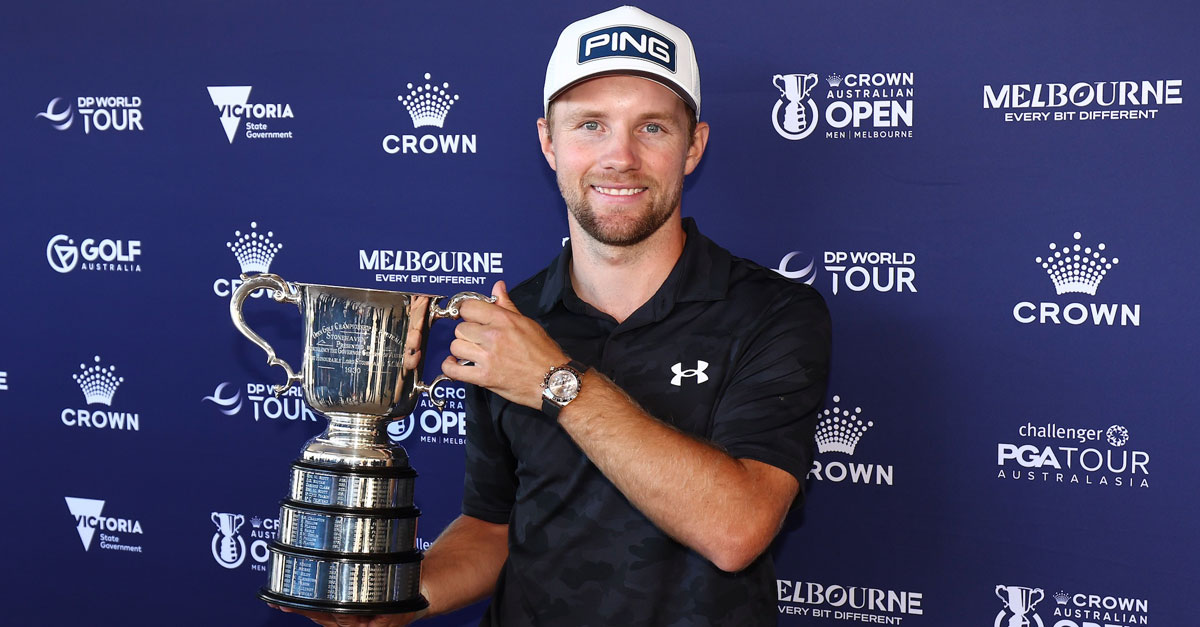
Then, encircled by a crowd rooting unanimously for their countryman, Neergaard-Petersen drained the clutchest putt of his professional career, leaving Smith’s attempt to force a playoff. To the crowd’s shock and disappointment, one of the game’s most reliable putters missed.
The back-and-forth sequence on the final hole embodied the essence of the test that is Royal Melbourne. Shots are demanding but achievable. Corridors are wide, but the line between having a scoring opportunity and needing a small miracle to escape with par is thin. Four days at Royal Melbourne, especially when conditions are windy and firm, leave no doubt as to who deserves the trophy. In Neergaard-Petersen, the golf course identified a worthy champion.
For RNP, an Australian Open win stands as the most impressive victory of his young career, and a potential springboard for a flourishing talent. The 26-year-old Oklahoma State product won three times on the Challenge Tour in 2024, and after a hot start to the 2025 DP World Tour season, his name started floating around as a potential Ryder Cup captain’s pick for Bethpage before a mediocre summer weakened his candidacy. A win against decent competition at Royal Melbourne represents another step forward on a career trajectory that’s been steadily moving in the right direction.
{{inline-article}}
Looking ahead to 2026, RNP has secured dual membership on the PGA Tour. A proven winner with loads of speed and consistently solid ball-striking, he is a name to keep an eye on as he prepares to face the stiffest competition in the world on a more regular basis. If he can handle Royal Melbourne alongside an Australian major champion, I suspect he’ll fare just fine at TPC Twin Cities – or, more importantly, somewhere like Augusta National.
Between the world-class host venue and an elevated field headlined by Rory McIlroy, this year’s Australian Open promised to be the most exciting edition in years. The tournament more than surpassed those lofty expectations, delivering one of the most drama-filled tournaments of the year. Ideally, this past weekend marked the beginning of a new chapter for the Australian Open, one in which the prestige of one of golf’s most historic championships can be rightfully restored.