I’ve been using LAB putters for more than a year now.
And while I’ve loved certain aspects of each one I’ve tested, there’s always been something that kept me from calling any of them perfect.
The DF3 was rock solid inside 10 feet, but I struggled with lag putting.
The Mezz.1 was better for the long putts, but the feel was still not quite there.
Plus, there’s the look of both of those putters. Let’s be honest, center-shafted putters look and feel a bit weird for a lot of golfers, me included.
Don’t get me wrong: The DF3 and Mezz.1 are both phenomenal putters. The hype is justified. But for me personally, while I definitely like them a lot, I couldn’t quite settle into what I felt was the right fit for my stroke and style.
So when LAB released the OZ.1i HS (the “HS” stands for “heel shaft”), I was curious. Could they really deliver lie angle balance technology without that center shaft? And more importantly, would it finally solve my distance control issues?
I’ve now played about 10 rounds with the OZ.1i HS (including 5 across Nova Scotia). And I think this might be the LAB putter that finally clicks for me.
Let me explain.
What Makes the LAB OZ.1i HS Different?
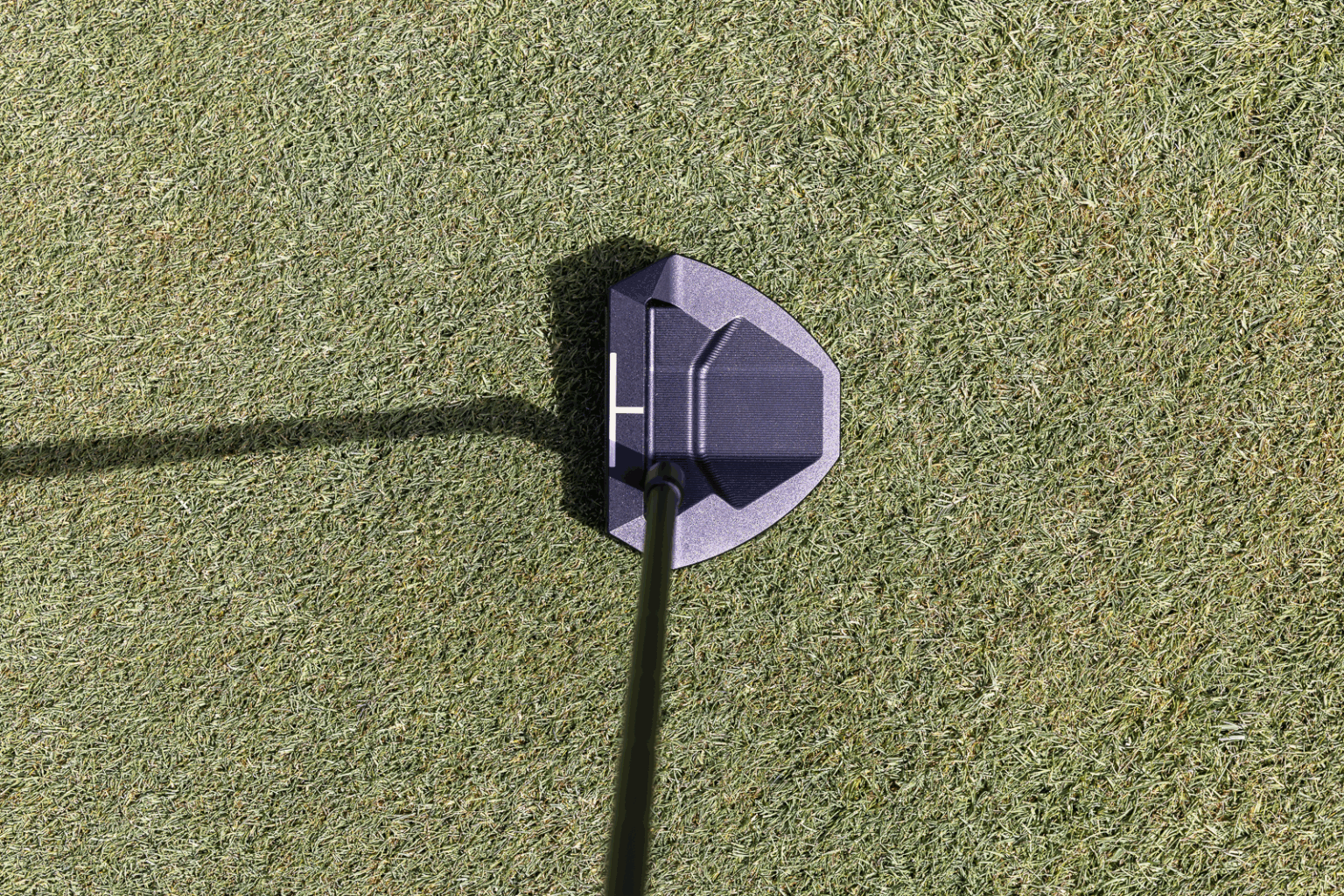
 The heel-shaft configuration of the OZ.1i HS.
So, as I said, the HS means that this putter is heel-shafted.
Every other LAB putter to date has been center-shafted. The shaft runs straight down through the middle of the putter head. For some people, that’s fine. For others, it’s a visual adjustment that, honestly, has never quite felt natural to me.
The OZ.1i HS changes that. Somehow, through what I can only describe as some kind of golf club voodoo magic, LAB figured out how to engineer lie angle balance with a heel shaft configuration. The putter face still stays square throughout your stroke, but now it looks and sets up like a more traditional putter.
So, for me, right away, I was intrigued just based on the look at setup. It just feels more conventional. And I’ve actually found that matters more than I expected it would. Keep reading.
LAB’s First Heel-Shafted Putter
LAB OZ.1i HS Putter
Finally, LAB releases a heel-shafted design that still incorporates the lie angle balance technology that’s made them the most hyped brand in golf. This is the LAB I’ve been waiting for, and it’s the one that’s worked best for me.
Buy from LAB Golf
Buy from Golf Galaxy
We earn a commission if you click this link and make a purchase at no additional cost to you.
My LAB Journey So Far
This is my third LAB putter, so let me give you some context on how I got here.
Also, just a very short word on the science behind LAB. Essentially, what they’ve figured out how to do through a combination of shaft angles, head design, face angle, lie, weighting, and whatever else goes into it is how to create a putter that basically self-corrects.
So, with most putters, it takes a lot of skill and timing to return your putterface to the ball with a perfectly square face. All of us open or close the face to whatever extent throughout our stroke. But for the ball to start straight, we need the face square at impact. Easier said than done.
The LAB putters, with their lie angle balance technology, kind of do that work for you. As your putter is approaching the ball in your stroke, the putter naturally wants to return to square. It does it on its own.
And I gotta say, it’s impressive. I mean, by this point, you’ve surely heard all of the hype. And from my experience, it’s absolutely legitimate.
But… That doesn’t mean I’ve found LAB putters to date to be perfect.
I started with the DF3 about a year ago. And like I said, from 10 feet and in, it’s money. The lie angle balance technology legitimately makes it easier to hole shorter putts. When you get everything lined up correctly, it really is like a cheat code.
Granted, you still need to make the correct read, and you’ve still got to be aligned correctly, and you’ve still got to hit the putt with the right speed. So, it’s not like it’s automatic. But when you do your part, the stroke kind of takes care of itself.
But on longer putts with the DF3, I’ve struggled. The face feels too firm, and I just can’t quite dial in my distance control.
After about three months with the DF3, I switched to the Mezz.1. And my lag putting improved. It was definitely better than the DF3 for me, but it still wasn’t quite there.
I tested both on my Puttr system at home, and the data confirmed that the Mezz was a better fit for my stroke, but like I said, I haven’t found it to be quite perfect.
Then LAB released the OZ.1i HS.
First Impressions: This Looks More Like a Normal Putter
The most obvious and very first thing that hits you when you compare the OZ.1i HS to any other LAB is the heel shaft placement. It just looks more normal.
The head itself is a half-moon mallet design and LAB’s first solid-body construction. It definitely still looks like a LAB in that it’s got a bit of a futuristic look to it. But I will say that it’s not nearly as radical as something like the DF3. I actually think this might be a good fit if you’ve been turned off by the unconventional look of LAB up to this point.
The feel off the face is softer than both the DF3 and the Mezz.1, although I still wish it were even a touch softer. But compared to the other LABs I’ve used, this was a noticeable improvement.
One thing worth mentioning: The OZ.1i HS currently only comes with a stainless-steel face insert. The standard center-shafted OZ can be configured with aluminum, which is softer.
 The stainless-steel face I was originally planning to avoid.
When I eventually got fit at LAB headquarters (more on that in a minute), we tested both. The aluminum felt better, but the heel-shafted version with stainless still won out for me because of how much more confident I felt standing over it.
For me, confidence is more important than specs. And I’ve found that I like the conventional look of a heel shaft more than a center shaft.
On the Course with the LAB OZ.1i HS
Over about 10 rounds with the OZ.1i HS, I’ve found this to be the most well-rounded LAB putter I’ve tested.
On shorter putts, it’s been very good. Maybe not quite as rock-solid as the DF3, but still excellent. I’m holing those round-saving 5-7 footers far more than I ever did before I started trying out zero-torque putters.
That said, if your primary concern is absolute confidence on short to mid-range putts, the DF3 or Mezz.1 might edge this out slightly. The center-shafted design just seems to inspire a bit more stability on these specific putts.
But on longer putts, the OZ.1i HS really shines.
My lag putting with this putter has been significantly better than with either the DF3 or Mezz.1. I’m getting those long putts close more consistently and reducing my three-putts as a result.
The slightly softer feel off the face is a big part of this. Distance control is all about feel, and when you can’t gauge the feedback at impact, it’s tough to dial in speed.
This is definitely a personal thing. Some people will prefer a firmer face. I personally like softer.
According to my Arccos data, I’ve been gaining between one and two strokes per round with the OZ.1i HS compared to my 10-handicap counterparts. I’ll definitely take that.
However, for comparison, the PXG Bat Attack ZT, which has been my overall favorite putter of the past year, has gained me over three strokes per round on average. Now that’s massive.
So, the PXG is still my top performer, but the OZ.1i HS is right there and the best of the LAB selections for me so far.
What I Learned from Getting Fit at the LAB Headquarters
After a year of playing LAB putters off the rack, I finally made the trip to my hometown of Eugene, Oregon, to get properly fit at the LAB headquarters. And, honestly, it was eye-opening.
They set me up with a Quintic machine, which is basically the TrackMan of putting. It measures everything: launch angle, ball speed, skid distance, forward rotation, impact location, face angle, path, you name it.
One of the biggest focuses was skid. We wanted to see forward rotation right off the putter face, which leads to a truer, more consistent roll.
What we found was, for me, the OZ putters achieved less than 30 inches of skid with forward rotation starting at zero.
With the DF3 and Mezz.1, it wasn’t even close to that.
That immediately explained at least part of my lag putting struggles. If the ball is skidding for the first 30 inches instead of rolling true, your distance control is going to suffer on longer putts.
We also tested different shafts, which blew my mind. I always thought a shaft is a shaft when it came to putters. Wrong. The Accra shaft was consistently my favorite. It provided a better feel and helped with the overall balance of the putter.
From a pure performance standpoint, the standard center-shafted OZ with an aluminum face was the technical winner. But when I stood over the heel-shafted version, I just felt more comfortable and confident. And in putting, that’s everything.
So I went with the OZ.1i HS, even knowing the face would be slightly firmer. Because all the numbers were still excellent, and that intangible feeling of confidence was more important to me.
How Does the OZ.1i HS Compare to Other Zero-Torque Putters?
I know people are going to ask about this, so let me address it head-on.
I don’t know if the OZ.1i HS is truly a zero-torque in the same way a center-shafted LAB is. I’m not an engineer. And honestly, I don’t really care.
What I do care about is the results. And for me, the OZ.1i HS has performed exceptionally well.
Like I said, I’ve also been using the PXG Bat Attack ZT this year, which is their zero-torque option. And I do have to say that the PXG has been the surprise performer of the year for me. It’s given me better confidence on both short putts and lag putts than any LAB I’ve used, and the strokes-gained numbers back that up.
Does that mean the PXG is better? For me, maybe. For you? Maybe not.
Putters are deeply personal. The best putter is the one that helps you make more putts. For a lot of people, that’s going to be a LAB.
Just look at how many people swear by them, including more and more tour pros. For others, it might be a PXG, or a Scotty, or a 30-year-old Ping they found at a garage sale.
I’m not here to crown a winner. I’m just telling you about my experience.
Things to Know Before You Buy
Even with the heel shaft making it look more traditional, LAB putters are different. Most of them come with a forward press grip, which takes time to get used to. And the lie angle balance technology itself requires a slight mental shift in how you approach the stroke.
The point is not to expect miracles overnight. Give it a handful of rounds to really dial it in.
Another thing to know is that while there are a ton of customization options, they can get pretty expensive pretty fast. Stock, the OZ.1i HS runs $499. But if you want a different grip, shaft, colors, weights, you’re looking at $599 and up.
Plus, there’s a significant backlog, so you might be waiting five to six weeks or more for a custom build.
And while I found the in-person VIP fitting experience to be incredible, I have to say that I think most people can get 85 to 90% of the way there without flying to Oregon. LAB offers a remote fitting process that’s going to be more than enough for most golfers.
Who Should Buy the OZ.1i HS?
I think this is going to be the LAB putter for a lot of people.
If you’ve been curious about lie angle balance but couldn’t get past the center-shafted look, this is the one to try. It sets up more traditionally while still delivering the performance benefits that have made LAB the hottest putter brand on the planet.
Is it the best putter on the market? I can’t say that. Putters are too personal to make any blanket statements.
But is it the best LAB putter I’ve tested after a full year of gaming them? Yeah. For me, it is.
So, take that for what it’s worth.
Final LAB OZ.1i HS Thoughts
With the OZ.1i HS, I finally feel like I’ve found the LAB that works best for my game. The heel shaft gives me confidence. The softer feel helps my distance control. And the performance has been consistently strong across 10 rounds.
Is it perfect? No. I’d still prefer an even softer face insert. And, for me, the PXG Bat Attack ZT is still edging it out in my personal strokes-gained numbers.
But this is the closest LAB has come to being the complete package for me.
If you’re considering a LAB putter and maybe don’t want to stray too far from conventional, this is the one I’d start with.
LAB’s First Heel-Shafted Putter
LAB OZ.1i HS Putter
Finally, LAB releases a heel-shafted design that still incorporates the lie angle balance technology that’s made them the most hyped brand in golf. This is the LAB I’ve been waiting for, and it’s the one that’s worked best for me.
Buy from LAB Golf
Buy from Golf Galaxy
We earn a commission if you click this link and make a purchase at no additional cost to you.
LAB’s first heel-shafted design is the one I’ve been waiting for.
9.2
Fantastic
If you’ve been intrigued by LAB but turned off by the unconventional looks and center-shafted designs, this new heel-shafted OZ.1i HS might be your best fit. It was for me.
The Good
Best lag putting performance of any LAB I’ve tested
Heel-shafted design looks and feels more conventional than other LAB models
Still delivers excellent performance on short to mid-range putts
Softer feel than DF3 or Mezz.1
The Bad
Stainless-steel face insert still firmer than I’d prefer
Expensive, especially with customization
Long wait times for custom builds
Presentation
9
Performance
10
Features and Quality
10
Price
8
Personal Affinity
9