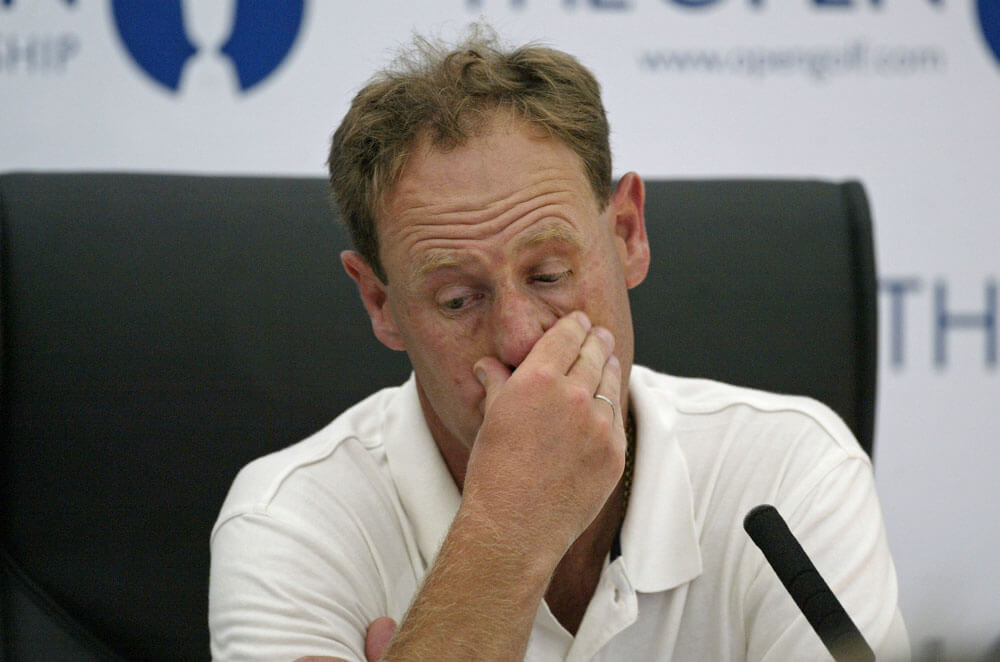
 A dejected Mark Roe of England addresses the media after being disqualified from the 2003 Open Championship. Andrew Redington, Getty Images
Mark Roe’s best-of-the-day 67 placed him among the leaders in the third round of the 2003 Open Championship at Royal St George’s. What is more, the fact that he had spoken of “a level of calm” he had never known before was quite something from the European Tour’s court jester.
His post-round conversation with the media had moved on to how he would be playing alongside his great hero, Tiger Woods, the next day. And that’s when a call came for him and Jesper Parnevik, his playing companion, to return to the scorers’ hut.
Straightaway, the 40-year-old Englishman was pretty sure that he knew what it might be about. With Parnevik having posted a shocker of an 81 to his 67, he thought he could have jotted the Swede down for a shot too many.
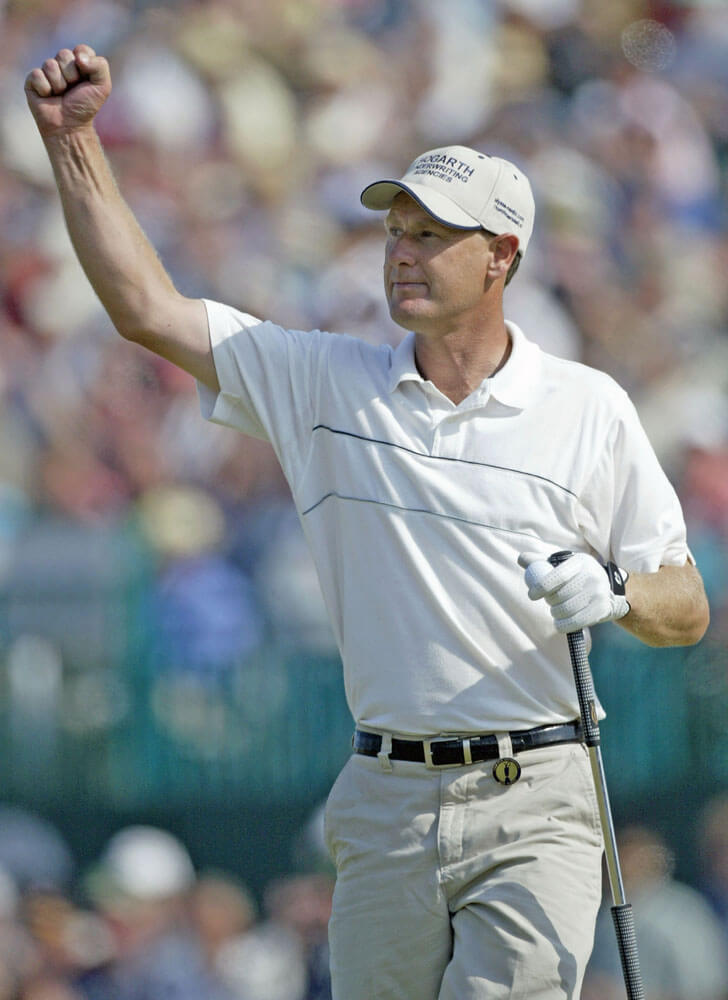 Mark Roe celebrates after shooting a 67 in the third round of the 2003 Open Championship, shortly before he would be disqualified for signing an incorrect scorecard. Andrew Redington, Getty Images
Parnevik had answered the official’s call first and was walking out of the hut as Roe was on the way in. “I’m sorry if I made a mistake,” Roe said, before suggesting where he could have gone wrong. The Swede stopped him in his tracks. “It’s worse than that,” he mumbled. “Much worse.”
The now 62-year-old Roe can still picture the scorers sitting at their table with the two scorecards turned around so he could read them. Straightaway, he realised that he and Parnevik had forgotten to exchange cards at the start of the round. And what that meant was that the 81 was under his name, and the 67 under Parnevik’s.
The result? Both players were disqualified for signing incorrect scorecards. R&A officials apologised but said there was no way to circumvent what most agreed was an unfair rule. (Three years later, Rule 6.6d was altered so that a recurrence of that day’s error would never again result in disqualification.)
Inevitably, the media were in a hurry to listen to what Roe had to say about the unfortunate turn of events and Roe, as per usual, was willing to help. First, though, he wanted a couple of minutes to think about how he would handle this sorry situation.
It was maybe because his father had never been able to bring himself to say that he was proud of his only child that Roe lacked that extra dollop of confidence he needed to go it alone. Hence, in what was the lowest moment of his career, he was still inclined to tap the memory of this hard-to-reach parent for guidance.
“The tournament goes on and life goes on. … Rules are rules and they are there to protect the game. I’m not bigger than the game.”
— Mark Roe
The outcome was that he made no excuses and blamed no-one other than himself.
“What can you do?” Roe said at the time. “I’ve just played one of the greatest rounds of my life and I can’t play tomorrow. I’m usually very diligent. It’s a freak – I’ve never done it before in my life. …
“The tournament goes on and life goes on,” he added. “I guess I feel a bit numb. Rules are rules and they are there to protect the game. I’m not bigger than the game.”
Reflecting back now on the notion of a potential waiver of the rule that would have kept him in the championship, Roe says he wouldn’t have accepted it.
“I couldn’t have gone on with that hanging over me any more than my late father would have done if he’d found himself in that situation,” he says. “Dad was a great one for sticking rigidly to the book.”
When Roe was driving home that evening, he pondered on how no-one would have been expecting him to win, whilst simultaneously remembering that clichéd saying about golf being a game where the impossible is possible. That the little-known Ben Curtis, who had been touring round London in an open-top bus at the start of the week, would go on to win the 2003 Open was a case in point.
Roe’s wife at the time, Julie, was waiting for him when he pulled up outside the family house. She gave him the biggest hug before gently placing one of their twin daughters in his arms.
For more in the way of consolation, the positive impression Roe left with his response to the scorecard disaster yielded something unexpected. Within days, he was fielding calls from TV companies inquiring about his interest in becoming a commentator when his career with the European Tour drew to a close. He said yes to Sky Sports and felt a tad less miserable because of it.
Meanwhile, messages were pouring in from all over the world. One that Roe mentions had come from a gentleman who said that the way in which Roe had behaved was in keeping with everything he so loved about golf: “It’s why I encouraged my son to play,” he wrote.
***
More than two decades after the scorecard episode, Roe occupies a visible place in the game as a Sky commentator and well-regarded short-game coach. His successful second acts followed a two-decade run as a European Tour player that yielded three victories and a jokester’s reputation but no shortage of angst.
The psychology books tell how comedy and creativity can alternate with depression as they “go down the same brain path.” As Roe would say of himself towards the end of a recent interview, there came a stage when he was only happy every other week when he was full-time on a home tour where he played a total of 524 events.
Plenty of others would no doubt say much the same of golf’s away-from-home demands, only in Roe’s later years there was that extra pang attached to his Open experience. Not for the first time, he returned to how he would have played with Tiger on the last day: “I was in a great place; it was a perfect time to be alongside him. The ‘never knowing’ lingers. I was denied the opportunity.”
“I saved me and golf saved me.”
— Mark Roe
Asked if he had access to mental-health help after that catastrophe, Roe answered in the negative. To him, mental-health problems have turned into almost too much of an issue in recent years and, by way of an example, he said that he doesn’t necessarily approve of players asking for extensions – i.e., being allowed to hang on to their tour cards for longer than they otherwise might have – “because they want six months to sort their heads out.”
Yet Roe confesses he could probably have done with some help when he left his first wife, Jane, for Julie.
“To be honest, which I always am, I hated myself at that point,” he said. “I hated how I was upsetting Jane. I loved them both but I eventually decided that Julie was the one I loved the more. I was hurting to the point where I was on the verge of going ahead with something daft.”
At that point, he told himself that what he had in mind was not the answer.
“I saved me and golf saved me,” he continued. “I was in my 20s at the time and, thank God, it struck me that everyone’s life must have its ups and downs, its good times and its bad.”
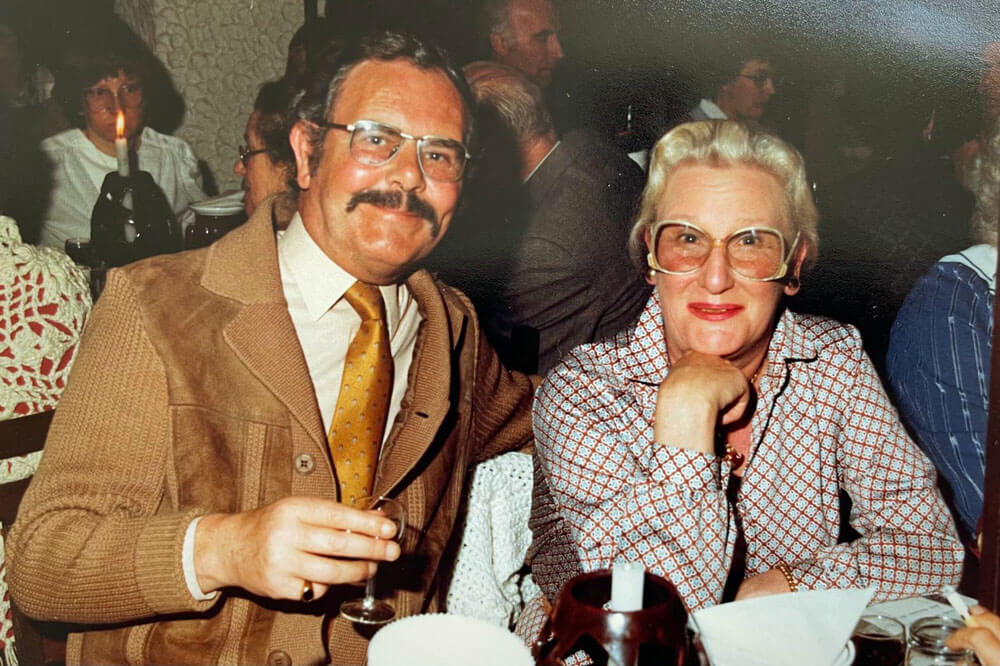 Mark Roe’s parents, Gordon and Phyllis. Courtesy Mark Roe
It wasn’t just in golf that Roe suffered the worst of sporting mishaps. At the age of 9, he had been third in the appropriate county age group for diving, and he was 13 when the time came for him to try his first twisting dive from the high board.
The takeoff was perfect, only when this would-be Olympian was in mid-twist he lost his sense of feel and landed on the side of his head. “Hitting the water was like hitting cement,” he remembers. The experience left him badly concussed and with a perforated eardrum.
So lengthy was the recovery process that he started caddying for his father, Gordon, a 17-handicapper at the Hallowes Golf Club near Sheffield, their hometown. And thus began what Roe describes as “a fabulous journey,” one that changed everything.
“When I was diving, my whole life had been about getting bruised in the diving pit,” he said. “It had called for hour upon hour of hard graft in a pretty miserable setting. In golf, on the other hand, I had walked with my father into this world of blue skies, trees and shades of green. I was in love with the game from the start.”
As Roe progressed as a golfer, his father, who had worked in the car industry, lost a caddie but took over from his wife, Phyllis, as their son’s chauffeur. Just as Roe’s mother had taken him to the swimming baths every day and read a book until his training session was over, so his dad would take him to the golf club on his way to work and pick him up at dusk. “Once we were home,” Roe said, “he would subside into his armchair and drink himself to sleep. He was quite a heavy drinker. … Seeing your dad drinking too much was a tough part of my teenage years.”
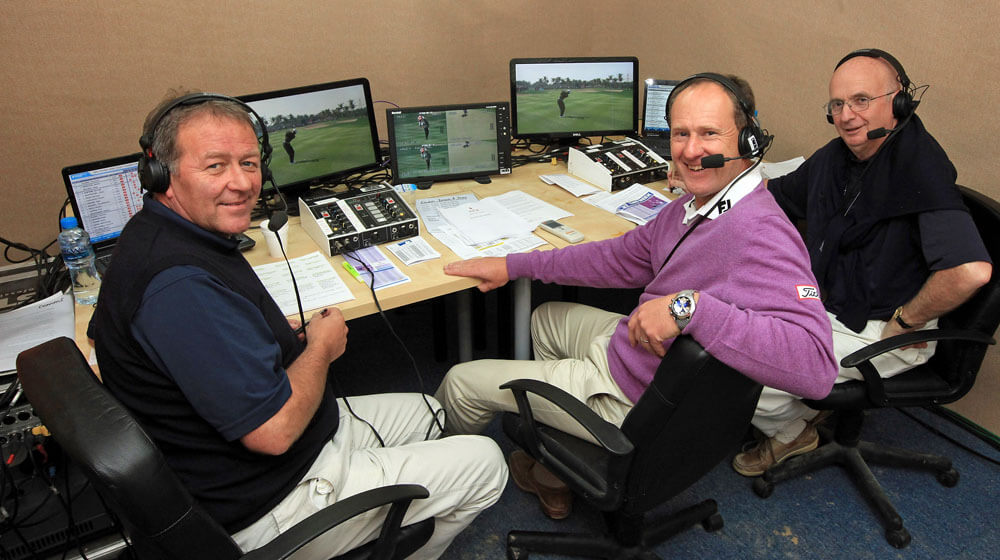 Mark Roe (center), with fellow commentators Ewen Murray (left) and Bruce Critchley, joined Sky Sports after his playing days ended. David Cannon,Getty Images
He became a professional in 1981 and earned his card in his fourth attempt at the European Tour’s qualifying school. In 1989, he won the first of his three titles, the Catalan Open, edging José María Olazábal, Colin Montgomerie and Gordon Brand Jr. by a single stroke. He went on to win the ’92 Trophée Lancôme and ’94 French Open.
As might have been anticipated, that French Open feat prompted media memories of how, at the previous year’s instalment, he had been fined £100 for throwing spaghetti over one of his professional pals.
There were players who would get mildly irritated with Roe’s fun-loving side but, for the most part, they enjoyed having a mood-lifter in their midst, as do his current television colleagues. At this year’s Alfred Dunhill Links Championship in St Andrews, Nick Dougherty, the former European Tour pro and leader of the Sky commentary team that Roe had preceded him in joining in 2007, remembered a day when they were all staying at the same hotel at the Omega European Masters in Crans Montana, Switzerland.
The hotels in Crans are bedecked in colourful flower baskets and boxes and what did Roe do but carry the ones from the windowsills of their establishment to the bedroom given to fellow commentator Richard Boxall. Once there, he lined the blooms up on every inch of the floor, the bed, the bath, and the wardrobe.
Then again, there came a night when Dougherty was heading off to dinner with his girlfriend. Roe gave them a cheery wave as they went, but, by the time they came back, the bed had disappeared. It was standing upright in the bath.
“His interpretations are great – and the same applies to his humour. I love the way it comes into his commentary.”
— Laura Davies
“The girlfriend walked out on me, but I liked Mark’s pranks even if she didn’t,” Dougherty said.
“Apart from being funny,” he continued, “Mark is the kindest person I know. In 2008, my parents enjoyed a great week following me at the Masters, only for my mother to have a heart attack and die a few days later. Everything in my life had revolved around my mum but Mark took me under his wing. He knew what it was to lose a parent and he couldn’t have been more thoughtful.”
Dame Laura Davies, the Hall of Famer and four-time major champion who joined the Sky commentary team when her golfing confidence began to slip, said that Roe is so knowledgeable that she listens and learns from everything he has to say. “His interpretations are great – and the same applies to his humour. I love the way it comes into his commentary,” she says.
Seldom can there have been anything to match Roe’s live report on the day the now 21-year-old Lottie Woad won the 2024 Augusta National Women’s Amateur.
As Woad holed one putt after another, he burst forth with an exasperated, “You’ve got no right at 20 years of age to be so calm in that situation. … You’re being watched around the world, you’ve got a crowd of Masters patrons yelling from around the 18th green and still you’re managing to hang in there.”
***
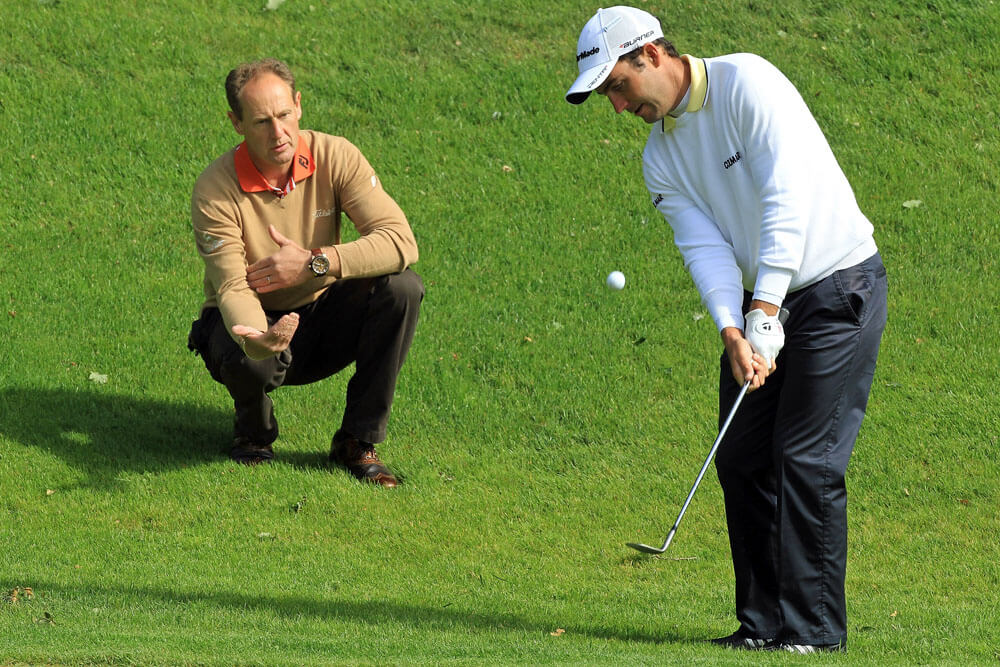 Edoardo Molinari (right) is one of many professionals who have turned to Mark Roe for help with their short games. David Cannon, Getty Images
Though Roe’s arrangement with Sky could have been down to the golfing gods making amends for that past misjustice, he had another lucky break at the 2007 Scottish Open. The latter was born of a conversation he had with Lee Westwood.
The moment he came off air, he had complimented his old friend on his long game. Westwood, in turn, had replied with the thought, “But if I could chip like you, I’d be the Open champion.”
“If you could chip like me,” returned Roe, “you’d win three Opens.”
“Why don’t you teach me then?” pursued Westwood.
And so began Roe’s career as a short-game coach. Westwood never did win the Open but he was second in 2010 besides finishing second in the Masters the same year and tied second in 2016. Rory McIlroy, Francesco Molinari, Paul McGinley and Dougherty have been among Roe’s other pupils. Indeed, when Molinari and his brother, Edoardo, won the Omega Mission Hills World Cup in Shanghai in 2009, Roe said it had given him as much of a buzz as if he had won it himself. By then, he had become a go-to expert on anything to do with the short game.
Dougherty says that Roe made a big difference to his touch on and around the greens and, in turn, his results. (He won all three of the Caltex Masters, the Alfred Dunhill Links Championship and the BMW International Open between 2005 and 2009).
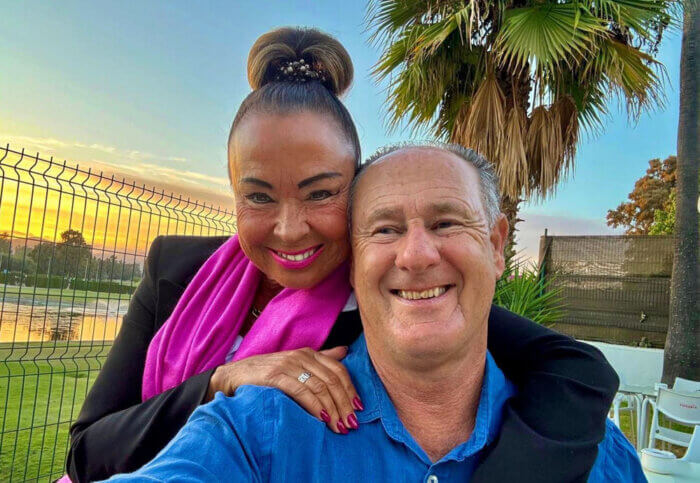 Mark Roe married his third wife, Veronique, after meeting her at a funeral in 2013. Courtesy Mark Roe
To return to Roe’s personal life, it so happened that, after 18 years, wife No. 2 gave way to wife No. 3. With Roe being the offbeat fellow that he is, it came as no surprise to learn that he had met the twice-married Veronique at a funeral in 2013. “A case of ‘Four Weddings and a Funeral,’” he suggested, before throwing in the fact that Veronique had fallen in love with him as she walked through the chapel door.
That’s the thing about Roe; gods and all cannot but like him. Yet when it comes to the commentary work he so loves, he is oblivious to whether the golfing public make admiring remarks or the reverse: “I don’t do social media so I don’t have to know what they think. If Sky are happy, that’s all I need to hear.”
Roe’s daughters, Alex and Emily, are now 24. He’s never quite sure what these free spirits are up to but he says to them what his parents used to say to him – “You must go with your heart.” The girls have been his best friends from the start; he is the first person they turn to if they have a problem. “It’s as it should be,” Roe said. “It’s what you want from a father.”
Much though he had loved his father, he clearly didn’t want his children to have to wait for as long as he did for an answer as to whether or not he was proud of his offspring.
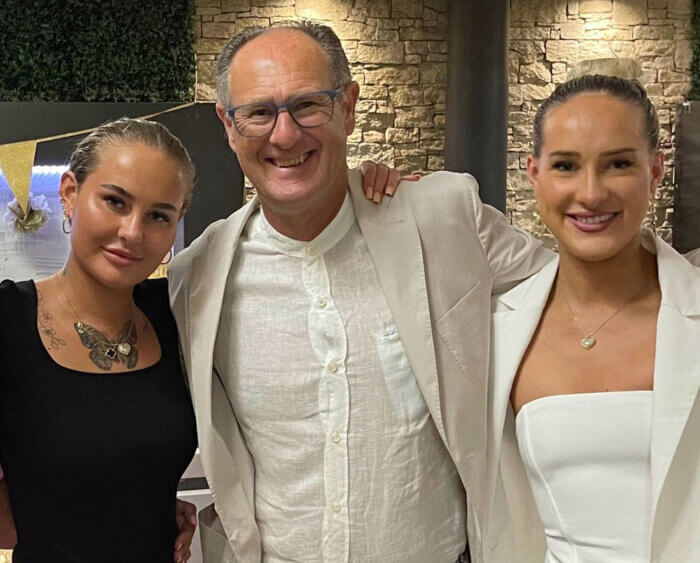 Mark Roe says he is best friends with his twin daughters Alex (left) and Emily. Courtesy Mark Roe
Yet strange though this might sound, he had that endlessly nagging question answered shortly after his dad’s death at the age of 64.
“Explain this,” he said, by way of prefixing the story he was about to tell …
“There was a day when my mother asked me to take all his clothes and shoes to a charity shop. So that’s what I did. But there was this handsome tweed jacket – a DAKS one, I think – which I decided to keep. It was the jacket he used to wear at the golf club. … I thought I could wear it myself.
“And when I came to try it on, I found a bulky parcel in the left-hand pocket. I pulled out whatever it was and there, to my utter astonishment, was this roll of Mark Roe press cuttings, all of them neatly cut out with my name and the date penned across the top. I never had the faintest idea that he was doing any of that.
“I sat down and I sobbed. It was one of those moments which will stay with me forever.”
***
Family apart, Roe is mighty proud of his three European Tour victories. He loves it when people ask what he’s won. “Whenever it happens, I’ll tell whoever it is that if anyone were to offer me a million pounds for my European Tour trophies, I’d turn the offer down,” he says. As for a question he gets asked on rather more of a regular basis, we all know what that is.
Back in 2010, when Doug Sanders was over in St Andrews and was asked about the 3-footer he had missed on the 72nd green to win the 1970 Open, which he eventually lost to Jack Nicklaus in a playoff, his well-honed and humorous reply was that he was over the worst of it. “Nowadays,” he said, “I only think about it every five minutes.” For Roe, it’s not so very different.
Like Sanders, he has a riposte at the ready. If, say, he is playing in a pro-am, he will go straight from introducing himself to his playing companions to a cheerful, “Whatever you do, don’t put me in charge of the scorecard!”
© 2025 Global Golf Post LLC