
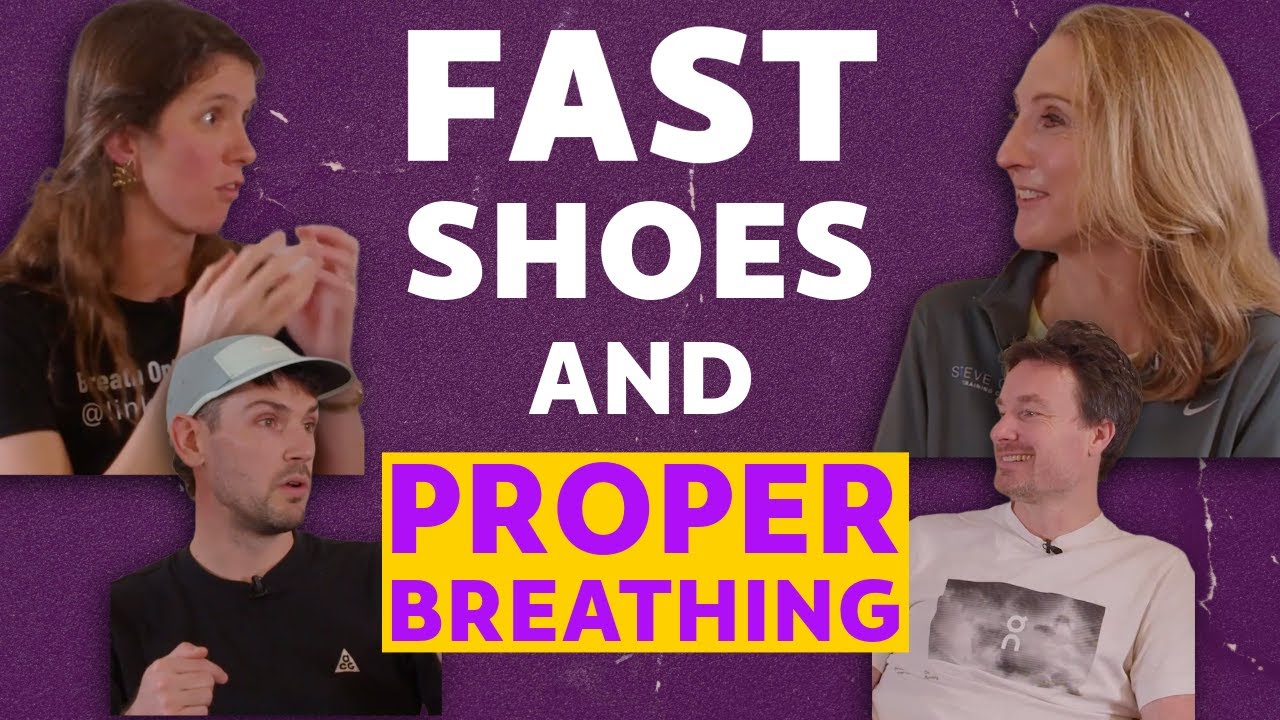
We’re back in Rutland for the second podcast recorded in front of a live audience at the Steve Cram training camp.
Today we hear from breathing expert Jane Tarrant and Nick Hardy, running shoe guru. Paula and Thommo question Nick about the carbon plate revolution and the science behind it. He explains the difference they can make to runners of all standards.
Jane speaks passionately about breathing. She tells Paula and Thommo how it can be used for performance and recovery – pre-race, post-race and on a run. There’s also an interesting discussion on taping up the mouth.
We’ve got the Honours Board and our sponsor for it is HIGH5 – the sports nutrition specialists helping people get the most out of their training and races. They want to give you goodies so please get in touch with your nominations.
Don’t forget to head to https://highfive.co.uk to use your exclusive Run Club discount of 25% off with this code: PAULA25
EMAIL: paulasrunclub@momentumbroadcast.co.uk
TEXT: +447564747914
INSTAGRAM: @paulasrunclub
Hello and welcome to this episode of Paula’s Run Club with me Paula Radcliffe and me Christopher Thompson and this is the second of our episodes from the Steve Cran Rutland training camp that we were at a couple of weekends ago now wasn’t it not this weekend the weekend before that and we have breathing expert Jane Tarant to share her wisdom on how to get better more efficiency I guess from your breathing isn’t it that was the biggest thing that she was trying to teachers apart from running around with your mouse taped up which I was a little bit skeptical about. We’ll get to that later on. Um and Nick Hardy as well who shares his wisdom on basically I think he does a really good explanation of how the shoe technology works, how the this the S of the plate as he termed it combines with the foam to kind of get the maximum efficiency out of people’s strides and to help propel them forward. So those were really really interesting to listen to. Let’s get into the interview from Rutland. So this is from the Steve Crown Rutland training camp part two and it is with Jane Tarant breathing specialist and with Nick Hardy, shoe guru we’re going to call him. That’s what he calls him. That’s what they call him on the camp. Oh, is it? There we go. Yeah. Yeah. There you go. So welcome to part two of the Steve Creme training camp. Paul has run club being welcomed here to get some chats and information um and really explanations I think from the next two guests. So welcome to Nick Hardy. What we’re going to call you shoe guru. Yeah, I’ve been called worse. So this we’ll stick with that one. And uh Jane Tarant who is well as it says on on the show. um breath optimization basically trying to help us to get the best out of ourselves in life or just in running from the way that we life. Yeah. As humans in whatever you choose to put towards. So do you want to should we start off? Where should we start? We’ll go ladies first maybe. No. Have you been called a lady before? You said you one of the things to shoe guy. Yeah. Yeah. We stick to shoe guru. Um, okay then we’ll go with we’ll go with the shoes just because it might take a little bit longer to explain. Um, and I do think that having sat in on a couple of your talks at the training camps, you explain really well how the carbon plate revolution kind of works and the and the promise behind it. Yeah. Um yeah it’s all come together very quickly but it was one of the things that it started again 1998 there’s brands doing carbon plates there but I think it’s a really happy sort of combination and concoction of three factors so the increased geometry within shoes um which has been aided by the increase in the benefits and changes to material tech so foams have become lighter bouncier springier so basically we can put more in it. And if we’ve got more of this big foam, um, then we need to actually stabilize it. So, the misconception with carbon plates is that they propel you forwards. They actually don’t. They just stabilize and direct the energy to your big toe. So, it’s stabilizing that big soft marshmallow, directing it forwards to the big toe, where the change in geometry gives you a big rocker to the uh to the front of the shoe, and it just rolls you forwards. So we get with that sort of constant momentum essentially with with carbon shoes and that higher stack height. So by the geometry you mean the heel to toe drop. Um little bits for the heel to toe drop but not as much as the actual stack height itself. So stack height being the amount of midsole cushioning. Um say back in the day you just had Steve on when he was running it was racing flats and flats were essentially that. They were just really thin pls. Um, and now we’ve got racing shoes and they’re leading to all these marathon times where they’ve had to had to put a limit on it. Can’t make them higher than 40 mil. So, that’s sort of really changed how it’s uh developed. And if you’ve got that big platform, you then get a big rocker on the forefoot just to roll you forwards and it changes the pivot point. So the pivot point being coming back from the end of your toe back towards more of the ball of the foot um where it’s in contact with the ground. What um h how much do you has this revolution change things in your opinion if you could I don’t don’t necessarily try and quantify in an actual number but how much of an impact do you think this has had? I think massively to the whole I think sport of running at any level. like we’ve seen race times plummet in every distance on the track. Um, and I know you can’t wear these super shoes uh on the track, but it’s come from training as well. Um, and then it’s completely changed the m change the mass market because the shoes were really designed at the sort of your 2hour marathon runners 220 people chasing world records there. And it’s only now that there’s models coming in where the 4-hour runner will really benefit from that shoe. And it’s aimed at that gate and that sort of foot strike as well. So what’s the difference there on that? What’s I mean because they’re both got carbon in them, right? So what are we talking about in a difference between an athlete trying to run sub two hours and someone trying to run four or five hours? What’s the the shoe differences that athletes should look at? the I think primarily the stability. We’ve all seen that athlete walk to the um to the start line of a race and we’ve all been there. Yeah. You try and walk in these shoes and they’re going all over the shop and if someone’s not really that stable, they’re going to I joke and say they’re going to run 27 miles because their ankles are falling in that extra bit. Um so the stability makes a big difference. Um, and I think also then the um how aggressive the shoes are for that rocker. So, how aggressive is that rocker? Is it something that’s quite subtle? So, favoring more of the sort of the heel strikers um and without sort of lumping everyone in the same box. more of the the four or five hour marathon guys versus then the super efficient and tuned and skilled and strong 2hour marathon runners where they’re able to have a bit more of an aggressive plate that’s stiffer on a more aggressive uh geometry and rocker because they’re pushing through it a lot quicker. So what what what do you mean by that in terms of the the aggreg like can you relate to the efficiency? Yeah. Like the angle of the plate how how curved it is cuz it’s typically in most shoes like an S-shaped plate. So the the plate is closer to the um closer underneath the heel than it is at the the forefoot. So it’s closer to the ground um and the outside of the shoe, the bottom of the shoe in the forefoot and closer to the heel. So that curve sort of flattens and then sort of rolls through directs the pressure to the goal is to spend as little time on the ground. Yeah. Yeah. Just speeds the foot. So I’m interested first time well when the shoes first started to come in it was very much road racing marathon. It was all aimed at kind of the the breaking project and it it came in with that. In the last year we’ve seen 800 meter times on the track really come down. Um, is that also carbon plates because it’s less foam coming into? Yeah, it’s less foam, a stiffer shoe. Um, but also that race performance is the icing on the cake of a of the training week. So, if these athletes can wear the shoes that are giving them more cushioning and they’re more efficient and they can be stronger um throughout the training week, then yeah, that performance is going to get quicker. I think going back to even the start of Tom’s career, shoes changed massively. And it’s like how long you had to wait between sessions probably changed massively from the start to the end of your career because your body was just so battered at the start when there wasn’t as much cushioning. Now we’re running on these big cushion platforms. You can do training sessions of 20 miles on double tempos like this double double threshold sort of days. And now where we have to wait two or three days, people are waiting six hours and bottle cornflakes like between it’s interesting because um we’ve seen such a revolution in 800 up in times that’s been quite visible and maybe a little bit in 400 maybe the more the hurdles than the flat four but I’m conscious that sprinting not so much but they I haven’t looked I haven’t really looked into sprint spikes and how they how they’ve evolved. involved. But when I did, it was brought up earlier. I’ve held Usain Bolt spike that he won in Beijing. It’s the most rigid lack of foam piece of machinery I’ve ever seen. And it’s got there’s no and he obviously ran his world records in that. And the tweaks that have been made around that I I kind of when you mention comments of how it pushes makes your foot fly forward. Why are we not seeing quite the improvement in sprinting, do you think? or we are. It’s just they’re just not as good as Usain, I guess. Um I mean, a little bit, but you get what I mean. Yeah. The main thing is though, what shape was Usain’s spike? It was curved. Yeah. So, what that’s done is with sprinting, they don’t strike on the heel in 100 m. They barely strike on like the heel doesn’t touch the ground. They want to be on that 4 foot aggressive position all the way through. And those people that were in the conversation earlier, this three-jint extension, we’re holding that ankle really stable and there’s so that’s one of the things that that shape he’s striking straight on the ball of his foot and propelling off. There’s no foam in that shoe that you mentioned because foam again is a soft material and it will never return 100% of the energy you put through it. you’ll always lose a little bit of that energy. And the Marathon foams and technology, you’re talking about product that has like 93% energy return in this foam. And so there’s 7% lost. So what they’re after with a sprint spike is the most direct rigid. I’m going to push all the way down into the shoe and everything I push into it, I’m going to get back and I’m going to get over that line as quick as possible. So, so, so the the change in spikes aren’t necessarily positive then for the sprinters. Maybe I to be fair, I haven’t really held, but they look like they’ve got something in them. Anyway, there’ll be a little bit. And I think over the last few major championships, I’ve almost started seen some of the sprint spikes, um, sorry, the hurdles, uh, athletes, they’re actually the winners of the like on the podium, they’re wearing middle distance bites because of the way that curve is. And with this super bouncy foam, they can just flex that, um, plate a little bit as they strike on the forefoot, there’s a bit of cushioning there that’s then getting them over, especially the 4 meter hurdles, isn’t it? But the other thing is I think over the last couple of years, and it’s a bit unfair to throw this one at you, but I do think they’re modifying the tracks to work with the spikes. So, they kind of complement each other. Um, and that’s why we’re seeing the the times keep improving. But I think the biggest difference with the shoes in the marathon is that get to 30k and your legs just don’t feel as dead. Um, so yes, the plate is helping with efficiency, but it’s really helping with a breakdown of muscle and that soreness and that just things starting to become more and more inefficient, which I think is my way of trying to bring Jane in to talk about efficiency. Um, because that’s what you’re trying to get to with with the the breathing, right? To have us breathing in the most efficient and natural way. Absolutely. And not overthinking it. Absolutely. and also dealing with one of the words used which is misconceptions. So my real bug bear is that we’ve had basically no education. If we have picked up some, it’s probably wrong. It’s probably misinterpreted by someone somewhere along the way and then rubbed it out, you know, to the rest of it. And it’s just that concept that we’ve never really been very curious about something so fundamental to every single part of our life. And you know, this is affecting our health, whether it’s our mental and physical health, it’s affecting our performance, it’s affecting our recovery. And I think also we’ve come in in the more recent years to really think about recovery a lot lot more. You know, what you’re eating during that time, what you’re doing in terms of whether you’re using biohacking methods or what, you know, whatever rest um ways you’re doing it. And we’re not really thinking about breathing. And I mean, it frustrates me because I I go to the sauna quite regularly and I see championship footballers in my sauna and I am regularly being like, um, aren’t you on like a a recovery day? And they’re like, yeah. And I’m like, “Are you aware that you’re impacting your diaphragm right now and therefore maybe not recovering as well as you could be?” And they’re like, “No.” I’m like, “Have you ever had any breathing education whatsoever?” They’re like, “No.” I’m like, “Okay.” Do you say that’s probably why you’re in the championship, not the premiership? I’d love to say that that was the difference. Um, yeah. Explain how how the sauna affects diaphra. So, in the sauna, for example, we want to be using our diaphragm, not compromising it. And when it gets quite hot, one of the things they’ll do is they’ll drop their head down to get out of the heat, which is completely fair enough. But they’ll curve their back and they’re just like, some of them are on their phones occasionally, but generally it’s just like this and they just collapse down. And I’m like, well, if you were to hip hinge and then go down, you can protect your diaphragm whilst bringing your head down. But because you’ve had no breathing education, because you don’t have any awareness of your diaphragm or even realize that your human breathing outside of your intense training, whether it’s running, football, whatever, the point is you’re not really thinking about those multiple tens of thousands of breaths you’re taking that could be making like all these incredible marginal gains. And if we are going into sort of compromised diaphragm, it’s so I I named a spot on the body basically called the D-spot. I thought it was that time we had an extra spot on the body. So just about three fingers down from the split of the ribs is the D-spot. And as you breathe in at rest, sitting here correctly, I would be able to move that away from me and then back in. And there shouldn’t be upper chest movement. There shouldn’t be belly movement from the belly button, no matter what you’ve learned from yoga or whatever that you might use during a specific example. And if our D-spot doesn’t work, i.e. When we’re doing this, which is why I’m not sitting in these chairs all like, yeah, chilled. Um, when we’re got that in there, when we’re down like this, it compromises our diaphragm and then we end up using our backup muscles. So, our belly muscles and up here. So, these are our sort of survive muscles, not our thrive muscles. And that just seems a bit wasteful, but also it trains an over breathing pattern. Same being if I just slightly go into this. And especially in running, you’ve all got friends that are runners that hold their shoulders forward like this. And this is kind of dropping your pecs over your diaphragm, which means you’re then going to breathe in here and up here. So you’re using two parts rather than one part. So from an efficiency point of view, just as a human, whether you’re running or not, that just doesn’t really make sense. But the most important part about this is what that means from a science point of view. Like how does it really impact us? Why does it matter if we breathe more, louder through our mouth, upper chest, shallow, etc. And this is all about carbon dioxide and it’s the gas that gets overlooked because most people are like, get oxygen into my body and then I’ll be gold. And it’s it’s actually about looking after kind of the backstage crew that you know, the thing that no one thinks about because oxygen’s like an actress and they can’t shine without the support of what’s behind. So you can’t get oxygen to your cells, to your muscles, to your brain as efficiently if you’re over breathing and dumping your CO2 a little bit too quickly. So it is a waste gas, but it’s got a job to do before it leaves. And it’s a little bit like having sort of red London buses driving around your blood and they collect the oxygen from your lungs, which I consider a tree, so from the leaves of the tree. And then as they’re driving down, you want like a motorway or threelane road. And you want little porters that are there to kind of open the doors and let the oxygen get off. So let’s say there’s six doors at a time. Now if I’m an overreather all the time, I’m going to take over breathing into my running. It’s not like I’m sort of like this generally all day and then I’m just like, “Yeah, absolutely. Total efficiency like perfect.” It doesn’t work quite like that. You’re always going to have some sort of decline within that running breathing too. And that might just be your CO2 tolerance is too low and you’re struggling to kind of slow your breath down. You’re struggling to kind of keep it nasal. um or or even sort of you might be restricted in your ribs or something as well or your perception. Now, when that over breathing happens, you’re taking that motorway or threelane road down to a dual carriageway or two-lane road. And that means that you’ve got the same number of buses. You can be training your V2 max incredibly. You can be having loads of oxygen in you, but you’re not delivering the damn thing efficiently. So, it’s very, very simple basic science. I only teach in sort of non-scientific language because this is kind of what we need to be teaching our 5-year-olds as well as ourselves. And this is very much that if you if you get stuck there because your CO2 tolerance declines over time at partway down you’ll be like, “Oh, yeah, I’m a bit stressed and bit anxious and yeah, whatever.” Continue that a bit more and suddenly you’re ping ponging between these two little close walls and that’s when you’re getting panic attacks. That’s when you’re getting, you know, intensity in terms of um allergies. So, you’re really struggling with your allergies because you’re not really using your nose anymore. You’re gasping through the mouth. You’re taking all this unfiltered air through your mouth. Viruses, bacteria, particles, allergens, it’s um cold air, it’s irritating air, your lungs aren’t performing as well. And all of this is because you just humaned in a way that you slightly declined. And even just like we we met last year um and you were sitting there and you were like, “Yeah, I’ve noticed my posture, you know, has kind of gone ever since I’ve had kids and stuff.” And it’s just dropping that little bit. It’s just that slight that slight thing without without awareness and and that’s going to impact you know what was that you said what was that thing you said about pulling pulling your chest forward what remind me again that you you like in terms of it’s going to bug me now it’s really bad it’s because I can’t remember in order to hold yourself up yeah in terms of rather than when you think when the posture it was the posture one when you said rather than think do that that’s a lot of effort think from from a different angle. What was it again? So, well, you don’t want to put your breasts out. You want to kind of show off a necklace. So, there’s a kind of elegance, a sort of a tall, strong, elegant ballerina, for example. The most important thing is actually feeling confident, feeling good about yourself. Am I able to stand up here? So, if you um if you’re there and you’re kind of going, all right, um if I stand tall, first of all, we could actually be impacted by a sort of a trapezius across the back that’s a bit tight. So I do a a release for people that just activates all three layers, stops them being kind of not a teamwork and allows them pick up. But also once you’ve got that unlocked, oh that was easy. And then once you’ve done that, you’re like, right, well if I feel sort of not quite confident, I’m tall, but I’m not confident. As soon as I’m confident, there’s that slight just a very slight change. And it’s it’s about dialing into the language of what we associate with our bodies. And runners particularly can find that they’re kind of curving forward, that they they’ve kind of given up. they’re feeling dreadful and we kind of need to fake it if we’re not feeling it just from a I want to feel good and I’m going to feel strong or I remember that language that works for me and so giving us these moments and then also in terms of recovery which is absolutely vital I am really on a mission to kind of ban this as a concept um is anyone doing it now now it was interesting because you think oh it’s only in football and rugby maybe and they have been kind of told to do this by certain coaches and it is not helpful in the slightest because it’s actually locking up the back of your ribs here. So rather than be able to expand opening here, I’m locked up like this. Yeah. And I’m in the side ribs and front ribs only. So I can’t even get to a kind of optimal recovery breath where I can really pull in in a really efficient manner. And so actually I saw um because it was Harry Jud that was on your on your show earlier and I’d actually met him once, didn’t actually know who he was and asked him if he was quite good at drumming. Um and he said, “Oh, he said uh oh actually in a band that’s quite well known.” I was like, “Oh really?” He was like, “Yeah, yeah, McFly.” And I was like, “Yeah, whatever.” Um hi Harry. You might remember me. I was 19. I’m now 37. Um but uh say Steve, he was in he was in my car for some reason wise. Um, and uh, yeah, so it was one of those ones where I was like, I saw him and I looked on his Instagram and I was like, “Oh, cool. Look into his marathon journey.” And then I saw this and I thought screen grab was getting on my Instagram later. So this is the warmup you’re talking about. No, this is this so when people kind of get really tired, they’ll either do this, which we know is bad or we’ll That’s because you just can’t stand up anymore or But that’s the point. But rather than curving over, we want to hip hinge to keep it better to fall on the floor then. No, it’s better to do this. Do this. Don’t because in football and things they say, “Oh, it looks weak and you don’t want to do that.” Rugby, they get told not to. But down like this is good or even better up like this if you can get your arms around you. So again, if you’re slim, great. If you’re a rugby player, it’s a bit more difficult. You’re going to need a friend to do that for you. And then if you do this, which is what some people do, they’re like, you see, and then we’re going through the mouth and when we’re going into a few little leaves here rather than entire canopy that’s down here. And just simple stuff. So, I just want to take you back to the bit where you said, um, think yourself confident. Yeah. Um, is that a technique that people can use at that point in thinking in the marathon when you’re really starting to fatigue, you’re starting to lose your form? I can remember being told just keep running tall. Um, similar kind of mindset. Is that something that you can do? Because I know breathing rate is very linked to effort, isn’t it? So it’s one of the things that’s so 35 breaths per minute is an easy run for everybody whereas heart rate is not in the same for everybody and transferable. So it’s interesting because there’s so many layers here and I’m obviously trying to keep this really quick. So things we want to look at is first of all trapezius. Is your trapezius kind of impacting your posture bringing you forward and then making your head go up. So I do a quick trapezius release which I’ll very simply tell you which is to keep the hips straight, head straight and go in three different layers. First one is at the belly. We’re swinging around the body without any strain. Just going to a natural stopping point. Four or so each side. Keeping your head forward, your hips, no. And then you go up to the shoulders and you do the second layer of the trapezius. Nice and gentle. Nothing to strain. And then up to the forehead. There we go. Wow. Crack on. You know, but you have to do all three layers otherwise don’t go too far. Right. And then and then that’s it. So it’s it’s one on the belly, one on the shoulders, one on there, and all it’s doing is activating the muscles and getting to work as a team again. When that you do that, Suddenly that that sort of feeling meant to try to pull up a brunch. No. No. So it’s very gentle. You don’t force it. It’s just activating the muscles and then as you stand suddenly oh I’m straight back and actually that’s not so much effort anymore. So you can pull it through. And when you’ve done that then you’re like right that’s a good starting point to run. If you haven’t released your trapezius but if you’re in the marathon already technique help you at that point. You could do it to help actually sort of feel if you’re feeling a bit like oh you could sort of actually do this. But the second of all is you should have done it at the beginning already. Yeah. And most people won’t have done hence why I mentioned it. Once you then get into it, it’s like right h how is my posture? Where where is the breath coming? And I sort of talk about like 1/3, 2/3, 3/3. One third is on the front here. This movement for walking nice and simple. You’ve got your hands around you on your bra strap kind of thing at the top there. Not wearing a bra, but you get the point. Um inspired inspired by Charlie didn’t when I was a kid, I think. Um, so when you have the fingers there, which would be around the bra strap, and you’re p pulling into the front ribs there. That’s just walking. Nice and simple. When you’re running, you want two/3s. So you’re going into the side ribs. When you’re recovering, and I like to call this like the nos button. So if you’ve ever seen like Fast and the Furious, there’s that moment where they just want to go and win the cars off the other people. You can’t do that for very long and you have to time it right. And that’s about these back muscles going into your thumbs. Um, and this is a case of going right recovery in and out. So if you’re actually on a run, you can pull in a couple of recovery breaths to really draw it down and reenter and get your posture up and then you can go back to your 2/3. So you’ve got one/3 walking, 2/3 running, 3/3 recovery. And that’s as soon as you stop as well. It’s none of this business. It’s like this is where the the hard bit starts. This is like the moment you’re like and that’s where posture matters, control matters, CO2 tolerance matters, and the ability to train that while you’re still before you start trying to run on it. So loads of people that I meet, whether it’s here or or professional athletes, they have some restriction on their perception of what they can achieve, what’s possible. They’ve even and they get my hands on on me, like even even the pro footballers, and they’re like, “Oh, wow.” And I’m like, “Yeah, you can do that, too. Just no one’s showing you yet.” And so I obviously get my hands on the I’m like I’ve literally got like, “Okay, they’re about to get out. I’ve got I’ve got a 4minute pitch here and one minute to get hands on and then I’m out.” What? So, um, who are they? Well, I can’t decay. I’m joking. I don’t. First, I wouldn’t know who they are. Paul is the only person I known that’s actually a pro alete that I’d actually recognized. I mean, I sat next to you the first night. I was like, “So, what’s your name?” Everyone else in the room is like, “Honey.” Yeah. So, I got I got Yeah. We’re doing a session this morning and uh and uh uh yeah, you asked me if I’d run before times. Tell me, you got told off earlier. What was it about? Did I? You said You said I’ll leave it till later. But Oh, yes. No, no, no. So I finished and I literally like I like I was working hard this morning for those I was trying hard and I went I I finished the one of them 75 second rep and I went down so Jane will tell you off for doing that so I was like oh you were so those people were listening so I was like I was just hunched over I meant to do like this not not overextending straight back. Yeah. Yeah. Yeah. Yeah. Well, if you if you come to the thing, you’d know. You do that with your hands on your You do what? Do well this. You don’t want to do that. No, you should not be up here. All right. But actually, what’s really funny because I I did the entire training this morning pretty much. I don’t run. I play rounders and I climb and I do a little bit of elliptical. But I decided to tape up my mouth like I do with my normal training and then open up the nose of the dilator. and I went for it and then I saw him and he went past me and I was like you better you better follow like go past me otherwise I’m going to have to take this damn thing up. I don’t want to be a runner. It is a good way of saying I don’t want to talk to you having actually taped your mouth. It’s also a good way to get really weird looks in the gym. But people were like so why are you wearing it? I was like well first of all leadership because you know I’ve just told you all you should be nose breathing. I’m telling you like how you breathe matters. I’m gonna close up my mouth and prove to you that we can actually do this entire exercise like that. So, I think it’s important to leave by actually showing, but second of all, you know, my teeth are slightly forward. I have an impacted airway and everything, which we can talk about later if you want to. Um, so my my nose actually does feel a bit too small for exercise, but during the day, I’ve managed to train it, so I can use it. I’m no longer a chronic mouth breather, no longer a snorer, no longer struggle with this upper chest an anxious breathing. And so you can you can retrain your deteriorated habits as a human, but you can also get to the point we can optimize and hack where you have a structural impact that you need to work on. So just for clarity though, you would have run a quicker workout without your mouth taped. No. No. Because I I would have over breathed and then gassed out really quickly because I would have dumped my CO2. My muscles would have been really tired and I would have been like, I’m done. But the end result of doing it is to get yourself to a position where you can actually use both. So no. So I don’t want to use my mouth ever. Well, not really because otherwise it’s going to make everything feel more sort of inflamed. I’m going to feel more like dumping. So my mouth would literally be used if I went into something that’s way past my abilities. I would nose breathe, nose breathe, nose breathe, dump through the mouth once just to bring the CO2 level just down enough to be tolerable again. Then I go back to nose breathing in and out. And people go, “But isn’t like isn’t it’s about sort of what you learn at school, in through the nose, out through the mouth.” And I’m like, “Well, not really, because you’re just making a fake nostril on your face, and you’re not remmoistening and rewarming the nose, so it can rem moisten and rewarm the air on the way back in. So, you’re kind of like circumventing in order to get a rhythm, but you’re also you got your tongue in the wrong place.” And they’re like, “Your tongue?” Like, “Okay, cool. We’ll start from basics.” And your tongue should be in the roof of your mouth. And if you want to try it, try it now. So you say N or N for no. So the flat tip of the tongue is in the roof of the mouth, pulled back slightly from the front teeth. And in that N position, you then lever up the rest of it to seal against the roof of the mouth as best you can. Preferably inside the teeth. Now some people like myself have a very narrow impacted airway. So, it’s kind of a little bit more origami to get up there sometimes. But you pull it up and then once it’s up, it’s going to um hold open this airway much better whilst closing off this airway. Even if you start opening your lips, close your lips, relax your face, and breathe through it really calmly and quietly. And just notice how easy it feels. And then to compare it, keep your lips closed. Now, drop your tongue heavy to the bottom of your mouth. How does it feel? A little bit restricted, a little bit faster, a little bit tighter. And that is what we’re living with. say mouth breathers who and then they go, “Oh, no. Nose breathing is really hard.” You’re like, “Well, yeah, because you’ve just like not picked up your tongue.” And they’re like, “But that doesn’t feel right at all.” I’m like, “Yeah, it’s just it’s out of position.” And that’s why when as a child we start to be really impacted in our airways and why we’re seeing such benefits of those who kind of have like sort of a you know African background that have this incredible airway that’s just like they’ve got the the the amazing starting point versus somebody who just doesn’t have the same genetics and is starting from a slightly smaller space. And then you put into kind of bad orthodontics and the fact that we’ve got tongue ties we’re missing and the fact that we don’t ever get told that nose breathing is important. we shouldn’t ideally be mouth breathing. And then we live in sort of toxic environments with allergens and all sorts of stuff. And we wonder why we’re constantly having problems with adenoids and tonsils and ear infections and you know crooked teeth and all the stuff that we’ve just completely normalized let alone sleep apnea, snoring etc. And then we try and take this into sport and nobody’s looking at what are we doing to our kids? How are we bringing this through? who are the, you know, how can we support the the next few um generations of sports people where their airway gives them a bloody chance? And that’s why we’re seeing so many people now taking up nasal strips or magnetic things which aren’t really See, that was my point that I’m I’m struggling to believe how two cannot be better. Um, when you see elite athletes and they’re working at maximum capacity, surely as much oxygen as you can get in once you’ve trained it to be more efficient. So, I can see the benefits of taping it up, but I just think it’s got to be more efficient once you’ve trained it up to then breathe in through both. There’s a point at a certain zone. So, so if you speak to kind of pro cyclists that really go for nasal breathing, they’ll go through zone two, zone three, maybe even up to like the edge, and then they’ll kind of be like, “Okay, at this point, I’ll mouth breathe.” Now, I don’t train like that, so I have no interest in using my mouth. The general person though, you make it efficient and then you use both. Because that was the I mean, I used to use a nose nasal strip. And I remember somebody saying to me once, well, why do you do that? Cuz you only get 3% more oxygen in if you use one of those. And I was thinking, well, 3%’s actually quite a lot when I’m operating at the top level. So even if it is only that, it’s still a benefit to get more into exactly system. And to give to give an idea of like the the the finesse of this, so I have a client called Millie Ken who I’m allowed to kind of talk about, and she’s a pro cyclist and has just got her white jersey and done incredibly well, and she’s just turned 22. and she came to me at a point where she was like, “My recovery isn’t quite as good. So, altitude wise, I can’t quite get to the same level as other people in the in the altitude hotel rooms.” So, I was like, “Okay, cool. Well, let’s have a look at your breathing.” And we looked through and to most people, she would be like, they’ll be like, “There’s no problem. You’ve got expansion. You know, you you’re not sort of looking like you’re excessively breathing.” She did she did mouth breathe. She’s also got a slimmer face like myself. So it’s that that impact in the nasal airway, but she’s trained really hard and she knows how to get through the pain of the breath. Basically, she’s she’s had to she know she knows nothing else. So she’s kind of at an advantage in that point that anything uncomfortable she’s already well used to. But when she changed how she human, how she started to think about her posture in chairs when she’s in hotel rooms, you know, all those times outside, we did 80% of her training just as a human being, you know, and we I’d have her down the park or we’d be running and things, but then we did like a CO2 tolerance test and I was better than her. I am nowhere near as fit as the pro cyclist. And yet over a few weeks she was then suddenly like right you know now my CO2 tolerance is way better than yours and I’ve got all of these adjustive things in my recovery practice. So when she went to um the tour to France she was like my recovery is so much better and you know and then went to Kaggali and Rwanda was at Alibabation it was like yeah it was tough because you know but it could have been a lot worse and so it’s it’s those things and I’m not putting a measurement or a percentage or a stats because I don’t really work with with digital stuff so much. which I’m much more about how do you feel, you know, where are you adjusting your body? What’s the awareness? But she’s a good example of someone who’s like she’s putting everything to her training. She’s already going to do brilliantly, but she’s also got an impacted airway. So, she does use nose and mouth, but she does now use nasal strips and it opens up, but she’s always recovering through the nose and she’s using the nose whenever she can during the race. And that’s the key of doing the best you can with what you’ve got and not thinking, well, you have to have an airway like somebody else. Brilliant. Thank you. Thank you both so much. We don’t have time for any more. We could keep We would keep going, but sorry. Yeah. Our producers like Yeah. Sorry. I’ll sit up straight. I’ll get better shoes. Thank you very much. Thank you. Thank you guys very much. And thank you. Thank you very much. Well, that was I remember it being fascinating at the time, Tommo. listening back to it again. I’m just imagining my face when I was envisaging Elliot Kipchigi running faster with his mouth taped up. I couldn’t hide my skepticism of that little bit. But that isn’t of course what she was trying to say. What she was trying to say was that by doing that she could train her breathing to be more efficient. Um, and she is of course very open of the fact that she’s not actually a an elite runner by any means. She’s just trying to teach herself to to breathe more efficiently. And that’s why she was trying to practice what she preached by taping up her mouth for the session which you witnessed. No. Yeah, it was it’s a bit of a conversation killer but but that was the kind of the running joke at the moment. But yeah, like you say, I think we can all be a little bit more efficient in all areas. That’s why as runners, you know, we’re all trying to be efficient. We might train our endurance a lot. Um but you can there’s always ways you can get that little bit extra. I think the the basis like she’s coming from an angle where and and she is fascinating with this. There’s a lot of stuff that happens at childhood that then can carry on through your lives through tongue ties and and all these things. And I think she’s been quite impacted by a lot of these. So she’s gone on this journey to learn and understand it. And it’s fascinating when she goes into it and it’s all kind of backed by very good science and stuff. And I think the and it’s little things that like you touched upon that that when you when you are an elite athlete, you kind of especially with a kipo, you get there for a reason that you can breathe pretty close to pretty efficient. And I was thinking I was driving home without realizing it and I had my mouth shut the whole drive home. I did the same. Did you Did you do that? And I was And I was thinking I’d go to sleep and I do the same. And then I thought I’d try it on the run as well. Yes. But it’s but again but again it’s it’s kind of I’m sure I’m in the 90%. There’s always ways you can be that. And she did show me a few techniques where I could be that little bit more efficient. But I did have a conversation with someone going I’m not I’m not sure about this. And and it’s not about it’s like anything. It’s it’s what works for you and how much you it affects you as a person and then how much you explore and what you need to do. And I think that’s where it’s brilliant is the fact that um there’s certainly athletes I’ve worked with that have had breathing issues and they’re still an elite athlete and it’s an area that we’ve worked on in the past with uh trying to improve that. So was because one of the questions I asked her which I didn’t really feel that she did answer but I was probably unfair in asking Jane because she’s not been in that situation was was there something that athletes could do say at a marathon when you’re really struggling something you could do with your breathing to get back in control of it. Um and so then that got me thinking I wonder if the actual pushing the roof the tongue to the roof of your mouth thing that she was talking about would help for a little bit. So, I did try actually running uphill and it was hard to keep my mouth shut the whole way up, but I did feel better the minute I opened my mouth again. Um, and it did help me to kind of get back in control and focus a little bit more. Um, so I don’t know if that’s maybe something maybe people can try it out a little bit and see. I know that you’ve talked about, haven’t you, that you really focus on the breath in, breath out. Is that you that said that? Uh, I I can’t remember. I do do I do uh use kind of deep breaths mid race or whatever to calm myself down and I use I use deep breaths to kind of flush lactate out. So I think cuz Laura said Laura Mure when we spoke with her made an interesting cuz she was at the weekend and I can’t remember if we were on the pod but she mentioned how she when she’s feeling when things are hard she just knows she can deep dig deeper and she’s obviously very good at going to the well. My reaction when I get tired is to go the other direction of trying to flush my system to go again. So I because I always found myself when I was young when I tried to dig deeper that I found myself slow down more because I tensed and it worked for like for someone like Laura that that works for me. I had to go the other way and had to relax to get quicker and so I would try and take a deep breath, flush my system, especially in the marathon because you can feel overwhelmed. But some of that overwhelmedness can actually be more through a mental panic than necessarily a physical one. So the breathing is the thing that connects the two. So I can totally get and I do feel the pushing my tongue up does open something. I find even when your nose is a little bit blocked doing that just helps to to clear it anyway just with allergies or whatever reason. Um it’s just it’s just it’s just the it’s the snot. Do you snore? Um, I don’t know because I’m always asleep. So, you’ve never had No, I have actually. Um, yes, I do if I’ve got a cold. Not all the time, but if I see, I’m the same. I’ve been told it’s like when I’m a little bit under the weather, it do. So, that makes me think that I’m not sleeping with my mouth open as well. But again, because Yeah, like you say, I don’t watch myself sleep. Although Gemma Gemma has recorded me snoring just to prove I do do it sometimes, but that’s another story. Um anyway, Nick, go on to the honors board. Oh no, we’re going to talk about Nick first, of course. Yeah, Nick was fascinating. I’d love to talk more with him because I and again he said to me afterwards when we talked a bit about the difference between sprinting and distance and the implications around why we’re not seeing the seismic jumps. And I and he said to me afterwards he really enjoyed that kind of line of questioning and challenging that thought process cuz he understands it brilliantly. Um but we’re but as a how the implications in sport are still kind of being ironed out a little bit which is why he loves that kind of questioning and I and I think it would be really great to kind of dig a bit deeper into that cuz I really enjoyed it. I think the whole the whole shoe thing is is moving on so fast and it’s all of the understanding that comes in around that. So that was one point that I was going to mention. Now I’m just reaching down. So as part of the no no the Nike um science lab they’ve done some research into the mind and like meditation seen these. So these are like little balls. So, I mean, they’re quite difficult to make, I think, these shoes, because they’re they’re actually like quite funky sliders, but by walking around in them, they’ve proven that it sends um relaxation waves up to your brain. I can’t remember what there was a there was a scientific term for them. Um, which basically is similar to meditation. So, now Sane and I did say, well, we’re pretty much meditating while we’re running. Um, but this does relax you just by walking. No, you walk around in them. You don’t run in them. um you walk around in them and ideally barefoot and it stimulates the senses all the way up to to your brain. So it doesn’t have any muscular impact. It is the the the brain waves um in helping your mind to just relax and it’s been proven to on the footballers. They’ve done a lot of research. It’s been proven to get them in the right state of mind before the game. So I’m trying that out now. So I’m actually sitting here rolling my foot on the floor seeing if that helps me think more clearly. my mind. I do feel. Yeah. Yeah. I think yeah, more time with Nick maybe in the future, certainly in that marathon buildup would be a good idea to explain more about how those shoes and how you pick your ideal marathon shoe. Um because I do I am conscious that because we were squashing in time at the run and train camp, we maybe didn’t get as much time with Nick as we would have liked. I know exactly. I think both of them had a lot to offer and it was kind of them and hopefully I always feel bad trying to share an audience but we only had so much time on like you say on our hands but thank you to both of them. They were both awesome guests. Love they’re lovely people as well and they fit into that kind of weekend excitement and buzz quite brilliant and they were very very approachable for everyone who was there as well to kind of pick their brains a little bit more and we just kind of a bit of a snippet. Right. Honors board. Yep. Yep. So, honors board. I’m going to kick it off um and hopefully we can drop in a little video here. Hi, I’m Alice and this is my sister Ne and we’ve just done the 10K and I’ve been listening to Paul’s pod and she’s always said to take it easy downhill and save your quad and I kept that in mind on the day. And what did you run out? Uh 4410 or something like that. Is that a good time? It’s okay. It’s not far on my PB. So, I’ll take it. I’ll take it. I’m playing Alice on the honors board because it was very twisty and she used the advice. So, thank you, Alice. My name is Steve and I just got a 10k PB at 14207. Excellent. There we go. So, we’ve got Eve and Alice on the honor board. Thank you and thank you for listening from the Afterdock tour um with Alice and Eve who came up to me as I was handing out the necklaces at the end um and said how much they loved listening to the podcast and Eve had run a personal best and Alice had come very close to it and had built back um through the race using a lot of the techniques that we shared. So I’m going to nominate Alice and Eve. I’m afraid I don’t have your contact details for the High Five goodies. And of course, the honors board is sponsored with huge thanks to High-5 who will keep you covered for hydration and for fueling in through your marathon buildup, through whatever you’re building up for. So, Alice and Eve, if you could email in, I know you listen to the podcast because you told me you do. So, um, hopefully you are listening to this one and you can email in or WhatsApp us on that plus447564747914 and let us know your contact details so we can get them out to you. Uh, do you have anyone, Tommo? Yes, I do. Yes, I have Paul Hogland. Uh, hi. Hello, Chris and Paul. The podcast keeps getting better and better. Thank you very much. I’d like to nominate a couple of people for the honors board. The first is my running buddy Dan Bert who is at the recent Toronto Marathon took a whopping 14 minutes off his marathon PB down to 30813 and now has a sub3hour time firmly in his sight. It’s very good. Uh the second uh and maybe a future podcast is Dame Kelly Holmes who has become a fullyfledged part room cult member having completed a alpha alpha beta at Jersey. What? Sorry. What’s Alpha Beta at Jersey? Wrong. the prog podcast host. It’s going to be the alphabet at Jersey and Saturday in another uh in another sub 20 minutes. I wonder if that is the alphabet for park run. Yes. Yes. Yeah, I think you might be right there. Yeah, it’s running one part run for every letter of the alphabet, isn’t it? That’s really good. Um very good. Well done, Kelly. We think you’ve got enough goodies, so I’m not sure she needs any high five goodies. We’ll send those to to Dan, though. And thank you, Paul, for nominating Dan. and Kelly for that and congratulations Dame Kelly on those performances. Yet another sub 20 minutes. Amazing. That’s a lot. That is a lot. Well done. Yeah. Yeah. And final sorry final honors board for this week is actually um it’s a renomination so I’m not sure she needs any more goodies. But just a quick reminder um and a congratulations to Rebecca Flatty. If you remember Tommo, her and her mom Sarah broke the record for the fastest mother and daughter at the Great North Run. Yes. Um the combined time and Sarah finished, no, sorry, Rebecca finished fifth in the under 23 at the weekend at Liverpool. Uh so she was super happy with that. And while we’re on the subject of Liverpool, let’s just quickly add in or shout out for next week’s guest in the run-up to the European Cross Country Championships. And that will be Inis Fitzgerald who did win by an absolute mile and you were there to watch and you did get a little bit of a snippet and so there will be a special cameo appearance from the man behind the camera that we’ll just tease that now and you can intro you can find out who he is next week if you tune in. No. Well, ju the Do you know what it was? And I’m sure you probably had this a bit when you were growing up, but there’s something quite incredible watching an athlete like Inis in motion at the time. And in cross country, because it’s not on a track, there’s a there’s a something there’s an aura about seeing a minute gap on a cross country compared to a track. And when she went past, it was just all I could hear is people going, “Whoa.” It was like, you know, when they when you’re in the midst of the race, everyone’s going cheering, clapping. But within this going past, she had such a lead. It was just like, whoa. Just this complete aura that she had going around the course. But she ran brilliantly. And you know what? Afterwards, I said to her, “Can we get a quick clip to insert?” She was buzzing. She got gav, her coach, to come over. Oh, you just giving it away. Uh, she got someone to come over and then and I don’t know. Oopsie. Um but no she she you know what she was just so buzzing to have come on and it was just lovely and I think a lot of people especially young aspiring athletes can take a lot from her cuz she is so good. She’s been to the world championships and you could think you could be forgiven to think someone was almost having felt needs to be someone different to kind of take on this higher level of pressure but she’s not. She’s just lovely relaxed so friendly. She’s walking around the course very approachable to everyone and she’s just a really good person and she’s got a great team around her with someone who is may or may not have been behind the camera and she said she’d come on anytime and in the future and talk about it just fingers crossed for her in and you can listen to that full episode with in next week and get more of an insight into probably why she is such a a great cross country runner. That is where she started out and she tells us all about that. So that will be in next week’s episode. That is just about all that we have. Quickly though, I think Polish, did you say you mentioned that Rebecca, she was fit in the under 23, made the team as well? Yes. So she will be in Portugal uh in the under 23 race. Uh so well done. I’m not sure if I’m going yet or not, but um if I am, then I’ll try and find her. Huh? Did you run? I don’t know. I can see the sarcasm in your face for those listening and not watching. Going to watch. Huge. There’s a huge amount of sarcasm beaming out of Paula’s face right now. No, I didn’t run Paul. I did I did run in the morning. I ran five more five miles in the morning. I ran to the new Everton stadium and back from my hotel, went to the course, but no, I’m hopefully going to go as a spectator. But yeah, but you you and I that was one of our meeting groups. Wait a minute. You didn’t run by Anfield. No, it was on the docks. So, I was I went They’re They’re right next door to each other, aren’t they? Or the old one was near the new stadium. Sorry. Sorry. I was thinking why as a Liverpool fan you ran to Everton Stadium. Well, it’s just cuz it was on route. I wasn’t specifically like It’s all right. Raph will continue speaking to you. It’s fine. Yeah. But don’t I will add our illustrious producer Mark today is a forest f Oh, no. He’s he lives in uh Nottingham, but he’s not a Forest fan. So, we made friends again after the 3-0 drubbing from Forest on the weekend. Anyway, oh well. Oh, is Steve Creme training week, so we’ll allow the football diversion for this week. I mean, criy, I can’t believe how well Sunderland are doing at the moment. It’s incredible. But yeah, all good. Anyway, anyway, moving on from Sunderland. Um, that’s Are they doing they’re actually doing a Hogman race? a little bit of a shout out for that and a little bit of a trail for anybody fancies a fun New Year’s Eve shakeout. They are doing one. So, head along to Extra Mile Events and Events of the North and see what they’ve got going on there. And that is all we’ve got time for this week, I’m afraid. Um, thank you so much for listening to this episode of Paula’s Run Club. Don’t forget you get that interview with Inis Fitzgerald dropping next week along with the honors board then and we have the shakeout coming up this Thursday. This honors board is sponsored by High Five. Thank you so much, High Five, for all of your support. They will be sending out the goodies to people nominated for the honors board. And don’t forget that you have that discount code 25. So head to hi5.co.uk and you can use the discount code to get yourself some money off all of their goodies. Thank you for listening. This has been a Momentum Broadcast production.






2 Comments
I've found a quick deep breath in using mouth and nose, then a long exhale getting all the lung capacity emptied, preparing for the next quick inhale is by far the most effective for me. Its a case of breathing less but getting more.
shallower/quicker breaths means you're mixing fresh 02 with lungs half full of remaining carbon dioxide and not maximising your 02 intake.
I had to force it to start off with but now my body switches to this breathing pattern automatically because it's so much more efficient.
Wow! Your guests today were next level. Something is expect of Steve Cram, but Jane and Nick were very informative. I’ve always thought that breathing techniques were erm… bull to be honest, but I’m now about to start retraining at the age of 63! I’ve always struggled with good posture, but I’m about to change that and look into the dilators, which I never felt worked for me years ago, but looking back, I used a dilator, then mouth breathed! 😂 Cheers guys, great podcast, as always. 👍