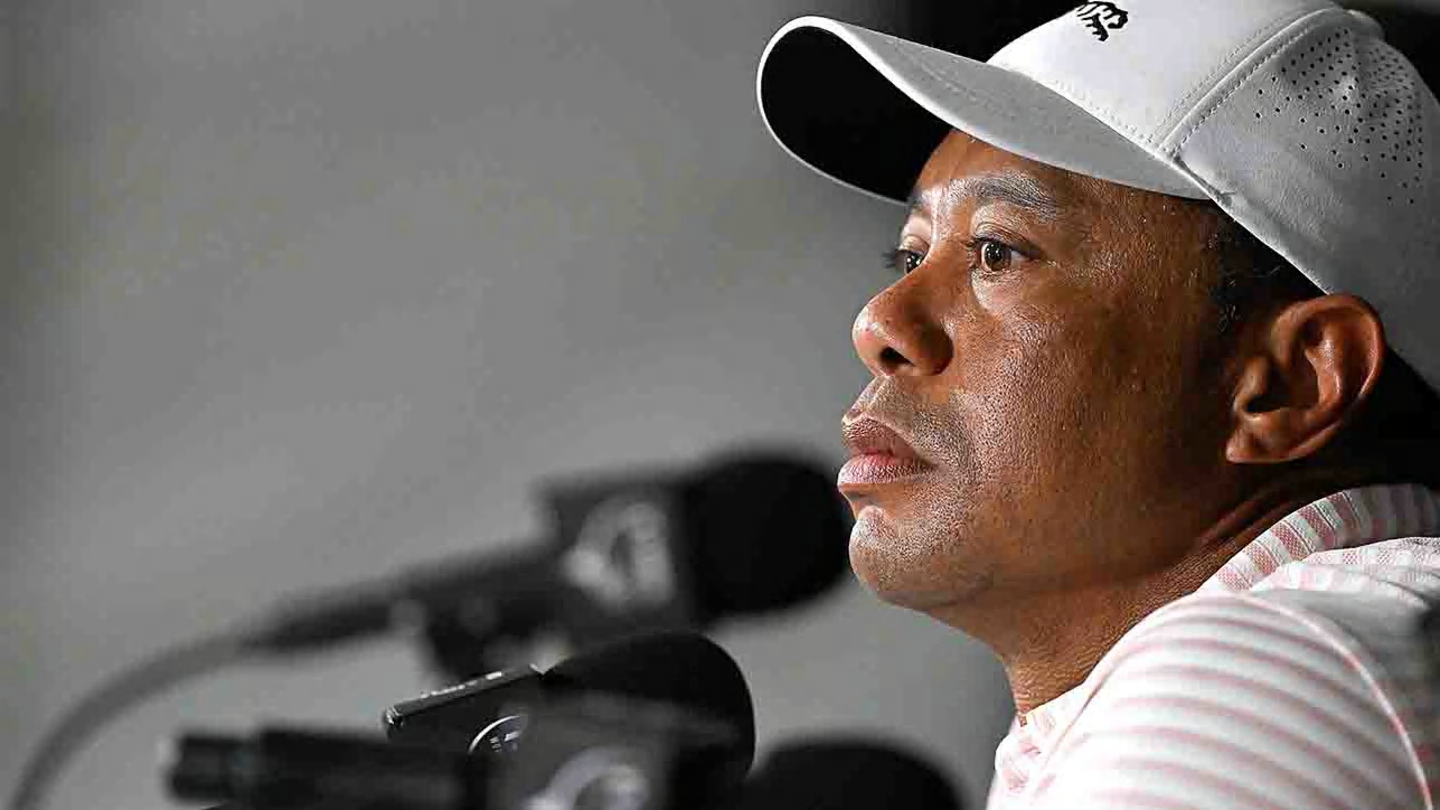
While he is uncertain of his own golf timetable, Tiger Woods has put a good bit of effort into a future schedule.
He may or may not be part of it, but it should shake up the way the PGA Tour has been presented for the majority of its existence.
Woods made his first public comments in months this week at the Hero World Challenge. It was the first time he’s been available since former NFL executive and new PGA Tour CEO Brian Rolapp appointed him as chairman of a new Future Competition Committee.
And it is becoming more clear that, perhaps as soon as 2027, the PGA Tour schedule will take on a leaner look, perhaps starting later than has been customary.
SI Golf Newsletters. Sports Illustrated’s Free Golf Newsletters. dark. Sign Up Now
“This is fan based,” Woods said at the Albany Resort in the Bahamas, where the Hero World Challenge began Thursday. “We’re trying to give the fans the best product we possibly can, and if we’re able to give the fans the best product we can, I think we can make the players who have equity in the Tour, we can give them more of that. So the financial windfall could be fantastic for everyone who’s involved.”
Undoubtedly money is at the root of this. Woods was uncharacteristically forthcoming about those aspects. Whether or not this benefits golf fans will have to play out.
A shorter schedule might make for a better commercial product, one that sells better to sponsors and TV media rights partners. It’s unclear whether fans would like waiting until after the Super Bowl—an idea that’s been floated—to watch the first PGA Tour event of the year.
But it’s clear this is a new PGA Tour world. Private equity money has come into the sport via the Strategic Sports Group, which expects a return on its significant investment. Player equity shares totaling more than $900 million are also part of the new for-profit enterprise.
Getting that kind of money back will require changes. Some may be jarring.
Rolapp said in remarks at the Tour Championship that he hoped to enhance the competitive product through scarcity, simplicity and parity. The latter attribute he believes the PGA Tour already possesses.
But the Tour has a long, never-ending schedule and the way it has crowned its season-long champion via the FedEx Cup has changed multiple times, sometimes in a complicated matter.
Streamlining the schedule so that the events mean more and so there is a more discernable path to a season-long champion appear to be part of the discussions.
Tommy Fleetwood won this year’s Tour Championship at East Lake, an event that may soon be overhauled. / Jared C. Tilton/Getty Images
A few weeks ago, during the RSM Classic, PGA Tour veteran Harris English surprised many with his comments that he believed the Tour was looking to cut the number of events to 20-22 (outside of the major championships) and wait until after the Super Bowl to begin.
“If you dig deeper into what he said, it’s not that complicated,” Rolapp said last week during a CNBC Council Forum in Palm Beach Gardens, Fla. “Competing with football in this country for media dollars and attention is a really hard thing to do. … The majority of golf is played in the summer and gets people’s attention, so looking at schedules that optimize that calendar is certainly something we talk about.
“Part of professional golf’s issue is it has grown up as a series of events that happen to be on television, as opposed to, how do you actually take those events, make them meaningful in their own right, but cobble them together in a competitive model, including with a postseason that you would all understand whether you’re a golf fan or a sports fan.”
And, apparently, how to do you do quickly.
The schedule is done for 2026 and it will look much like it has in recent years, starting next month at the Sony Open due to the cancellation of the Sentry due to golf course watering issues.
There will be eight Signature events and the usual way to qualify for them but it hasn’t been determined if the Tour Championship will conclude as it did this year with a single stand-alone event to determine the winner.
But 2027 is definitely in play for change.
“I think that the Tour is having to constantly evolve into what the golf world is becoming. I really love the fact that we’re not waiting, like this isn’t like we’re changing in three years, four years,” said Keegan Bradley, who is playing the Hero event. “Like no, we’re doing this next year (2027). And I think Brian has a really clear vision of what we’re going to do. . . .But I really think it’s great that we’re like acting like right away instead of this is what we’re thinking down the road. I think Brian’s trying to make changes right away and he’s definitely got a great vision to make the Tour as best as it can be.”
Woods said the committee had already met three times and he had plans for more talks during the Hero week.
Paring the schedule down won’t necessarily be easy. There are 34 weeks, including majors, in the FedEx schedule from January through August now. Getting down to even 26 weeks means cutting out eight tournaments.
How is that accomplished?
It’s unlikely the Tour would want to give up the Waste Management Phoenix Open, and its annual party on the 16th hole. / Diannie Chavez/The Republic / USA TODAY NETWORK via Imagn Images
Starting after the Super Bowl would help but there are some long-running events during that timeframe, including Torrey Pines and Phoenix, that would seemingly be priorities for the Tour to keep. Perhaps they can be moved to March if there are plans to cut out a Florida event or two. Maybe there will be off weeks worked in, perhaps after the majors.
And how does all this work with the strategic alliance the Tour has in place with the DP World Tour, which just got a 10-year sponsor extension from DP World?
“The scarcity thing is something that I know scares a lot of people, but I think that if you have scarcity at a certain level, it will be better because it will drive more eyes because there will be less time,” Woods said. “But don’t forget the golfing year is long. So, there’s other opportunities and other places around the world or other places to play that can be created and have events.”
That suggests the Tour might be willing to co-sanction some events around the world, but how that fits into the overall schedule is unclear.
Woods did not get any questions about the Public Investment Fund, which backs the LIV Golf League, or the negotiations that he joined early in the year that have gone dormant in recent months.
Rolapp was asked about the situation at the CEO Council Forum and specifically about Bryson DeChambeau, the two-time U.S. Open champion who plays for LIV Golf and is one of the game’s most popular players.
Bryson DeChambeau, who played on the recent U.S. Ryder Cup team, remains a popular draw. / Brendan Mcdermid-Reuters via Ima
The new CEO said he has had discussions with LIV representatives but did not offer specifics. He did say that he only favors a deal that makes the PGA Tour stronger.
“Every sport has stars, but what really makes sports work is really the middle class,” Rolapp said. “So, in my old job, sure, we put the Kansas City Chiefs on primetime as much as we can, but that’s not why the NFL was so successful; it was because when the Bengals are good, you watch, and when the Lions are good, you watch. The middle class matters. You cannot build a lifelong sport that outlives your stars if you don’t build a system that works beyond your stars.”
The counter to that: a smaller schedule will deprive the middle class of playing opportunities. Especially if the limited field Signature events continue.
All of which means there is plenty of work to do.
“Hopefully we get there, hopefully we get to that point,” Woods said. “We’re working with all of our partners to create the best schedule and product to deliver all that in ’27 is something we’re trying to do. I don’t know if we can get there, I don’t know if we will get there, but that’s what we’re trying to do.”