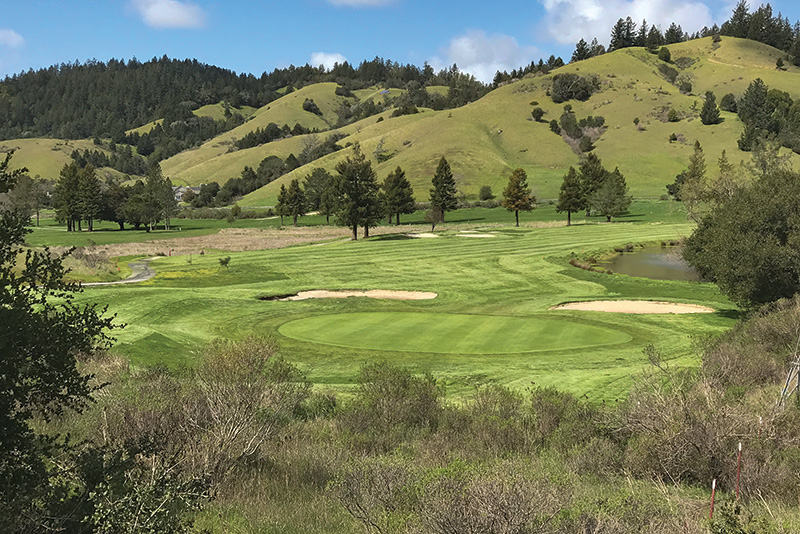
A view of the 18th hole at San Geronimo Golf Course in San Geronimo, Calif. Built in the mid-1960s, the course struggled financially and was put on the market in 2017. Photos by Craig Zellers
There is an old saying, “They say that you can’t go home again.” I did when I purchased the family home in 2005. But what if you had two homes? One that you grew up in and the second being the first golf course you ever worked at and called your home course and you had the opportunity to be the superintendent?
Upon telling numerous longtime clients that I had created a part-time superintendent position for myself, they responded with laughter and shakes of the head (not the vertical “yes” shake, but the horizontal “no” type). The negative nonverbal glare was followed with questions: “Are you kidding me?” and “Are you an idiot?” My answer remained the same, and I could only smile as I answered the questions: “No and yes.” I had come home a second time to the San Geronimo Golf Course.
Beginning on April 7, 2018, I had the miraculous opportunity to oversee the San Geronimo Golf Course located in northern California, only 4 miles from my home in Fairfax. “San G.,” as we called it, was a healthy, beautiful golf course that I had called my home course since 1975. On Dec. 29, 2018, I had the ill-fated experience of watching the commencement of a golf course dying a slow death. It was only slow because it was winter in northern California, and the rising temperatures of spring and summer had yet to begin permanently sucking what moisture was left from the roots of the turf.
Despite the greenness from the winter, my experience pierced my thoughts until I succumbed to the sadness of the inevitable. Deep down, I knew that it would be my obligation to “pull the plug” and shut down the irrigation system. Turning off the lifeblood of an irrigation system at the pump station is not an uncommon occurrence in the golf industry. However, to do so knowing that it is the last time you will pull down on the breaker generated emotions, so I chose to do it alone in June 2019. No friends, family or past employees could have changed what I knew. I wanted to do this alone, with my memories, as I sat on an outlet pipe in the small, clean pump house located in pull-hook territory left of the lake on hole No. 18.
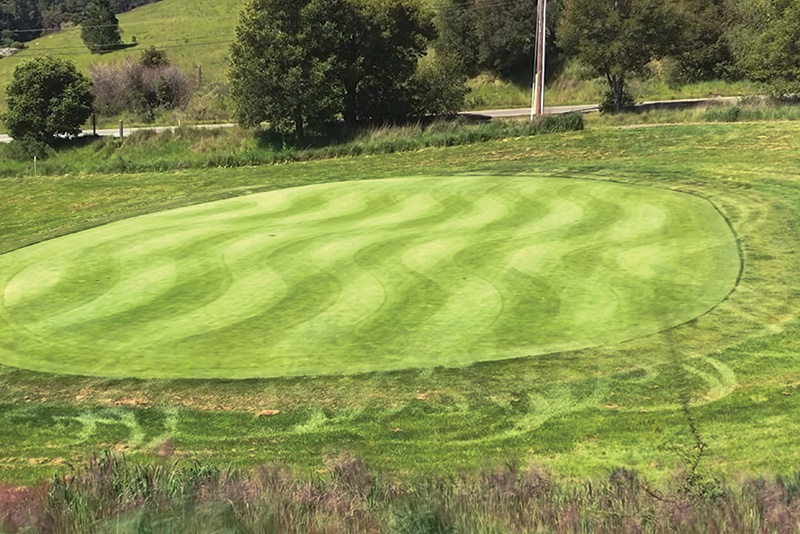
The practice putting green in 2017, before the course began its slow decline.
The beginning of a life in golf
San G. was where my junior high P.E. coach, Mr. Berwick, first took us seventh graders who were interested in golf. He told us to bring clubs and balls and show up at San G. the next day after school. After rifling through my dad’s old golf bag, I brought two or three clubs and a golf ball.
Mr. B quickly noticed my equipment and had an exaggerated eye roll for me. I did not know why until I looked at the other students with sterling-clean golf bags full of golf clubs. I remember wondering, “Why do golfers need more than a few clubs?”
I enjoyed being on the golf course and ended up washing carts and picking up balls on the driving range. I worked as a busser for clubhouse banquets, and San G. was where I wanted to be whenever I was not in school.
The superintendent took a liking to me, and I began working on the maintenance crew for the salty, tobacco-spitting tough guy, Earl Thompson. On a few chilly winter mornings, Earl would give us a sip of whiskey, shove the maintenance door open and send us on course to perform our morning chores.
I loved the smell of mowed turf and diesel and the sculptured look of different golf holes prepared for golfers who seemed to never get enough of the game. On one occasion, I found Earl dressing a dead deer in the bowels of the maintenance office. The legality of the deer obtainment was unknown, but feasting on my first taste of venison by lunchtime was a treat that I will always cherish.
I worked at San G. until 1983, when I left for San Diego State University for a degree in business. The business of golf never left my thoughts, and I knew I could use golf to get through school. My goal was simple: Obtain my degree and continue working on golf courses.
I was fortunate to have been introduced to Dave Fleming, the superintendent at Singing Hills, who produced many superintendents who remain in the industry today. I thought that I had no chance to work on this 54-hole resort given my full-time school schedule. But Dave hired me immediately after telling me, “School is more important, but we have a weekend crew, and you can work any days and times that you are not in class.”
I was off and running, learning how to maintain a golf course and sprinting toward a couple of superintendent positions, including building the Real Del Mar course in Tijuana, Mexico.
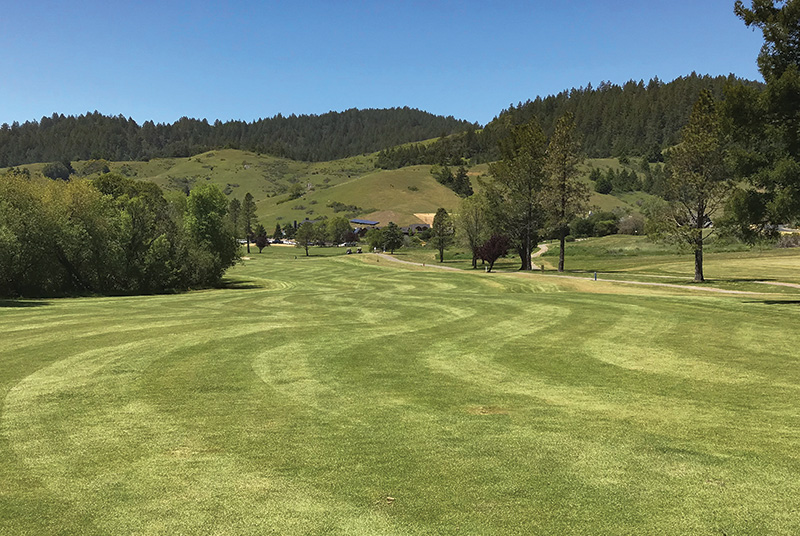
No. 10 fairway, showing the author’s preferred mowing pattern.
Course closed
In November 2017, the San Geronimo GC was purchased by the county of Marin and the Trust for Public Land (TPL) with the agreement that the county would find funding and purchase the course from TPL, who fronted the $9-million purchase price. The county’s goal was to close the course and re-wild the land.
Overnight, San Geronimo became a source of contentiousness as word quickly spread that the county was closing the golf course and it was to be minimally maintained. In December of 2017, pressure from golf enthusiasts forced the county to agree to lease the golf course for a period of two years to a golf management company that would keep the course open and provide time for the county supervisors to decide the best course of action.
Touchstone Golf, a company I was familiar with after having worked on numerous properties in my own irrigation consulting business, ended up with the contract. In a brief meeting with the CEO and VP of Touchstone, I presented them with my plan to be their part-time superintendent. My pitch was unassuming and modestly thought out, but I knew it did not have a guaranteed outcome.
Their first response was as I anticipated: “We have never hired a part-time superintendent.” They listened as I informed them that I only lived 4 miles away and that with only a two-year lease agreement, housing in the Bay Area was going to be costly for a qualified person to come in for only two years. In addition, I told them, “I do not need a vehicle or insurance,” and I used to be a Certified Golf Course Superintendent. I concluded by mentioning that when my golf irrigation consulting business road work was required, I would be gone anywhere from one day to two weeks.
Under the circumstances that I presented, we immediately reached an agreement, and once again, I was a golf course superintendent. Shortly thereafter (within an hour), I questioned my own rational judgment.
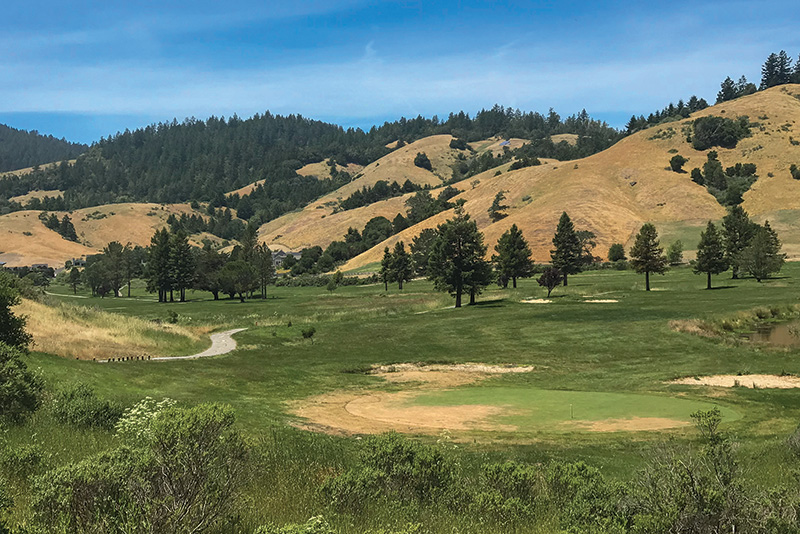
This is the same view of No. 18 as on page 44, but after the course started to deteriorate.
Wait! What?, Why did I do this?
From that April 7 date, we had one week to prepare a golf course that had been closed for over four months. A county Park & Recreation supervisor had been on-site overseeing two people from the previous maintenance crew. Mowing was the only constant necessity they had tried to keep up with. There were bunkers to clean, cups to be cut and all the countless duties all superintendents and their teams perform every day of the year.
The suddenness of dealing with employees, working with clubhouse staff, paying bills and hosting golfers brought a jolt of reality to my world. I ran my business out of the maintenance facility and settled in. I garnered my pesticide applicators license for the second time, and with that I was, once again, a Class A member of GCSAA.
I could not have been luckier. Masters tournament, here I come! No. 5 tee was outside of my office, and it beckoned me to tee it up and hit balls down the fairway, sit on the bench and sip on a beer. I appreciated the environment and always felt at home and appreciated my good fortune every day.
‘It ain’t over till it’s over’ (Thanks, Yogi)
The golf community was still irate from the four-month closure and the potential for permanent closure in two years. Thousands of signatures by golfers and even non-golf community members led to a ballot measure in November. Measure D, if passed, would keep San G. as a golf course. The “No on D” backers spewed ignorant remarks on mailers accusing San G. of being toxic from pesticides and a waster of water. Their biased remarks also referred to golf as being a “rich white man’s sport.” As much as I wanted to fight their words with the truth, I refrained after the president of Touchstone Golf said, “It is not worth fighting with people who believe only in their truth.”
By a small margin, Measure D did not pass and consequently reinvigorated the desire of Marin County to close the course. Like an angry toddler who grabs his toys from the sandbox and goes home, they exercised their right to cancel the lease with a 60-day notice to Touchstone Golf. On Dec. 18, 2018, San Geronimo closed again, and permanently. Every staff member was let go.
When I was on a golf course job in southern California, Touchstone called me and said that TPL needed a property manager and asked if I was interested. Yes! I was back again and now without almost all employees and the sleep-depriving nuances that come with maintaining turf that wants to die every damn day of the year.
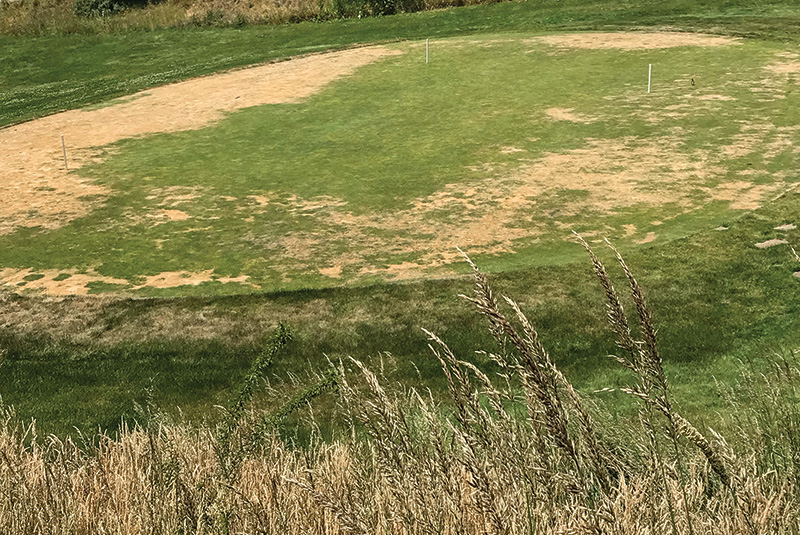
San G.’s practice green, two weeks after the irrigation system was shut down.
Reality, aliens and beer
With two other crew members, we tried to maintain the 156 acres of turf and clubhouse landscape. TPL encouraged the community to use the cart paths for walking, biking and enjoying the hills and scenery. It was inevitable that the end was near for the two guys left working with me. The clubhouse was deserted and reminded me of a movie about a western town where aliens swooped in, took the townsfolk and left every spiritless object in place. We would head to the clubhouse late in the afternoon and pour ourselves a draft beer.
Although the beer taps, the bar, stools and everything that one might see in a typical clubhouse were inanimate, the beer kegs were alive and provided, for that period, some small respite from the deterioration which we were witnessing and unable to prevent.
All by myself
The end for my two guys was near. One of them had worked as the mechanic at San G. for 30 years. When I heard that a nearby course in San Francisco managed by Touchstone needed a mechanic, I drove him over to meet the superintendent, and he was offered the position, and it was for much higher pay than at San G. I took him aside and told him, “Take this job and take it now!” By early June, TPL told me to turn off the water and cease all maintenance of turf. The last hourly guy was soon gone.
I was the one remaining caretaker of San G. with the role of an independent property manager. I paid the bills, arranged for clubhouse repairs and occasionally cut trees that had fallen on cart paths now used by dog walkers, bikers and me. Nobody, except for a faint few, knew my history at San G. I put out trash cans on various golf holes where the dog owners would put their bags of waste. Was this effort easy? Yes, and I was appreciative to have such a simple position that helped pay for the kids’ college and was fix-up-the-house money.
The mowers and about everything else used to maintain the course were sold. I had them purchase a 6-foot flail mower, which was invaluable and used to mow what was left of the ryegrass that was mixed with thistle and every weed imaginable.
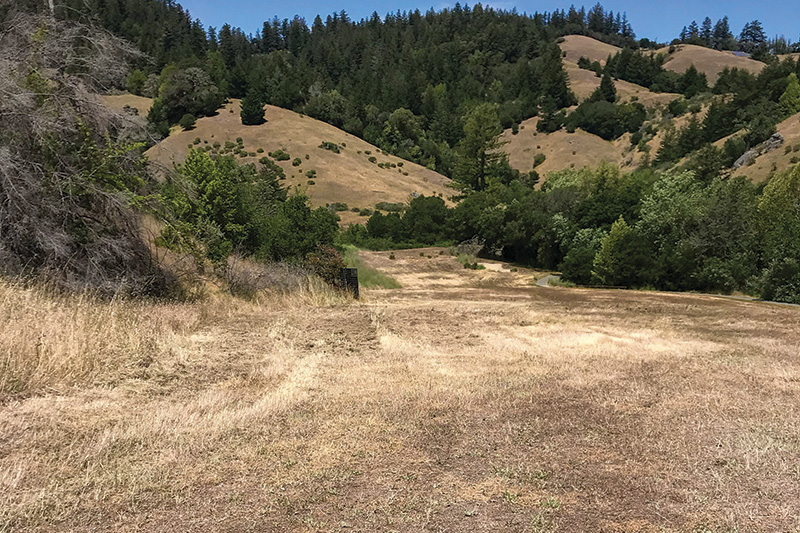
It didn’t take long for the course, once the irrigation system was shut down, to wither.
Eulogy for a golf green
My site visits entailed driving the property in a Toro Workman. As spring turned to summer, what was left of greens, tees and fairways rapidly succumbed to the forces of nature and died. One day I walked onto what is No. 16 green. This green had been a challenge, but I had nursed it to respectful condition and occasionally asked the green what it needed from me for it to be as healthy as some of its 17 other course mates.
After only one month without irrigation, the soil was cracking, and gophers had made it their home. I felt sad, and, without planning a eulogy, I found myself saying aloud to what was left of the sparse green Poa annua: “I am sorry, No. 16 green. I tried. We both tried. This was not my idea.” Those words resonated in my mind for weeks, and I should have gone into the golf shop, turned on the loudspeaker and said that to everyone who could hear me. Would it have changed the outcome? “No,” was my internal answer, and I unplugged the loudspeaker after being the last person to have ever spoken into the once-lively microphone and said something like, “Zellers foursome, now on the tee.”
After the closure, a scant few told me that I should look at San G. as if I was looking after my sick child. The demise of San G. brought emotions that were deep, and with no trepidation, I responded and informed them that I felt like I was the caretaker to my sick and dying child. As morbid as it may sound, it was my own way of accepting the death of a golf course that I will always cherish and consider my home.
During COVID, the Marin County Fire Department rented the clubhouse with the intention of using the 40,000-square-foot space as a place to spread out and to decrease the risk of spreading COVID. They liked the property so much that after four years of use, they wanted to purchase the clubhouse and the 155-acre property. The purchase deal with TPL closed in May 2024. The county had plenty of its own resources and my memorable, self-serving position ended.
I began drafting this article four years ago to share my myriad feelings with the golf industry. Now I realize I finished it for inherently selfish reasons. It is my way of dealing with my sadness while simultaneously stowing away my fond memories of the golf course, the people I worked with and my career in golf those experiences have provided.
We all eventually learn in life that there is a beginning and an end to everything, and there is joy and disappointment. Without some negative, the constant positive would be expected all day long and would go unappreciated.
I appreciate and miss my friend San Geronimo. I know where it remains and will always visit to say hello and, “Thank you for introducing me to the wonderful world of golf.”
Craig Zellers, a GCSAA Class A superintendent, is a principal owner of Golf Irrigation Consultants. He is a 37-year member of GCSAA.