Our 62-ball robot test revealed a shock standout – a two-piece ball that out-spun dozens of premium models and delivered tour-like iron control… for half the price of a premium model.
Every year, we undertake the biggest and most comprehensive golf ball test in the industry. And every year, it highlights one or two models that perform much better than expected. But this time, one golf ball didn’t just exceed expectations – it embarrassed half the premium golf balls in the test.
It’s a low-profile, low-price, two-piece design that sits quietly on the shelves while golfers load their bags with Titleist Pro V1s, TaylorMade TP5s, and Callaway Chrome Tours.
But when you look at the numbers coming off the $100,000 swing robot in our test, it didn’t just punch above its weight – it absolutely crashed the party.
 How we tested the golf balls
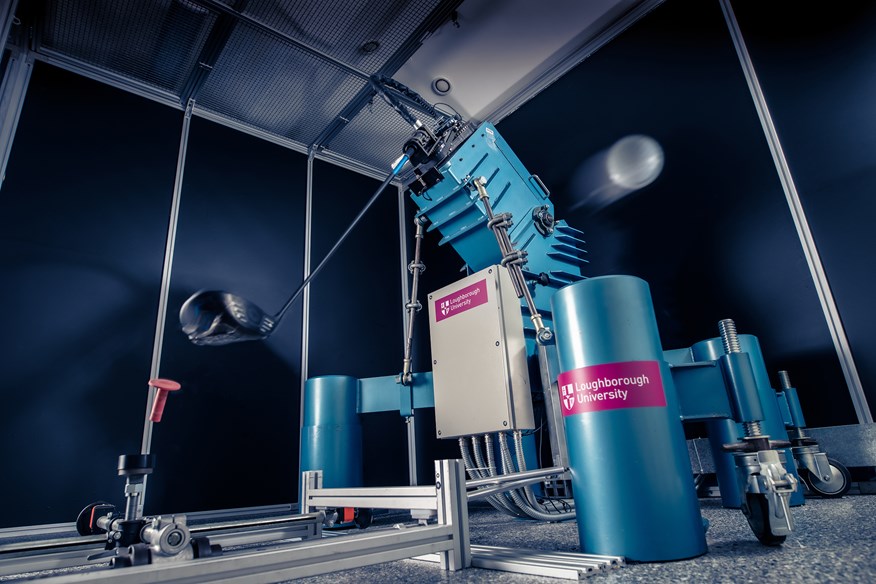
We put 62 golf balls through a series of wedge, iron, and driver tests on a $100,000 swing robot.
This machine delivers exactly the same strike every time, which means the only variable in our test was the ball itself.
We tested every ball across five different shot types to get a complete picture of how their performance stacked up:
114mph driver – PGA Tour average
93mph driver – LPGA Tour and typical male club golfer
78mph driver – average female club golfer
7-iron – 80mph, which is club golfer average
56° wedge – hitting a 40-yard pitch shot
What is the most underrated golf ball of 2025?
It’s the Mizuno RB 566.
I’ve never thought of the RB 566 as a “performance” ball. It has sub-100 compression. It doesn’t have a urethane cover. It isn’t used by any tour players. It’s rarely recommended in ball-fitting chats.
So when the robot delivered its results, I genuinely had to double-check the label.
On a 7-iron, it produced:
4,947 rpm of spin – the fourth-highest of all 62 balls tested.
A 45.3° descent angle – joint-highest in the entire test.
Carry and peak height numbers that looked identical to true tour balls.
Those are elite, tour-style approach shot numbers. Not “good for the price”. Not “decent for a two-piece”. Just flat-out impressive.
On a 40-yard wedge shot, it delivered:
5,960 rpm – which placed it 17th of all 62 balls.
It generated more spin than the Titleist Pro V1 and Pro V1x, Srixon Z-Star and Z-Star XV, Bridgestone Tour B X and Tour B XS, Callaway Chrome Soft, and the PXG Tour.
That’s a seriously impressive list of scalps for a two-piece ball. And remember: all of those balls cost more than twice as much as the Mizuno RB 566.
A dozen will set you back just $21.97!
Pros & Cons
Pros Great short-game spin and controlUnbelievable valueSolid performance from tee to green Cons Struggled to reduce spin off the tee on the course How the Mizuno RB 566 stacks up on irons and wedgesMetricMizuno RB 566 ResultTest RankingWedge spin5,960 rpm17th of 627-iron spin4,947 rpm4th of 627-iron descent angle45.3°T1 of 62
These numbers alone should have golfers paying attention. But golfers also want a ball that delivers strong performance off the tee, so let’s talk driver numbers.
Driver performance at all three speeds
This is where the RB 566’s story gets more nuanced – but still interesting.
It isn’t a bomber. It isn’t built to be. But its driver performance is solid, predictable, and absolutely playable for the golfers it suits.
Here’s what the robot found…
Driver performance: 78 mph swing speed
The Mizuno RB 566 was 3.4 yards behind the test leader at this speed, but only 1.2 yards off a place in the top 10.
It launches slightly higher than average, which will suit golfers with slow swing speeds who sometimes struggle to get enough height on drives, and sat close to the middle of the pack for spin – giving it enough to keep drives airborne, but not so much it balloons and goes nowhere.
It’s not the longest, but it’s a very solid performer.
Driver performance: 93 mph swing speed
At this middle-of-the-road swing speed, the Mizuno RB 566 sits right around the middle of the pack. Again, not a distance monster, but less than three yards behind the longest ball at this speed.
Spin was moderate, launch was ideal, and nothing in the numbers gave cause for concern.
Driver performance: 114 mph swing speed
At high swing speeds, you start to see the Mizuno RB 566’s limitations: it gave up 6.8 yards against the longest ball at this speed.
That said, it was still longer than premium models like the Bridgestone Tour B X and Tour B XS, and the TaylorMade TP5, and was only 4.1 yards off the top 10.
Realistically, the Mizuno RB 566 isn’t for the very small fraction of golfers blessed with a 114 mph or faster swing speed. It’s for normal golfers, swinging 75-95mph, who want decent driver distance and great control into the greens without paying tour-ball prices.
 What’s the catch?
The Mizuno RB 566 was one of the shorter models when it came to iron distance. It carried 154.8 yards, which was a little below average and almost six yards behind the longest.
But the longest balls when it came to 7-iron shots were all low-spin, distance-focused models – the kind that fly a long way but struggle to hold greens.
The RB 566 sat right among the tour balls for this metric – delivering reasonable distance but fantastic spin. Most golfers would be willing to forego a couple of yards of iron distance in exchange for a lot more spin and stopping power.
So why does nobody play it?
After digging into the data – and thinking about golfer psychology – I’m convinced it comes down to three things:
1. Zero tour validation
Golfers love playing what pros play. Mizuno golf balls have a much lower tour presence than Titleist, TaylorMade, and Callaway – and the RB 566 has absolutely none.
2. It looks a bit weird
That 566-dimple design looks unusual and, for some reason, a bit cheap.
3. Mizuno are known for irons, not balls
If this ball had a Titleist or TaylorMade stamp on it, I suspect you’d see far more of them in play at golf clubs around the country.
Should you try the Mizuno RB 566?
In my opinion, the RB 566 is the most underrated golf ball in the entire test. It beat some of the world’s biggest names on the shots that matter most, held steady on driver for the swing speeds it’s actually designed for, and proved that performance doesn’t always come wrapped in urethane.
If you’re happy with your current ball or have no issue paying premium prices for best-of-everything performance, there’s no reason to switch. But if you’re looking for a hugely underrated, incredible value-for-money option, and you’re willing to try something outside the usual suspects, this is the ball I’d put in your hand.