
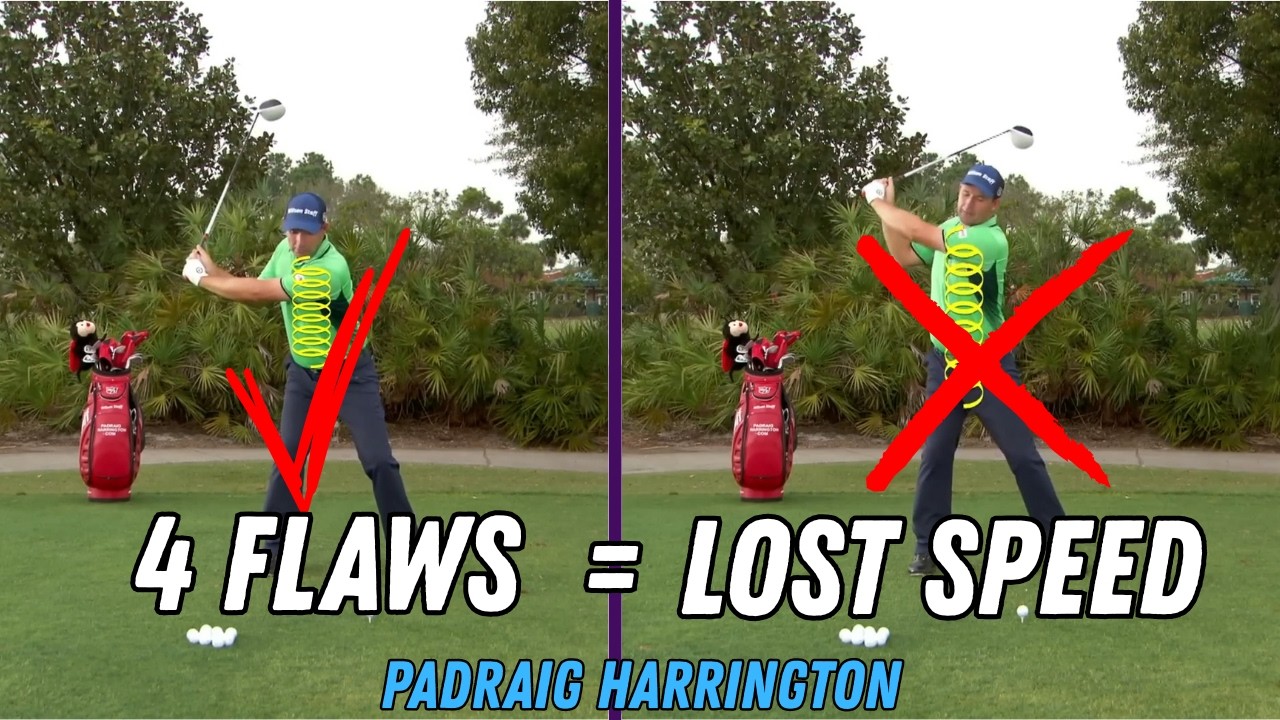
Padraig Harrington breaks down the four biggest swing flaws he sees amateur golfers make every week — especially players who’ve been told to “keep your head down” or “stay still.”
In this energetic lesson, Padraig shows why those old-school ideas destroy your rhythm, power, and swing speed, and how to fix them the way tour pros do.
If you’re over 50 and want to reclaim lost distance and hit the ball with effortless speed, this is one you’ll want to watch to the end.
⛳ What You’ll Learn:
Why staying still kills your rotation
The truth about “keeping your head down”
How pros create rhythm and coil without tension
What “lifting in the backswing” really does to your accuracy
👀 Next Video in the Series: Padraig Harrington on How to Train Swing Speed (coming soon)
#PadraigHarrington #GolfSwingSpeed #SeniorGolf #GolfMistakes #GolfTips #LowerMyHandicap
HACKMOTION DISCOUNT CODE: my favorite golf aid:
The Hack Motion (5% off with link): https://hackmotion.com/?aff=136
This is what I see when I play every week in the proam, my amateurs, what I see going wrong. One, don’t try and stay still. This is the worst thing you could try and do. Somebody who tries to stay still in in the golf swing will actually probably go forwards as they go back and when they try and hit it, they’ll be going backwards. Don’t try and keep your head down. If your head goes down, it’s going to get in the way. Terrible idea. Let your head float in the golf swing. You wouldn’t try and keep your head still if you were swinging a a baseball bat. You wouldn’t keep your head still if you were throwing a punch. Why would you keep your head still playing golf? Okay, next thing is professional golfers actually swing the club back three times faster than amateurs. So, the rhythm of the back swing really helps the club set. You don’t go real slow. This isn’t going to help you. So, a nice rhythm in the back swing. Allow your head float. Don’t try and stay still. Don’t keep your head down. And lastly, don’t lift in the back swing. People always want to make a bigger back swing. They think that’s going to equate to more power. That’s okay if you’re supple. But if you get to a point in your back swing where you you’ve you’ve got a tight coil, don’t lift past that. The minute you lift your arms and your body stretches like this, you’re going to lose all your power and your accuracy. So, you got to stay within yourself. And what you will see, especially with pros, when they’re taking practice swings in a in a static environment without the ball, they only ever swing about that long. They don’t make a big swing in the back swing because we don’t want any of this lifting. Okay? So, nice and tight in the back swing. Good bit of rhythm. And I would recommend to people at home in their garage during the winter, you know, years ago, if you were watching Hogan, they had lovely waggling going on. Their feet were were dancing. They were moving and they hit that back swing with speed and that got the club lovely to hinge up here on plane. They got a lovely wrist because of the speed of the back swing. So, get that nice rhythm going. Allow yourself move. Essentially, as you turn, your turn shifts your weight. And as you can see, it shifts my head a little bit to this side. I don’t need to move my hips over here. I just need to turn my body. And once my body turns, you can see I’m going to that is actually going to turn into a full golf swing when the golf ball is there. See how it gets to parallel. When when you’re doing that, Podrick, I mean, certainly I love the idea of the movement. No question. Are you still mindful of keeping the eyes somewhat on the back of the ball, though? Absolutely. Like all sports, it’s a good idea to look at the golf ball, but it doesn’t mean you need to keep your head still. I can still see the golf ball as I move my head. It floats. But it’s the same as, as I said, if you were hitting a tennis ball, you wouldn’t try and keep your head still. If you were hitting a hockey puck, you’d still see the ball, but you wouldn’t keep your head still. We don’t want it that fixture there. It will actually hurt your neck. It will hurt your back if you try and keep it still. We always want to have that big follow through. But, you know, if you’re getting a bit older, that’s going to put a lot of strain on you. So, do as Gary Player does, and when he’s on the range, if he hits it and he steps over that left leg, that’s to take the pressure off his follow through. We want that big follow through. So, I’m going to copy Gary Player here. Okay. You’ll see a nice bit of movement in the back swing. [Music]

11 Comments
Trying to hinge the wrists and get a square club face seems really difficult.
I want this man as my coach.
THe speed of the backswing is a great tip.
Paddy a great teacher
What about hitting irons, same advice?
I can 100% understand what he is talking about. I just can’t do what he says….
Totally disagree
Thanks for checking out the video! Padraig broke down the 4 flaws he sees all the time — curious which one hits home for you.
Comment your “#1 flaw” and let’s see which shows up the most!
Sungjai Im may disagree with your take on the backswing Paddy
3 times
Basically i'm swinging too fast but i need to make sure i swing faster. Got it.