
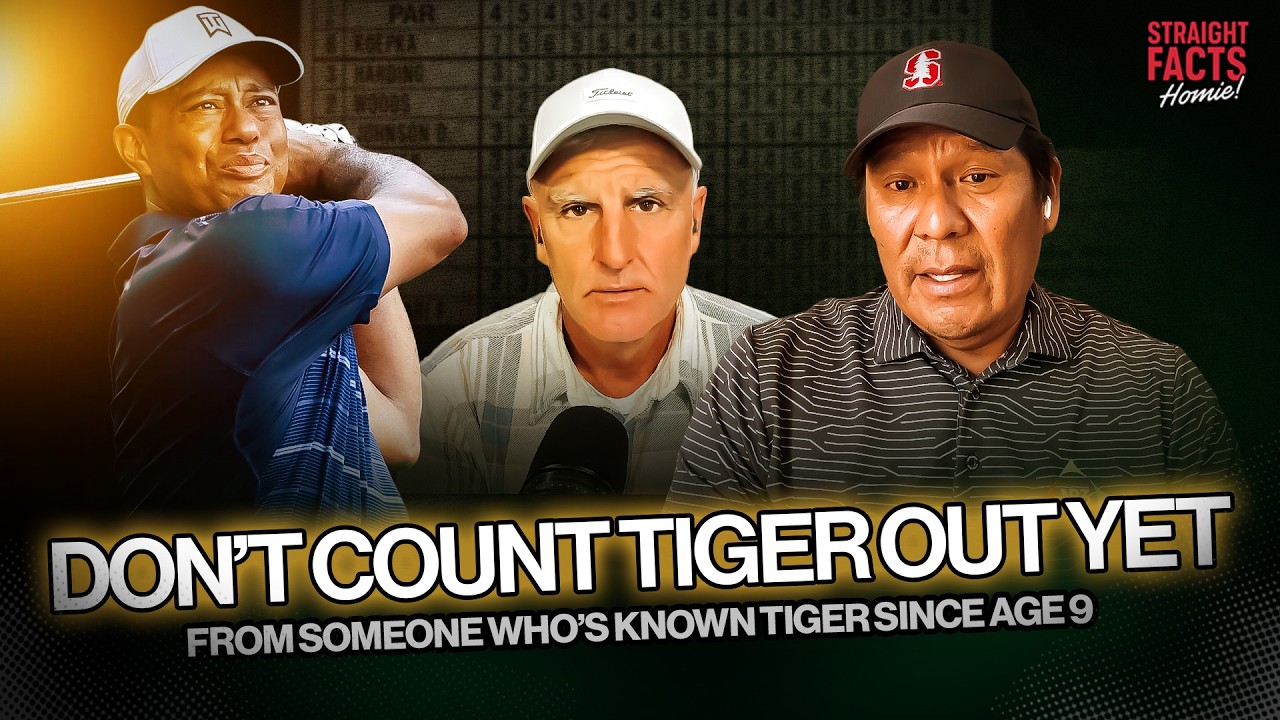
Don’t Rule Out a Tiger Comeback — Notah Begay Explains Why
How important do you think 83 is to him? Because, you know, the other number everyone always talked about with Tiger was 18. Jack’s 18 majors, he has 15. Uh, obviously that’s always been his stated goal, but he can’t get three more. How important do you think that number is to him? I think that’s probably the more tangible one at this point in his career. The cherry on top would be as if it would be another major and it would be 83. We still wouldn’t get to 18, but I still do think in a perfect world, maybe Tiger could do it. Ben Hogan did it on on one leg. You know, maybe Tiger could do it, too. [Music] Hey everybody, Trey Wingo here. Thanks for being with us and welcome in to another episode of Straight Facts Homie, the podcast where we try to use data and analysis to tell you how things are going to happen and why they did happen. Plus, we have great conversations with great guests around the world of sports. Uh, if you like what you’re seeing here, and we hope you do, pleaseick click that like and subscribe button wherever you’re getting this podcast, especially on YouTube. It really helps us get out to more people and they find the product. You know, one of the more interesting names in golf over the last 20 years has been someone who’s been sort of Tiger Woods affiliated. Uh, it’s not Beay. Not Beay grew up playing alongside Tiger in junior events. uh was a partner of his on the RDER Cup, won several times on the excuse me on the President’s Cup, won several times on the PGA Tour. So, we took this opportunity to sit down with not to talk about is it possible that Tiger can still be competitive, what are his future plans, what are the plans of the PGA Tour, and also his journey into golf, which is very, very unusual and unique. Please sit back and enjoy the conversation here with Not Beay. Not thanks for being with us. Um, you know, we’ve had a lot of people in golf come on over the last couple of months, and I always start with this question, and I’d like to get your thoughts on it. I I feel like, well, let me put this way. How how important do you think the 2025 season was for the PGA Tour in relation to everything that’s gone over the last couple of years? Uh, I think it was a a paramount season for the PJ Tour for a number of reasons. Number one, it clearly established itself as the premier uh collection of golf talent in the world. Um, regardless of name recognition, regardless of, uh, pedigree in the in the sense of some of the players that defected to live did take with them quite a bit of championships and majors. But, um, I think what the general public and the golf fan did establish is that they want to see golf that matters. they want to see golf that in certain cases the results change lives that um people are legitimately crying on the 18th green with their families because it’s something that they’ve envisioned since they were 10 years old and um so it was great in that and then second part of that is that it was great to establish the tour um the tour’s identity without Tiger I think that that that’s a huge thing you know there’s There’s life before Tiger, there’s life with Tiger, and then unfortunately the tour didn’t do a great job of planning for life after Tiger. But luckily things worked out where um the the players and the results and and everybody that sort of makes up the body of of what the tour represents as a as a product um is is is great greatly valued in the marketplace. Yeah, we’re we’re Hold on to that tiger thought. We’re going to get back to that in a second cuz I’m not sure people totally understand the connection between you and Tiger in full. Um, but how important was it for them to have that Paramount season based on, you know, there had been a couple of body blows with with Liv taking away those guys. How not only was it paramount, but how important was it for the tour to find that footing? It was incredible. And it didn’t hurt that Scotty Sheffller was Yeah. Albeit he he’s not the perennial superstar that people want him to be. um he sort of um goes about his business, likes to fly under the radar as much as a number one can and but when he starts doing things that only one other player in history has done, you have to watch. And so he created must-see TV on golf again, not because of his courageous uh recovery shots or his fist pumps or just the fact that um you know he transcended the game so to speak. That was that was Tiger’s era. This is the Scotty Shefflla era in the sense where he’s just doing where he’s just beating you and everybody else in the game with just some of the best golf that we’ve ever seen. Yeah, that’s a really interesting way to put it because I think they’re the two most dominant players over a certain amount of time we’ve seen, you know, this century. But I think the way they’ve done it is very different. With Tiger, it felt like you get these thunder strikes out of nowhere and suddenly go on this incredible tear and these one or two incredible shots would define it. where I feel like Scotty Sheffller’s the definition of that, you know, if you just let water drip on a rock over time, it eventually wears it down. And and I feel that’s Scotty’s superpower. It’s not so much the miraculous shot of the recovery. It’s just the incredible consistency and it doesn’t waver and eventually it’s that constant boom boom boom boom that just allows everything to dissipate. Yeah. And then just just the way that he goes about his business. Again, very understated. Um he’s not in every single commercial um on television. Really tries to maintain a bit of privacy with his home life off the golf course. So, you don’t see him doing a lot of of corporate um self-promotional type of things. He really wants to focus on winning, keeping his game sharp. And you know, one thing that I that I always tell I think that encapsulates what Scott Scotty Sheffller stands for is virtually every single week that Scotty Sheffller starts a tournament week, he starts one of his practice sessions using a grip trainer. Now, a grip trainer is a tool used by teachers to teach um 15, 20, 25 handicaps how to hold the club, right? uh a PJ tour player almost never uses a grip trainer because they’ve done it a 100,000 times. They don’t need to sort of figure out their grip, but it gives you just a little bit of insight into how he views the game. He takes nothing for granted. He starts each day as this fits square one again. And I think that’s what’s added to the consistent level of highlevel performance that we’ve seen from him is that every week that he starts out, he’s looking to sort of establish his presence um from the get-go. Yeah. One of my favorite sort of memories from Scotty over the last couple of seasons was the year he was in a duel with his good friend Sam Burns at Colonial. Uh and he was on the 17th or 18th hole and he’s getting ready to hit and he backed off and his caddy Ted Scott said, “Everything good?” He goes, “Yeah, I just wasn’t feeling it.” You know, and then he he went through the process again. And you know, I I think about that a lot when I play with my friends and I’m like, “Wait a minute. If the best player in the world needs to back off every once in a while because he doesn’t just wasn’t feeling it.” That’s a really good indication that maybe and I’m not advocating slow play. I hate slow play. But maybe the rest of us should maybe do that every once in a while just to make sure we’re we’re focused and in the moment. Well, I think Sean Connory said it best when asked in an interview why he liked golf. so much. And he says, “When you play golf and you try and do your best at golf, that’s the only place you can be. Um, you can’t be off thinking about another movie or an appearance or something related to your personal life. You have to be completely dedicated to that moment in which you are trying to execute that shot.” He goes, “Otherwise, you won’t you won’t be any good.” And the professional level of golfers do understand that that you know that two and a half seconds that it takes to execute a golf swing requires um quietness in the mind. And that’s what they’re all trying to do is they’re trying to quiet the mind down so that they can focus on whatever that particular swing key is, whatever shot they’re seeing in their mind and whatever challenges are actually being presented by the situation. You you mentioned Tiger and obviously folks most folks know, but in case they don’t, you have a real connection with him. You guys were teammates at Stanford and and you were the one that came up with his nickname when he was a freshman at Stanford, which was Urkl, right? That’s right. And we were playing Tiger and I have been friends since he was 9 years old, so over 40 years now. and we first sort of got to know each other at the uh what used to be the Optimist Junior World Golf Championships in San Diego. He was playing in my brother Clint’s age group. And I went to watch my brother, but then I’d been hearing about this kid who’d been winning tournaments by 15 and 20 shots. And I said, I’ve got to go watch this kid. And I got to run into a young Tiger Woods, age of nine, out there competing with older kids and beating older kids. And just the the pizzazz and the energy and the way that he went about his business was really captivating even at that age. And so after the round, I went up and introduced it introduced him myself to him and uh we became friends and we we would meet at junior tournaments along the way and we would stay together and um Earl was always traveling with him. Um and my parents couldn’t travel cuz it was expensive. And so Earl would always look out for me. He’d always make sure I had dinner. He always made sure I had a ride to the course. He always made sure sort of I could get to and from the airports when we were flying out of town. And so we we you know we became like almost uh like like pseudo brothers almost. And um we carried that friendship into college. And so um you know I’ve been then been there through every step of the way, the good, the bad, the ugly uh with my friend. And I I have the utmost respect for everything that he’s done. And nobody could really understand just how many mountains he had to climb to put those records up and what he had to sacrifice to put those records up. But nobody ever worked harder at the game than Tiger Woods and and possibly nobody ever had more talent, which is why I I I consider him the best to ever play. Well, you’ll get no argument from me there. And just for clarification, he he got the nickname Urkel because he was a skinny kid with big glasses and all these allergies. He was sneezing. That’s where that question started. Yes. Yeah. So, we were at a junior we at the we at the PJ National Junior uh in um Palm Beach Gardens and we were staying together and he he wore contacts and so he went into the bathroom. I think it was the first time we have a room together um at a junior event and he came out and he had these big old thick glasses, you know, thick as Coke bottles. Yeah. And I go, “You look like Urkl.” cuz at the time that that that uh sitcom Family Matters was really kind of big on network television and I go Urkl that’s your name. And so as soon when he arrived on the farm at Stanford the first week I I made sure that the entire team called him Urkl and then that quickly stopped as soon as he started beating everybody on a weekly basis. I was about to say I’m sure I’m sure he loved that. I’m sure it wasn’t motivation for him at all in any way, shape or form. No, he was he was great. He’s always, you know, Tiger likes that and I think that’s why he gravitates toward people that will give him a hard time. I mean, I think that’s really been a nice thing between him and Justin Thomas over the last 10 years is JT will go at Tiger will will give him the business. Um, and I think that’s what Tiger appreciates. Tiger wants to be one of the guys. And it’s very hard for people in the golf community to treat him like one of the guys because they know that what he’s accomplished in his career is just so um incredible. You know, you mentioned earlier the post Tiger Woods era and you we’re just coming off another back surgery in October. Do you think that we’ve seen the end of Tiger as a threat in in real major competition? I think so. um consistent threat. I I never take anything away from the guy. I think that in in his heart of hearts, 83 is a big number. It’s an important number. Um and I think there’s a couple venues that, you know, I think could accommodate his current physical condition, which I think the biggest problem in in the conversations that I’ve had with him is is the walking. That’s it. He hits it great. He’s in a tremendous physical condition. Um, his ball speeds are fast enough. They’re 175 to 180, which is just that’s adequate for the PJ tour. Um, and it’s just can he walk 72 holes plus a prom? I I don’t know. And and that’s that’s kind of the big question. So, I think that a major championship venue with, you know, flatter terrain, uh, Hilton Head with flatter terrain, Colonial with flatter terrain, I think might be targets that, and those are two venues that he’s typically never really played at. He played Colonial once and never went back. Um, and I don’t think he’s ever been to Hilton Head. So, I think those are two things that that you may see at some point. Um, but we’re all also dying to see him on the Champions Tour, which he can take a cart. So, yeah, I mean, the the walking part becomes alleviated at that point. Um, if he wants to just kind of enjoy the competitive environment again. All right. So, that that really brings up two questions. You you mentioned 83 and for those that aren’t aware, he’s tied with Sam Sneed for the most wins in PJ Tour history, 80 and at 82 when he won the Zozo Championship, Jesus, five years ago now. Um, how important do you think that number is to him? And because, you know, the other number everyone always talked about with Tiger was 18. Jack’s 18 majors, he has 15. Uh, obviously that’s always been his stated goal, but if he can’t get three more, how important do you think 83 is to him? I I think that’s probably the more tangible one at this point in his career, if there were to be one. I don’t I think because the majors are there’s only four of them and the venues are typically I mean Augusta’s one of the top three hilliest courses players walk all year. Um and you know maybe the open championship where distance is less of a consideration when you look at guys like Franchesco Morinari, Brian Harmon um not high ball or long ball hitters that have both walked away with there with the clarrett jug. So that is and and one of the best shot makers in the world in Tiger Woods. Like that might be the actual best fit that we’re looking for uh that he would be looking for in terms of adding another major. I the cherry on top would be as if it would be another major and it would be 83. We still wouldn’t get to 18. I think that’s kind of out of reach, but I still do think in a perfect world um you know Ben Hogan did it on on one leg. You know, maybe Tiger could do it too. No. Well, the similarities there would be remarkable because those are the two top winning percentages all time in the history of the PGA tour. Tiger, I think, is at 21.6 and Hogan is 21.3. It’s it’s really fascinating. Along those lines, you also mentioned the senior tour. I have always thought that that’s not something he would enjoy, but maybe because it might be a way for him to be a little more competitive because he can take the carts. Do you think Tiger Woods will be an active participant on the senior tour at some point? I don’t know about active. I I think he’s going to try it. I think that you can only sit in your house and think about golf and hit balls at the range for so long when you want to go out and you want to see if I can beat somebody. Um, and the level of competition I’ve been I’ve been out there for two years so far is extremely high. The players work very hard and they’re putting up some incredible scores. I mean, I’ve walked out of there feeling like I’ve played some of some pretty high quality golf and I I finished 15th. um and lose by 10. Uh so um but what Tiger still possesses that I don’t possess at the age of 53 is that he can still carry the ball, you know, 285. And out on the Champions Tour, that’s a huge huge asset. You know, any anybody that’s finishing in the top 10 on in the Charles Schwab Cup points is is is carrying the ball over 280. There’s a huge distance advantage out there. Um but I do think he will try it. Um, and I hope he likes it because you know the the world of golf with Tiger, it’s just it’s so much better. It’s so much more fun even if we just see little glimpse of glimpses of him from time to time. No, no question. And you mentioned you were there for the highest of highs and the lowest of lows. I remember interviewing you after he won the Masters in 2019 on the radio show I did with Mike Goolic and you told me one of the most incredible stories after that last surgery, the last back surgery before that one. Like he had trouble getting out of a chair, right? At one point you had to help him get out of a chair. That’s how sort of debilitated he was. Yeah. We were in the house. It was time to go pick um Charlie up from school and um he’s like, “Do you mind driving me?” I said, “I don’t mind at all.” and he had a special chair that would sort of level out and take some weight or pressure off his low back where the where the surgery was. And you know, he put chair up upright so he and you know, he physically couldn’t get himself out of the chair. So it was mixed emotions for me at that point. I was looking at my dear friend in the world who I care about so much, but I was looking at also at one of the greatest athletes in history that couldn’t get out of a sitting chair. Um, so it was sadness on one point, compassion on the other. Um, but also not wanting to show those things because I knew that he believed he could win again. And I didn’t want to be the one that was taken away from that mindset because his mindset is probably his biggest asset. And I think that when people ask me what was Tiger Tiger’s biggest strength is what how he approached the game mentally. And I think so many of the young upand cominging golfers now focus so much on their ball striking and their stats and their this and their that and they just they they can’t see that Tiger was so intense and focused that um that was his superpower. Um, but I got him out of the chair and you know, I don’t remember that image of of Kellen Winslow after the game in Miami getting field, right? You know, that’s he was I mean, his weight was on me. I’m like, man, this guy’s bigger than he looks, right? Cuz I was trying I would have help him get into the car and, you know, he laid the passenger seat back again to take the stress off the back. We drove to school and we were waiting in the carpool line and and he goes, “Wow.” He goes, “You and I used to travel the world and play golf and and live kind of a carefree life and look at us now. We’re both broken down with bad backs waiting in the carpool line to pick our kids up at school.” So, um, we had a really good laugh about that. And, um, but yeah, it was it was interesting. And then to go from that to go from that to winning the Masters, I just like, like I said, that’s why right now talking to you, I will not say he won’t win 83 because I can’t I’ve seen too many crazy things from him. I’m you know, it’s like when Tom Brady was with the Patriots or Patrick Mahomes in the NFL. I’m never going to doubt the guy. if he says he can do it, I’m until he’s gone forever, I’m always gonna hold out hope and belief that he’ll find a way to get something done because I’ve seen it happen so many times. Um, if we’re talking about the post Tiger Woods era as we were and I thought this year was the best era or the best year for the PJ tour since the Tiger dominant era, how do we go how do we keep it going forward? Obviously, Brian Rollup is a guy I know well from the NFL side. He said some really things some really interesting things that have some people really excited and some people a little concerned that are traditionalists uh on on the on the golf side. What do you think the expectations are for how Brian might shake it up or what do you think he should do? Well, I I think he should do what he’s good at and I think that he’s going to bring golf, the game of golf into the modern era in terms of a business and um assigning uh quantitative values to our assets and really getting a better understanding of just um what various revenue streams are important, where there’s opportunity, uh what we have to maintain, what we can capture, and to make the tour overall. um I think more efficient and effective as an economic engine in in the modern sports era. There’s so much competition out there from different leagues and different um things trying to take people’s eyeballs away from TV screens and people’s attention spans have gotten shorter and so we’ve got to do a better job of making sure that our stars show up as often as possible and I think that he’s going to do a good job with that. Now, that being said, um I think the the the Journeymen the journey’s over. Uh yeah, I think their time is done. And and that’s unfortunate because the tour has always been great about um you know, providing opportunity for numbers 100 to 150 on the money list. But I don’t think that’s any longer going to be the case because with a 100 tour cars out there, with the number of signature events that are out there, um, breaking into the top 100 is going to be an extremely difficult proposition. Um, and with the 20 cards coming off the cornfairy tour, um, it’s going to make it even harder because now you’re adding younger, hungrier, to a certain degree better players, um, into an equation where the the, you know, someone, you know, Joel Damon’s a great example. He’s been stay on the PJ tour for quite some time. He’s struggling right now. Yeah. Right. like and and you know it there was a time and a place on the PJ tour in the 80s 90s and 2000s where the Joel Dammons weren’t going to have any problem maintaining status because that one those 25 cards make a huge difference. Yeah. But I like keeping the product sharp and new and giving new younger players a chance to uh make their name. Well, that’s an interesting perspective from yourself because I would never consider you a journeyman because you were as high as 20 in the world. You played on President’s Cup teams. You won four times, but essentially what you’re saying is people like yourself or maybe just slightly below your status may be in real trouble. And how how do you feel about that? I’m I’m okay with it because I love competition. I love to know I always love to know where I stood in with regard to the best in the world and and I was so fortunate to be best friends with the best in the world. So I knew if I could just stay one step behind him I would be about two steps ahead of everybody else. Um so you know Tiger was always my benchmark and you know we grew up junior college professional. We were teammates on the Walker Cup team and the President’s Cup team. Um, so I always had that motivating me and pushing me, which is probably what allowed me to get to as high as 20th ranked in the world and and win four times in a short period of time. Um, I don’t think with if I wouldn’t have been gotten injured uh after my second year on tour, I don’t think I would have had problem keeping my card. But the fact that I did, it sort of did automatically thrust me into the journeyman category. And I’m okay with that. Like professional sports has never been about mediocre performance. Professional sports has always been about the best. I want the PJ tour to reflect the best golf in the world because we have to because we’ve just maybe survived um a period of time where there was some uh you know when Liv was really threatening the the future of the tour. And I think it put a lot of people back. We weren’t ready as an organization. Um Jay Monahan was not ready, nor was the rest of the tour. But thankfully, we’ve we’ve had enough support from I think enough business leaders in the community to to back the tour, but also, you know, the Tigers, the Jordans, the Scotties, the Marawas, the Havlins, the JTs, everybody that stayed cuz they could have jumped ship. And in the modern era of sports when you know when the brand’s all about the me you know when you’re looking at a hundred $200 million to to jump ship you know a lot of people in a lot of other sports would have done that. There’s no question. And you know, Brian is not afraid. Brian Rolup is not afraid to say, “We’re going to make changes.” He said, “We’re going to respect the spirit and the tradition of the game, but we won’t be bound by it.” You know, and the last conversation you and I had in person was in Maui. You, me, and Mark Ralphing at the Honolulu store and there in Capalua, and of course, the Sentry isn’t being played this year because of what happened to the golf course. How concerned are you uh that the Sentry as a sort of a launching point in Maui and then the Sony open the next year? How concerned are you that those things might be things we won’t see anymore on tour? I I don’t know that the Sentry will ever go back, unfortunately, to Maui. I think it was ever since the days that it was hosting the the Lincoln Mercury Championship and watching Freddy win that like it was his playground. And um it’s just the new era of the tour. I mean, we we we’ve got to take the circus where we’re going to and and and I hate to say this because this isn’t really how I feel as a traditionalist, so to speak, but I’m also a realist and I’ve got an econ degree from Stanford and I understand the numbers like if we don’t protect the integrity of our product, there’s not going to be a product um in 5 to 10 years. So, we need to know what our strengths are and and that’s what we face to the to to our fans and because our fans want to see the best players. They want to see us come together. Um, not a lot of people could get out to Maui to watch a golf tournament, but I don’t know I don’t know that Sony will go away. I think that’s a great place for us to start uh the West Coast swing. Um, I would love to see that be the the springboard into the the new season. Um, and and then we just go from there. But I I do think that there’s going to be a retraction in the schedule. I I do think that anybody that’s sitting between, you know, number 75 and 150, so that section of of golf is really going to have to work hard to to to keep their status. Listen, as someone who has roots in Maui and over in Kapalua, I hope you’re wrong. I I don’t I’m not sure you are. Uh I would hate it if that was the case, and we’ll just have to see how that plays out. Um, for for people that don’t know like your story, uh, obviously you’ve always been associated with Tiger as you said because you grew up together. You played at Stanford together. You were one of his best playing partners in the President’s Cups when you guys played together. Um, how did you get involved in golf? What was your beginnings in the game? Well, my my dad who um and and belated happy Veterans Day to all the veterans. My my great my my grandfather was a uh was a Marine code talker and my father was in the Marines and my brother served in the Marines. So, um, come from a very proud history of service to this country and, um, you know, and when my dad got out of the Marine Corps, he ended up, um, at College of Albuquerque, uh, got a degree in computer program, ended up working here in Albuquerque at the Bureau of Indian Affairs as a computer programmer. and um got into that, you know, late 30s, early 40s where the knees were broken down and the, you know, couldn’t go to the to the YMCA to play pickup hoop anymore. And so him and all of his buddies um picked up golf and it might have been the worst assemblance of golfers that has ever been brought together because I saw duct tape on clubs. I saw some of the worst swings and biggest slices and and that was my exposure to the game. I would uh my parents were divorced so on the weeks that I was with my father, I would my brother and I Clint would tag along with him to his Thursday afternoon 9-hole beer league. And you know, the golf was just a bridge for them to go drink beer in the Mesa. Um, so I spent a lot of nights doing homework out on the mesa sitting in the truck while they were talking about all the great shots they hit, which should have taken about five minutes because none of them hit any good shots, but um, that was it. I fell in love. Yeah, I fell in love with golf. I don’t know why. And, uh, at the age of nine, I I went to the local public course and asked for a job. I told the pro not to pay me. and uh he let me work there every summer until I turned 17. And when I was 17, I was the number one ranked junior in the country headed to Stanford on a golf scholarship. So um kind of created my own opportunities there, which is what I tell kids, don’t let anything stand in your way if there’s something that you really want to do in life. Certainly inspirational. And you mentioned it earlier, back surgery. You you’ve had some health scares besides the back surgery. I’d forgotten that you had that heart attack in 2014. Uh that had to be like what the hell is going on? You weren’t that old at that point. No, I was in my early 40s and um American Indians have a high incidence of type 2 diabetes and heart disease and I’ve got a family history of that. I didn’t realize that I was that exposed to something like that and unfortunately it hit me. Um, I mean, if you’re gonna have a health incident, I think a private golf club is the best place to do it if you don’t actually do it in a golf at a hospital like six doctors in a locker room or I had people coming in to me, you know, and um, uh, they were kind enough to call the ambulance and got me to the hospital and got the the blockage cleared out. had two stints put in and um thankfully haven’t had any problems since. But, you know, it’s been a consistent decade of of monitoring nutrition and wellness and staying fit and and just doing all of those things. And that’s part of the advocacy that I have through our foundation’s work at the MB3 Foundation with our young kids is to know that, you know, they have these predispositions toward certain chronic illnesses that, you know, we just try and make sure that they’re ready for. Yeah. Well, listen, it’s great to see uh healthy and and moving. And you are a big part of NBC’s coverage at the Ryder Cup and obviously I’m that’s my favorite sporting event of all time. I will I I’ve said that a million times. I’ll say it again. So, I I would I would love to get your thoughts on how we fix the US RDER Cup team. Again, they didn’t play poorly. It’s just that the Europeans played out of their minds. And you know, we had that great rally on Sunday, but we were just too far behind. And now we’re in this thing where we’ve only won twice in the last eight times we’ve had this event. How can we get more competitive at the Ryder Cup? Well, we got a couple big issues. The first of which is that we haven’t won on the road since 93. Yeah, it’s a long time at the ble. So I don’t know how many players on this next Ryder Cup would have actually been born the last time we won. uh which is telling me meaning meaning that it becomes one of these things in in the historical timeline where the players are so far removed from it that I think it can be used as an advantage because they you know that they have this opportunity to reset history as far as the US writer cup competition is concerned. Um I think secondly we should look a little bit more to the successes of the the European side and why are they so so successful. I don’t think we can replicate replicate their type of camaraderie because they grow up in uh a different type of of cultural environment just in the sense of you know with the exception of of the UK they all operate off of a single currency because they all agreed that that was in the best interest of the countries that did uh subscribe to uh implementing the euro as the baseline of currency within their country. If you want to if you’re in Spain and you want to go skiing, you got to go to a different country. If you live in Switzerland, you want to play golf, you got to go south to the warmer climates, like there’s much more sharing of of things and it’s it’s a much more sort of unified mentality as Europe sits kind of in in all the various countries. And it’s also very easy to establish the Americans kind of as as as the Death Star, so to speak, right? Um, and so I think that we don’t need to really change anything as far as how good our players are because we do have the the ability to win the RDER Cup. It’s just that it’s synergizing them into a common focus around a singular goal, which is to go out there and be as prepared as possible and to understand that, you know, they kind of have to play for each other, which I just I think that they have to spend a little bit more time together. I don’t think that these meetings and right because any coach will tell you whether it’s a Bellich checks that the time together sweating blood and tears when nobody’s watching is the time when those bonds are formed and you can’t say that you’re going to go out there and play for a guy when you just barely met him a month ago. Um those are just things that I think that can be improved. And secondly, you know, Luke Donald’s only job the last two years was to be the RDER Cup captain, right? And so his singular focus every day was to get up and address Ryder Cup issues and fix Ryder Cup problems. I think that Keegan Bradley did a wonderful job um with with with the fact that he also had another full-time job. Um, and so when you’re want when you’re trying to win the Super Bowl of golf, you don’t hire a coach that you allow him to work somewhere else. Yeah. Um, you hire a coach that wants to be focused on winning the Super Bowl of golf. And I think that that that shortens the list quite a bit. And I think there’s a lot of really good candidates out there that can create this synergy that the US needs to take into this next Ryder Cup because it is going to be hard because the same list of people that went out there and just kicked our butts is going to basically be the same. They’re going to be looking at almost the same identical team. Yeah. And and listen, and people some people say, “Well, this was a stupid little thing or whatever.” But I don’t know if you saw the thing that Luke set up with that famous photographer of of the European team in the in the like the 1920s and 30s New York and they dressed up in these costumes. I really think that stuff matters. Like that that group felt bonded in a way and they played all those rounds together out on Long Island for days and days in a row. It’s little things like that in so often in situations, the little things become the big things. And I felt like just little gatherings like that that are stupid or just sort of not stupid but off the the the whole thing of golf, but it just brought them together in a really fun way that bonded them in a way that I don’t feel like the US team ever is. Yeah. And I think any coach in the traditional team sports in terms of basketball and football, I think football coaches do an amazing job of it. I mean, I think that is inherently what separates the best football coaches from the mediocre ones is that with so many players on the team, they still are able to create this culture and this sense of identity within the confines of of the system that they’ve created. A little easier with basketball, you’re dealing with a much smaller roster, but those are just team building exercises, right? um the the 5:00 a.m. workouts, um the the the social events that you use, what whatever coach uses uh to get the teams looking at other attributes of each other besides what they do on the field, I think is critical. And understanding and appreciating each other’s families and backgrounds and um what they’re good at, what they’re not good at. Um, I think all adds into this kind of element of understanding so that when you show when you do show up, you are shoulderto-shoulder. Yeah. And if you haven’t if people haven’t seen the video, it’s pretty cool. They hired this uh incredible photographer. They shot in Grand Central Terminal. They went uh to the southside with the Brooklyn Bridge in the background. It’s really fascinating and just a little insight into how Luke was able to sort of get those guys cohesive. And hopefully we’ll see something like that from the US at a Dare Manner in 2027. Uh, not listen, it’s great to catch up with you, man. I appreciate your time. Thanks for uh, sharing your insights and we’ll see what happens going forward. Now, a lot of fun, Trey. Thanks. So, once again, thanks to Not Beay and we’ll see what happens with Tiger and what happens with the PGA Tour under Brian Rollap supervision. Once again, thanks for being with us. If you like the show, make sure you tell your friends. Make sure you click on that like and subscribe button wherever you’re getting your podcasts, including on YouTube. And we’ll be back real soon with another episode of Straight Facts Only.
Trey Wingo sits down with Notah Begay III for a smart, no-nonsense breakdown of what the 2025 PGA Tour season really meant in the post-LIV landscape, why Scottie Scheffler’s quiet dominance may define a new era, and how the Tour is trying to build an identity that can survive life after Tiger Woods.
They dig into whether Tiger can still realistically chase win number 83, what venues might suit his body, how a potential move to the Champions Tour fits into his future, and why his mental approach remains his ultimate superpower. Begay also explains how the business side of the PGA Tour is changing under Brian Rolapp, what that means for journeymen and rising young players, and why the US keeps getting outclassed by Europe in the Ryder Cup from culture to preparation.
Along the way, Notah shares personal stories about Tiger going back to junior golf, his own unlikely path from a New Mexico muni to Stanford and the PGA Tour, and the health scares that reshaped his life.
This episode delivers smart, factual, no-nonsense golf insight for fans who are done with empty takes and want the truth behind what’s happening in the game.
#StraightFactsHomie #TreyWingo #NotahBegayIII #GolfPodcast #PGATour #TigerWoods #ScottieScheffler #RyderCup #GolfAnalysis #SportsAnalytics #LIVGolf #GolfBusiness #GolfFans
More Straight Facts Homie! Episodes: https://youtube.com/playlist?list=PLihC6TAafKWcDbvIlAMc87HibcOlDYf8c&si=sPioGmRdOG8yZOVk
Some Quick Facts: https://youtube.com/playlist?list=PLihC6TAafKWfD9U_ly2tdTcFaRBnX2VsI&si=9lp2eHAHCbLNmA3P
Find us on all platforms here: https://linktr.ee/straightfactshomie
12 Comments
Good interview, lots of insight from Notah. He nailed it when he said Tiger's superpower was his mental strength. Regarding PGA Tour- LIV – the only thing the PGA tour got right was offering enough financial incentive to keep most of their top stars from defecting to LIV. I don't think Scheffler is much of a compelling TV watch, he boringly consistent to watch. Mostly it is down to LIV's abject PR failings, they could hardly have done a worse job. Even my daughters, as little as they know about golf, think LIV is the 'big bad wolf'.
If you go back and look at Jack's final years he would be leading the tourney on Friday afternoon, but at 48 the hills, food, hotels, and grind would take 1-2 shots per 9 from him.
To win after 45 is only possible on flat courses like St Andrews (Watson). Try walking Augusta 72 holes plus practice rounds after 50.
count him out. he's cooked.
Hardly. This is a joke.
I don't think Tiger could win any more.😅
Never count tiger out
Can Tiger use a cane to help alleviate wear and tear on his bad leg while playing a tournament?
I do think Tiger playing on the Champions Tour with a cart will help sharpen his game with minimum stress on his body which will help him at the majors.
I think he will win one more major.
😮Women and Cars can do aMan in😮😅
The "never count Tiger out" mantra needs to be retired. That 2019 Masters was his Jack '86 moment, probably the most unlikely and inspiring win of his career. But folks need to accept that his ailments won't allow him to play frequently enough to keep his short game sharp enough to compete with super-talented golfers half his age over four rounds. Other than his 2013 comeback season, he's not really been the same golfer since his life blew up in 2009. He's the game's biggest draw, but he's not been a significantly competitive factor on tour in well over a decade. It's possible Tiger might enjoy life on the senior tour, being able to play more regularly by using a cart and hanging with his buddies in a more relaxed environment.
As much as I luv Tiger, I believe today's players are too good and too deep for Tiger to win again on the PGA Tour. Today's Tiger . . . older and wounded . . . will not beat a field of today's Fleetwood, Rory, Scottie, etc.and etc. Hard to accept as Tiger Mythology tells us otherwise, but it's true.
Great interview. On the Ryder Cup, I see that for the U.S. is about selecting the best individual players based on statistics. For Europe is about creating a brotherhood among the best they have. As an ex-athlete, I know that the best individual players not always perform at their best in team competitions.
Notah "Fire Water" Begay is a joke. Total Woods ass kisser.