
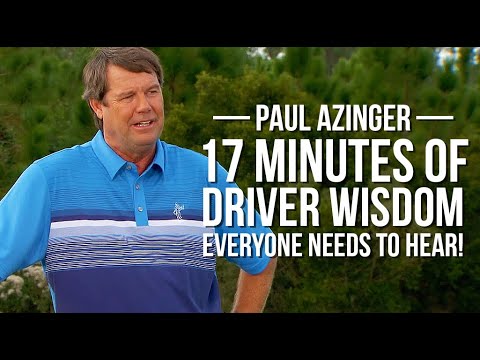
Paul Azinger shares tips on how to correctly swing the driver and how to generate lag without trying to generate lag.
Welcome to Golf Channel Academy. I’m Brandle Shambbley and today we’re alongside 12-time PGA Tour winner, major champion, uh, Paul Azinger to talk about why he was one of the great drivers on the PGA Tour. We’re going to talk about your stance a little bit, maybe some things that’ll help you back at home. Maybe along the way, debunk a few myths. But before we get there, Paul, I just want to ask you your general philosophy because I know you’ve read just about every book on the game of golf, taking lessons from just about every teacher. But your general philosophy on hitting a driver? I think that every player that’s played golf for a living has fought a hook at one time or another. And and the reason they’ve been able to fight a hook is because their body moves correctly. If you’re falling back, you’re probably not going to fight a hook, Brown, you’re probably going to have a slice. So, we get into grip. The guys on tour grip it anywhere from from pretty much from this grip right here all the way over to a grip that looks like mine. But, we’ve all figured out how to hold off a hook. We’ve dug it out of the dirt ourselves. I mean, it’s up to us to figure that out. So my grip and the belief in my grip is that grip tensions, you know, you’ve got to be relaxed, Brandle. You can’t be squeezing it. You’re not death gripping the steering wheel of a car. You know, you’re just holding on and and fingertipping it. You want to be relaxed when you grip it. I believe the club should be in the fingers. You know, my if I’m just sitting here talking to you, my left hand hangs to the inside and almost exactly where it is on the club. It does. And that’s kind of how I grip the club. When I worked with John Redmond and and Dr. Jim Studied, they never changed my grip. Maybe Redmond changed it a little bit cuz my right hand used to be on top and he wanted my right hand my palms to face so that my palms would be facing like this. He felt that that was fundamentally okay and he taught me around my grip. So grip pressure is huge. Just have a nice fairly relaxed grip, nice, you know, relaxed arms brand and try to get the club into the fingers. Well, you’re hitting a driver now and there’s a lot of u there’s a lot of publicity these days about guys trying to hang left, put their weight left. Uh what do you think about that philosophy when you’re setting up to hit a driver? Uh I mean if you’re hanging left that the likelihood that you’re going to fall back is probably increased dramatically. So what are you trying to do then in your set? Ideally I mean this would be ideal if if you’d set up here with your feet together and take a stance and make a back swing. That’s about where you want to be and then ideally after you’ve hit you should be able to make a step forward to go through the hit. But you want to be in my opinion you want to be back here behind it. every great player. If you look at Sneeed and Byron Nelson and uh shoot Nicholas and Tiger Woods, these guys that just bomb it off the tea, if you draw a line straight up and down on a picture, if you take them a dead face on, they’re all behind the ball. Doesn’t mean their head moved, but their body’s behind it. And then how do you get back to the ball? They just unleash, man. They release it like they’re squaring an ax to a tree. That’s the the great Jimmy Ballard comment. And you know, he’s he’s springing that shaft, getting that thing over there. And your weight moves correctly. If you’re going to square an axe to a tree, you’re not going to pull like this. You’re not going to fall backwards doing it. The thing is though, when you square the axe, you only get that one result. That axe hits that tree and it stops. If you transfer your weight, you can’t release the club too fast. I agree with that. If you’re transferring your weight, you got to you got to get that thing moving. So, where do you put your ball? Uh where do you where do you place your ball when you’re set? place somewhere between the the the big toe and the heel somewhere. So, you’re moving forward then. If you got the ball that far up, you got to move forward to get there, but you’re still behind it. That’s right. And if you watch these guys hit after the ball’s gone, they’re all out in front of where the ball was. It’s just the natural movement. You square the axe, it stops, but man, you get that second result and that ball goes flying. So, the tendency for a guy who struggles is to fall back and try to lift. But if you watch this, like I can make this move right now and hit it and walk through the shot. I mean, that’s the key to be able to get your weight to move in the right direction. You get the idea. I mean, you want to be back here behind it. And if you’re behind it, you can deliver a mighty blow like that. Paul, we started talking about your grip when you were playing your best on the PGA Tour. You led the tour in ball striking. You led the tour in the allaround. uh with all this what some people would call unconventional type method, specifically your your grip, um the Varden grip. Uh what are the what are the benefits of the Varden grip? A weak grip, a strong grip, or what are the uh uh the things that players needed to do to compensate for those grips? I I think every golf swing is a series of compensations. Doesn’t matter how you grip it. And uh I think Peter Costa said it best to me in 1989. and he says, “Zinger, you have a hook grip and a fade swing.” And that really resonated with me. Hook grip and a fade swing. And uh I thought, well, you know, I can live with that. Um Bernard Langers lived real well with that. And the fade swing, you’re right, Bernard Langanger, certainly Bobby Jones was another one who had a hook grip and a and a fade golf swing. Um but the fade part was you clearing real quickly. Is that right? Yeah. You know, I did I had a fade attitude, but I didn’t hit a big cut. you know, guys that played with me, I hit the ball pretty straight. Uh, for the most part, I didn’t um block it like people thought. You know, here’s the big thing, too. And I wish I knew what a a Varden Trophy grip felt like, and that I could hit balls. You know, maybe I could have done more with my golf ball, but I just know that if you hold it like Johnny Miller or Cory Paven, that thing’s going to be turned over right here. If you hold it like Harry Varden, you know, most of these guys on tour, Tiger Woods, that that hand that you’re turned over a little bit later. And if you hold it real strong like myself or Langanger or Fred Couples or somebody, I’m trying to release it knuckles up and my hands turn over here, but I am trying to release it. It’s not a hang- on block. When we come back, we’re going to talk about trajectory, high and low. We’re going to talk about shape shot, and we’re also going to tell you how to hit it longer. Woo! That’s a vapor trail. I wish I could hit them all like that. Golly. Paul, we live in a in a high launch, low spin world on the PGA Tour these days. That’s that’s not how you played golf, though, was it? No, it’s nothing like I played golf. The game evolved kind of and it completely changed. Metalwoods changed the game and so did that high-speed video or film. Actually, not film, but video. The ability to see the ball smash flat on the club face and the ability to measure RPMs and um that you know, ball speed, that sort of thing. Brand will change everything. um driving it miles now is the key to golf is more so than accurate. You you made a comment earlier about the accuracy of kind of our generation and earlier versus today. What were those numbers? Well, in the in the mid90s there were about 90 guys that hit 70 70% of the fairways and almost every single year since then it’s decreased to where now there’s just a couple of guys that hit 70% of the fairways. A big part of that, I think, is because you guys guys are hanging back, hitting it high on the face. Yeah. With very little spin, which was opposite of how you drove the golf ball. Yeah, no doubt. I mean, I was more, you know, center of the face and kind of down. Um, I think even, you know, I I think Calvi was like that a little bit. Fred Couples was always center of the face maybe and up a little bit. But what did you have to do in your golf swing to get there? Well, you could just measure up. I mean, you know, there I could actually make a full swing and just, you know, tick the top of the driver all day long. So, or top of the ball with the bottom of the driver. I mean, if you know where the bottom of the club is when you play this great game, I mean, it makes a gigantic difference. And, uh, so if you measure up, doesn’t matter how high you, you know, teed it up, how high I teed it up. Um, I always tried to hit pretty much from here down. And later in my career, I tried to hit from here kind of up and out a little bit. And I lost accuracy. I got actually pretty bad about it. But if you’re covering the ball, generally speaking, you’re going to hit it a little lower on the face, aren’t you? I mean, wasn’t it Trevino that talked to you about hitting the ball lower on the face? Yeah. I Lee liked you to live kind of center the sweet spot down. And uh my old coach, John Redmond, would say that, too. Golf was meant to be close played close to the ground, and that’s the way I thought. And that was my go-to thinking and my go-to shot. I mean, if I never hit it left. I remember one time at Hartford, I actually won the tournament and my caddy Billy Poor, I had missed the fairway right on like the first five or six holes and Billy had this funny way of saying things. He was like, “Ah, Zinger.” And he he said, “Uh, he said, “Zinger, release that club. You haven’t hit a hook in seven years.” I mean, it was true at the time. Um, and I just started to release the club better. But, uh, I lived down low. it. I told you earlier, uh, we were talking about Vegas and, uh, playing over there at the Vegas Country Club and there was all these out- of- bounds walls that were on both sides of the fairways and they were, you know, just lining back people’s backyards. They were about this high. And I remember on the 12th hole, I started getting really nervous because I was close to the lead. And I said to Billy, I said, “Billy,” I said, “You see those walls over there?” He goes, “I I see them.” I said, “Billy, if I hit a ball out of bounds, it’s taking a bad hop, buddy, because every shot from now on is going to be head high.” And I did. And so I would I would try to make my swing. You know, I I became really trajectory conscious. And I think it’s important. And what am I going to tell you to help you hit it straighter? How are you going to tell somebody to hit it straighter? You don’t know what their swing looks like. The only advice I can give you to try to hit it straighter is to try to control your trajectory where you’re obsessing the trajectory you want the ball to leave on. It kind of eliminates that stuff that’s to the right and to the left. Doesn’t that make sense? It does. So how Sutton, Curtis Strange, yourself, three of the best players of that generation, you all got at it differently, but you all moved into the ball and covered it, which does help you hit it lower, doesn’t it? Right. And what is covering it mean? Covering it means your your weight is shifting in the proper direction. All great players probably when they’re done, I mean, they’re going to be able to lift their right foot. They’re all moving this direction. Some may be offbalance this way or that way, but they’re moving the correct direction. And that’s what covering it means. If you’re firing and falling back, you’re in big trouble. I always remember you moving off the ball, moving into it. You made it look simple. Uh you were also a long hitter. And like I promised, I promise folks, when we come back, he’s going to tell you how to hit it longer. The way to hit the ball far is develop a lot of lag. You got to get that elbow way out in front of your body. You got to increase that. Isn’t that right? Yeah. Who told you that? I don’t know. That’s what I’m reading these days. Is that not true? I think lag is something that has to happen naturally. Y’all look at all the lag that Sergio Garcia has. If you told Sergio Garcia to lag, it would slow him down and and that would be it. He’s one of the greatest drivers of the golf ball. He hits it a mile. And uh so uh no, I think lag is something that’s a result of loading the golf club. I mean, you got to get loaded into your right side a little bit and then as you transfer your weight, that lag happens naturally. It it it happens moving. Yeah. It’s a result. It’s a result of a relaxed, you know, a relaxed grip and relaxed arms. If I tried to pull this down and lag, it’s it’s no good. I’m not going to slap you trying to, you know, hold my ankle and and and lag and and slap you. My my main amount of force would be to just let it release and just give you a whack. So, it’s the same really with a golf golf club. You want Does it feel like you’re throwing it from the top? Sometimes it does. If you’re if you’re moving correctly, you can you can spring that thing as early as you want. If you feel like you have to lag, that’s a slow down move, and I think it’s a death sentence. I’m going to clear my body with relaxed arms, and the lag happens. The lag is a result of being of loading that club at the top of my back swing, clearing out of the way with a lack of tension, and then it all just happens naturally, and you spring it at that last second. can only release it once. Brandle, your your your teacher, John Redmond, always talked about cracking the whip, right? Uh, you know, lack of tension, moving into your left side, that cracks the whip, doesn’t it? Well, and you know, he his big thing for me was to feel like I was turning in a barrel, you know, and I always he wanted me to turn level, too. And you know, your shoulders can work your shoulders can work that way, kind of more vertical, which is for a weaker or neutral grip player, but a strong grip player has got to have his shoulders turned more level. And so I always tried to work my left shoulder up to my chin. A lot of guys tried to work their left shoulder under their chin and I just couldn’t swing that way, Brand. So then my a lot of my speed came from trunk rotation and my arms and hands would carry the message. I know you’re a big fly fisherman. That the the the beauty of of casting a fly rod. You create lag doing that, don’t you? But you’re not trying to what you have when you watch a guy who’s really good with a fly rod. You have effortless power. And you know, someone who doesn’t know how to do it and he’s strongarmming it. He’s got powerless effort. And the same with a golf swing. If somebody’s firing and falling back, he can swing really hard at it, but it’s it’s powerless effort. I mean, it is just powerless. And if you if you had to really hit a golf ball far, you wanted to drive one uh you know, on a par five and let it go, uh what what were your keys? You know, truthfully, if I had to bomb one, uh, I would I would relax my arms and, uh, I I wouldn’t really try to swing any harder. I know you hate hearing that, but but really in the end, it was this ability to get behind it and have this just ability to rotate out of the way with relaxed arms. Um, occasionally I would try to hit it higher, but not necessarily harder. I personally would vary my trajectory to hit it higher. And I repeat, I know that’s not what you want to hear. You want to hear what’s trajectory to hit it higher. I mean farther, right? I would I would vary my trajectory. I’d try to hit it higher to hit it farther. U but that’s about it. And uh I’m sorry there’s no super secret, but maybe that is kind of the super secret. Well, that’s it. It can be as simple as that as you talked about at the top of the show. Now, I know you wrenched your back the other day, so I I I don’t want to burden you here, but I’d like to see, you know, uh want to see me hit a bomber. I want to see you hit a bomber. Uh, I want to see what you would do and see if it was any different from your other swing. I may tee it a little higher. And you know, like we said earlier, I like to I made my living from the sweet spot down. And I’m not going to try to impact any higher, but I’m going to eliminate the down part. Gotcha. I’m going to try to go sweet spot only. And uh I will get behind the ball more at dress. I teed it up ever so slightly higher. And my goal now is to flight the ball higher. I’m not going to swing harder at this. I’m just going to try to flight the ball higher. So, I’m picking a cloud. My goal is trajectory, so I can still hit it straight. [Music] You’d never know you’re 50. I’ve forgotten. When we come back, he’s going to tell us how to work the ball. Both directions. Don’t go away. Back with Paul Azinger talking about working your T- shots. You said in one of your telecast with Mike Tico, Mike, the straightest hitters never hit it straight. What do you mean by that? The most accurate drivers of the golf ball never hit a straight drive. They’ve always curved the ball. Bruce Litzky hit a cut shot. He hit a lot of fairways. Calvin Pete hit a draw. He had a lot of fairways. The advantage to curving the ball is that you actually have the entire fairway to play with where somebody like myself or a lot of guys in this generation, Brandle, hit the ball so straight that they have to aim down the middle. And if the ball’s curving one way or the other, they’ve got only a half a fairway to work with. But you got to remember that um that uh a slice or a fade is only sid spin on the ball. There’s only a couple ways to create sid spin on the golf ball. And the main way is to create a an outside to in path. And that’s how I hit a cut. And the same when I tried to hit a draw, it was more inside to out path to just create a little bit of spin to move the ball in the direction you wanted it to go. For the most part though, I tried to hit the ball pretty straight, which is kind of a detriment in the end. But if you had a big dog leg to the right, uh little bunker over on the right, wind coming off of the right, you needed to slide it in there. Yeah. What What manipulations did you make at address and and uh and thoughts that you had in the down swing? From my normal setup position, I would generally play the ball a little more forward and obviously aim a little more to the left and then I would try to take the club head a little more on an outside path and at the bottom I would clear like crazy with this. I had to fade attitude even when I hit a draw and that was just to make my hips fast, my my lower body fast, but my left shoulder would get a little farther from the ball. You know, Hogan used to say the left shoulder is the ship. And when he wanted to hit a draw, he wanted that left shoulder going at that ball. When he wanted to hit a fade, he let that left shoulder open up and create space visually between the ball and where his shoulder was. And I’m kind of the same way. If I want to hit a cut shot, Brandle, I’ll take that club a little bit on the outside line, open up that shoulder a little bit, and hit that sweet little cut. And, you know, I would say that under pressure, that’s probably my go-to shot. But if I wanted to hit a draw, which usually when I won tournaments, my normal swing would ever so slightly fall to the left. I release the tar out of it. And and by the way, that fade is a release. It’s not a hang on. To be able to hit a release fade is so liberating. But when I want to draw the ball, of course, I’m aiming just a smidgen more to the right. And I’m going to let my left shoulder stay in the shot longer instead of open up and clear, but the club should go inside to out. Beautiful draw. Get that little baby draw. Real quick, what’s the difference between a release fade and a hang fade? Well, a release fade is one where you just kind of hold on. And I think that’s counterproductive to what you’re trying to do. You mean like a hold on fade? Yeah. And it’s a disaster. I think you want to be able to let your path create the fade and fully release it so that you don’t lose a great deal of distance because people would think with your strong grip you were always hanging on blocking. You weren’t. Your feeling was you were releasing. My swing thoughts, if you want to know what they were from the beginning, I would set up to the ball. I would say arms relaxed, turn level. That was my back swing thought. And then before I drew it back, I would say lower body first. And the lower body first was my down swing thought. And I thought that before I drew the club back and then as I was in the swing, the only thought I have would let it release. Well, everybody wants to hit the driver. Uh, and I’ve had a fun day out here watching you hit a lot of drivers. Learned a lot. Uh, thanks so much for your

42 Comments
Paul spoke the truth 🙀 and 99% of teachers and golf companies don't want the truth to get out because your their profits 💰💰💰 they sell rubbish ideas and half truths and you lap it up.
Best golf video ever, im only 84 and I have been searching for these answers for a long time. This is pure gold instruction. Thanks so much from NZ.
Too bad Chamblee is in this video, he ruins it.
Not many videos I watch twice but watched this yesterday & went to the range , been fighting a hook for years, tried the knuckles up follow through & saw immediate improvement, still a work in progress but I now know I'm on the right track, came back to watch it again & say thanks.
I've just purchased the Driver he's using- a TaylorMade SLDR here in Australia for $85 and have to say I couldn't be happier, maybe the straightest driver I've ever hit.
In those old photos those guys were behind the ball but weight was forward.
Love Paul, can't stand the other dipsxit
BC is the ultimate D Bag
This is so redundant😂😂😂
Zinger, that was a great video. Baby fade and baby draw both had the sound of the ball compressing on the club face and with a full release. Full of wisdom, indeed. Miss watching you play.
Thank you both for this. Paul I can’t tell you how grateful I am for this lesson. These were things I did when I was young and have been trying to change with all the new swing styles being taught these days. Weight back, swing in a barrel, strong grip and walking through the shot are great reminders for me and I took them right to the range. My driver feels natural once again.
Great informative video!
Totally refreshing to hear one of the great golfers of our times talk about his golfing philosophy. So pleased you guys debunked that crap about hanging your weight on the lead side. Also really good to see Paul Azinger’s grip and how he compares this to the natural lead arm hanging straight down naturally hand position. Priceless.
Myles
When Azinger talks about falling left, or staying on the left side, he has zero clue what he’s talking about. Brandel is no expert instructor either, name one student of his! First guy in the history of golf to write a book about golf instruction, without actually giving instruction. Priceless! Azinger was a golf hero of mine growing up, and a great player. But his swing wasn’t very good. He just made what he had, work. All these guys who played have very antiquated ideas of what happens, or should happen, in a good golf swing. It’s almost 2026. These things from the past have been proven wrong daily by video, launch monitors, force plates, wrist sensors, and more, But this stuff is just painful to watch and hear.
Zinger may have even won more had he not had a bout with cancer. Great competitor
Now why does Brandel Chamblee have a driver in his hands for this? C'mon, I just wanna hear what Azinger says… (Also, Mr. Chamblee the term is 'Shot Shape', not 'Shape Shot'. SMH.)
Great video. Paul was a great shotmaker and had an amazing career. Paul wasn't a can't miss college player, he worked hard and developed his major championship game.
Rip Azinger 🖤🩵
Good player, bad teacher
Great video on what a release looks like for each style of grip.
Very good, thanks
He had one of the strongest grips on tour and that helped but you also can not teach height. At 6'4" huge arc but Tiger blew it by him back in the day. Like Faldo they both could have hit a lot further but for a limit in athleticism which is not a criticism. Anybody out there on tour is better than the best amateur in large measure. One point he really stresses but I would perhaps offer a more exacting word and that is using a "lighter" grip not a relaxed grip. At 64 I carry 285-300 with driver and 195 with a 7 iron playing to a +5. Clearly not youth but bio mechanics. Check out Mike Austin. Longest drive in history of pro game with a 515 drive and 450 carry with a 43" inch steel shaft and balata ball in 1974 U.S. Senior Open. 135 Club head speed and had a student WAY LONGER than he was. At 75 stiil 340. Kinesiologist that knew the physics.
Cheers!
@William Woolford
Great! 👌
Great book on this is John Redmond’s Essentials of the Golf Swing. A zinger does the forward introduction. Goes into grip,weight shifts of drivers vs irons. To me it’s been the Bible for golf
listening to these two is almost as cringeworthy as listening to johnny miller.
great video hearing it is one thing doing it is another, but he didn't complicate the swing thoughts. I'm a high on the face but it a low ball with a lot of roll
he looks the same as he did 35 years ago
The way he did that swing to show how he could perfectly top the ball all day long was impressive control
Every time Azinger says something interesting, Brandel interups to derail the thing. Yech
I have several comments on this EXCELLANT video that needs to be in the Golf HOF. First, the Teardrop "overspin causing 2nd putts being further from the hole because of slight misreads" story was repeated in history by the YES putter and the Nike Method putter. Do not buy an overspin/topspin putter. IMO Sik/LAGOLF putters need some testing to avoid being on that list as well. Again, the faster the ball starts rolling on the ground, the quicker the ball moves away from the hole on misreads. Most putters in your garage have standard 4 degrees of loft on the putterface that gets the ball into the air where misread ground slope is minimized.
Besides PUKU, other putters historically in the same category of no continued success because of lack of Sunday TV time. Alien Tutch Mallet, Carbite, Octagon, Happy. The latest appears to be SeeMore.
Quel load of bullcrap. Great player, Redman taught you well but please stay away from swing mechanics.
Wrong grips should be firmly
Paul has always been one of my favorite players. I still have my Azinger instructional VHS tape with him and John Redman. It's really solid instruction.
seems like a lot of lateral movement. not sure it's repeatable for the average golfer.
Almost didn't watch because of bramble shambles. But I like Paul.
Brandel is equally annoying in the past as today on TV.
This guy was some player back in the day………VERY competitive! Good to see the Zinger 🙂
Remember Zinger and Chip Beck as Ryder Cup partners. Very formidable!
Having to skip over Bramble talking to hear Paul's wise words was an effort but was the only way I could watch
This is the first video that encouraged me to slow down and not chase swing speed, and now I actually have way more effortless power, yet I’m swinging slower lol.