
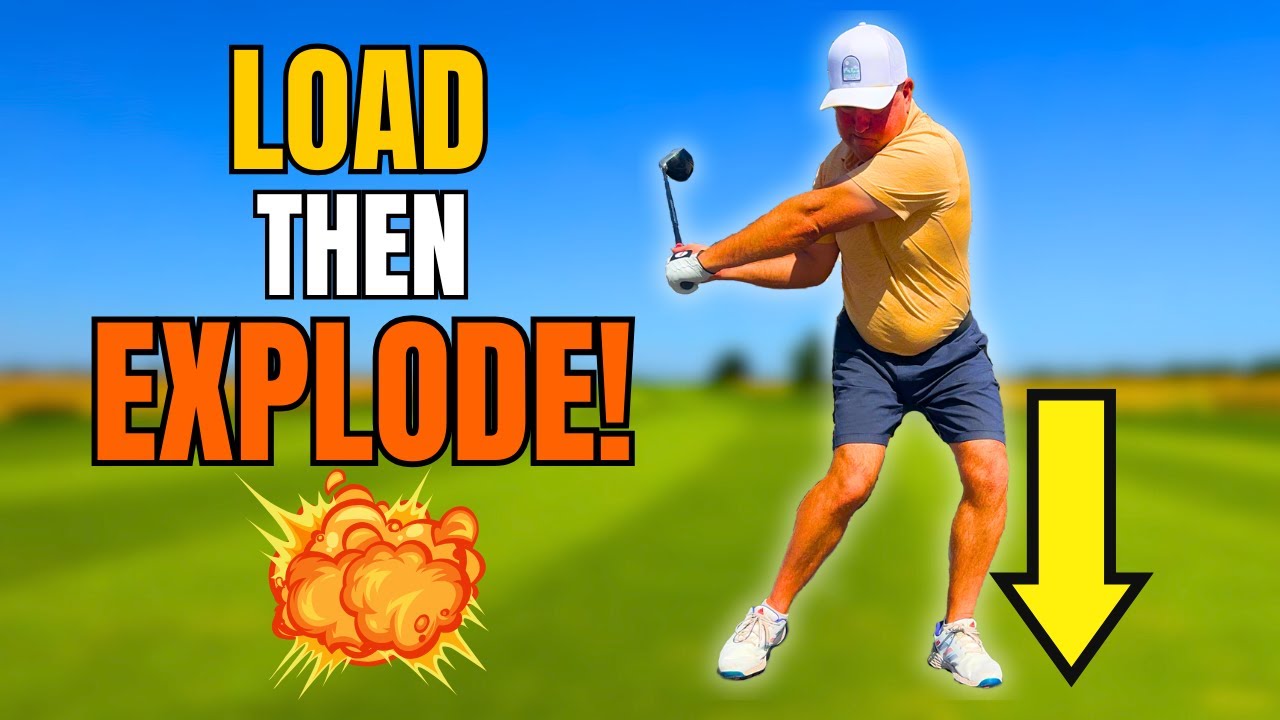
In this video, Steve shows you how the mastery of the feet and harnessing of ground forces will help you understand the movements of the body in the golf swing better!
Follow these tips and drills to increase clubhead speed, smash factor, driver distance, and have more FUN!
—————————————————————————————
For LIVE, IN PERSON instruction with Steve, please email Steve@hititlonger.com.
To get your swing analyzed, email Steve@hititlonger.com!
The Power Coil Pro is BACK! Add Massive Distance! https://hititlonger.com/product/power-coil-pro/
I’ve created a Distance MASTERCLASS designed to help you pick up 30+ yards off the tee…and it’s completely FREE! Sign Up Here: https://go.hititlonger.com/free-distance-video-course9c3uf7m6
To order the ORANGE WHIP please click here: https://hititlonger.com/product/speed-whoosh-by-momentus-sports/
Measure each swing clearly and accurately with the RYP RADAR!! Click Here to check it out:
I’ve put together a complete program to teach you a powerful on plane swing, increase your clubhead speed, and hit it solid and pure.. Check it out here:
There are so many important fundamentals of the golf swing that can be discovered when you simply focus on how your feet move. Remember that while we swing, we put energy down into the ground and then the ground responds to make our body move. And of course, the first line in that chain is going to be the feet. So, whatever your feet do is going to be a reflection of what forces you have put into the ground. So, this is a great way to hack the system. You could say if you can make your feet behave like that of a tour pro, then it’s a very good chance that you’re doing a lot of other things like them, too. Okay, let’s start by looking at the left foot. There’s a few fundamental positions of the left foot that would indicate that your body has made the right moves in the down swing. So, first before we get there, let’s look at the back swing. I think in a perfect world, especially if you’re looking for more distance, you’re going to flare this left foot out maybe 20, 30°. It’s going to help you turn through the ball a little bit easier. So, I do recommend that if it feels comfortable to you. And then, in a perfect world, you’re going to get this left foot to roll inward. So look, you watch as my foot rolls to the inside, my knee and thigh kind of almost automatically move towards the center like that. And that really gets my weight to start to move into my right side because when my foot is in this position, I really can’t support very much body weight. Now, especially if I were to lift the heel off the ground as well. Now, that kind of puts the right knee right in the center, almost like my two feet and my left knee are making a tripod. Kind of like a real balanced three-point stance. And now I really feel the weight has loaded up onto my right foot because I can’t sustain any body weight on the left. So, it’s kind of an automatic load up. And I really like this position here. When your foot is in this position, it’s a really good chance that you’ve made a really nice powerful weight shift and now you’re ready to step down into the down swing. Now, that’s the first thing that’s going to happen in the down swing is we’re going to be stepping down and planting that heel again. And the harder you plant that heel, almost turning it into a stomp, the more you can get that down swing moving for power. Now, next thing you’re after is you want to get the weight in that left foot to roll the foot to the outside like this. Just like you see in a lot of great players on TV, they’re rolling that foot to the outside enough to where I can stick, you know, the blade of an iron underneath there. And another thing you’ll notice is that my toe is also slightly off the ground. You can see I can stick my club under the toe as well. Oh, I can slip it under both sides. So, my weight, similar to everyone you see on TV, is on the outside of the left heel. Now, this is a good indicator that you have both taken your pelvis, the center of mass, and you have shifted it and relocated it nearly on top of the left heel. And this is why I can stand on this foot and pick this foot up. And you can see I must be centered on my front foot. because I don’t need the back foot at all anymore to stay in this posture. And then the weight being in the heel would tell you or the pressure being into the heel more is also going to tell you that you’re probably keeping your rear end back, which is going to enable you to turn a little bit more easily, too. Generally, when someone early extends this way, their weight goes forward onto their instep. And since you’ve lost equilibrium and you’re now ready to fall over your toes, say if I push my my pelvis forward, if my head doesn’t come up and back, I’m going to fall over. Some of you might be doing that, too. But if my weight steps into my instep this way, see, I’m going to have to straight there. I’ve I’ve rebalanced the equation again. I was about to fall over my toes, but now I have gone back to equilibrium by straightening up and back. But still, the weight in the instep is a good indication that you’re early extending or standing up. If your weight does not get all the way to the outside of this foot is an indication that your hips or your weight shift has not gone far enough laterally. If I just went halfway now here, my weight is kind of centered on that foot. I definitely feel much more pressure on this foot than this foot, but I haven’t gone far enough to achieve a one foot balance. So, I cannot pick this foot up and stand on the other foot because the pressure is still on the inside of the left foot. Has not crossed over as I get my left hip well outside my foot. trying to center my belt buckle on top of the heel. Now I can get and this is a big difference for some of you out there who tend to hit behind it just a little bit. Drop kick it, hook it, push it. And of course the people on the instep, you’re going to tend to block it and hook it too when you stand up. All right, let’s take a look at the right foot now. And the right foot, the first pitfall that you need to avoid as you load up onto the back foot is to allow this foot to roll outward. So, it’s opposite of the left foot. On the left foot, we’ve already hit the ball. It’s a follow through. So, it’s just the ball’s gone already. But here, if we get this foot rolling to the outside, it becomes very difficult to plant and shift the other way. So, if you get this to the outside, it becomes very hard to get back into the correct position on the way through because there’s you’re in an awkward position. You it’s hard to support your body weight in balance. So, you’re out off balance, not supporting the full body weight. So, I want you to take this right thigh and I want you to resist it with it. It almost feels like an inwards twist against the ground as you go back. And see, I can wind into this foot. And I can keep that weight really structured. No, not nothing outside the middle of my foot, but everything kind of feeling like it’s staying a little on the inside here. I can still make a full wind up but not let that weight get to the outside of the foot. Now, if you can mimic the correct actions of the right foot on the down swing, you’re going to be in great shape, too. Going to be opposite what the ideal was in the left foot on the back swing. It’s a mirror image. So, here we’re going to roll this foot to the inside. Now, this is not twisting the ankle very much at all or the knee. So, if you’re you feel like you’re doing that, you’re doing this wrong. Watch how I allow my entire leg to come to the middle. So, I’m flexing that whole leg to the middle. My ankle right now is mostly in a neutral position. It’s not turned outwards that much because my entire knee and thigh have also contributed because I cannot sustain body weight on this foot in this position. It’s a guarantee that your weight has stepped over onto the left foot. Now, all that’s necessary is to create even a more insecure platform by lifting the heel off the ground. So, the only part of your foot that’s touching the ground as you go through impact, right about here, is going to be the inside of the big toe. Notice how I also have the heel slightly in front of the big toe or more target words than the front than the big toe. So yes, there are a lot of pitfalls associated with the right foot positioning. Rather than doing the ideal, some of the other things I see often are this motion. So just pushing the knee straight towards the camera or straight towards the ball and lifting the heel way up in the air. And this is will encourage early extension and discourage lateral shift to the front foot and discourage rotation. So if you find yourself doing this, you’re often going to have a lousy path, but also you’re going to not be able to control your low point very well. Now, one more thing that I see commonly in the right foot, I will see people sliding the heel back around the toe more in a counterclockwise way and then up. I even see some pros on this do this on TV and this is a definite pitfall because it does not allow the right side of the body to crimp under the left as it goes around. But instead, watch what would tend to happen. It would force me to rotate with my right shoulder very high like this. keeps my left hip from advancing laterally, creating a secondary tilt of the spine. So, you see, I turn in a barrel, my head gets thrown forward, and my right side of my body goes around the circle too high. This would be associated with a really bad over-the-top pull hook or outside in in general. All right. So, let’s take a look what it will look like when you put it all together. Right foot and left foot. Just going to hit some small shots here, which is how you should work on it, too. And you’d want to hold your finish so that you can check out where your feet ended up. Here we go. So, what I love most about working the feet is that it’s something that you can do anywhere. You don’t need a club. You don’t need a ball. You don’t need a driving range. You can do this at home. You can do this in the supermarket. Anywhere. And that is just practice working the feet back and forth like this. until you kind of have it memorized. Then you might add a club to it in the backyard. And when you go to the driving range, you’re just hitting some easy pitch shots, right? And when you can mimic the foot action, you can’t fake this. I can’t fake this. If I get my foot in this position, I cannot do a reverse pivot because if there was any weight on this foot, I would collapse to the ground. So, you really can’t fake this. If you can move your feet like I’m showing you here, you can really duplicate a lot of great movements of the great players with the rest of your body, too. It’s a great baseline to start from if you’re trying to learn how to be a better player. Hey, give it a try. Let me know down in the comments what your results are, if you have any questions. Thanks so much for watching the video. I hope that you’ll hit the like button, if you got some value out of it. If you haven’t subscribed yet, hit that button, too. Check out my website, hititlonger.com. And don’t forget, YouTube videos are probably not the end solution for everybody in getting to their golf goals. So, consider getting some extra help at hititonger.com where I offer personalized coaching. And I hope I can help you, too. Hey, I’m Steve. If I don’t see you in the next video, I hope I see you longer and straighter down the fairway.
1 Comment
!