
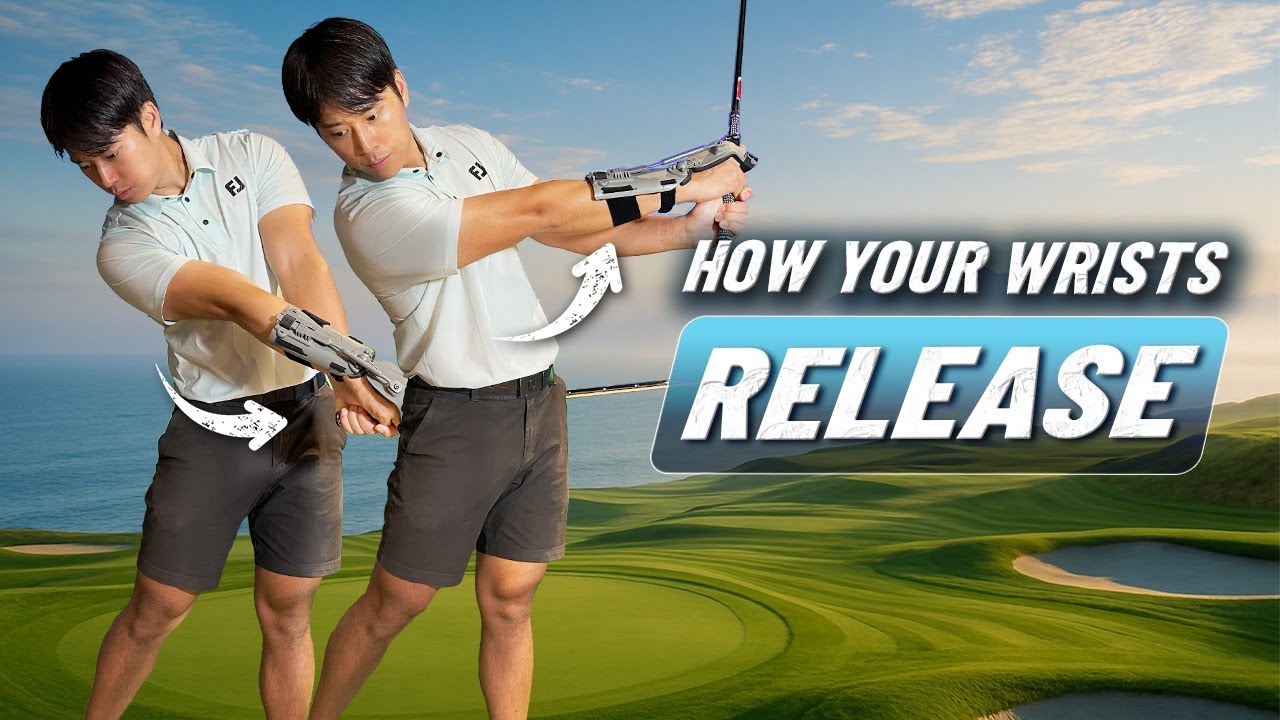
In this video I will be explaining how your wrists should be moving through impact. This is a movement that MUST happen if you want to be a consistent ball striker and want to create speed efficiently. To supplement my explanation of the wrists I will be using the “Precision Impact Training Aid” to show you exactly what you should be feeling and what position your wrists need to be in.
What you will Learn:
1. The key movements of the wrist in the follow through
2. What to FEEL in the wrist to ensure it is correct
3. Drills to practice
PRECISION IMPACT TRAINING AID:
https://pureswingproducts.com?sca_ref=2113785.NOMzg5axxE
Discount Code: “JKM”
*** $30 DISCOUNT UNTIL 11:59pm EST October 23, 2025 ***
ONLINE COACHING:
https://skillest.com/@JKMMetaGolf
INSTAGRAM: @JONATHANKMOSS
TIKTOK: @JKMGOLF
In this video, you guys are going to learn about how to release that club to create the most amount of speed with the least amount of effort. So, if you’ve ever been unsure as to how your wrist should be turning, bending, hinging, things like that, I’m about to give you an answer in this video. And for my explanation today, I’ll be using the precision impact training aid, which I’ve used for a little while now. But the reason why I like this so much is because it’s one of the only training aids that I’ve ever used that really puts the player in the positions that I’m trying to explain in all my videos. So, especially in the back swing, the down swing, and the follow through and release specifically is the reason why I’m using this today is because it really forces the player to feel out where the wrist should be through impact and what their release should feel like. So if you guys are interested, I will leave a link in the description box below so you can see all of the details. Now without further ado, let’s get back to the video. So I want to begin by just explaining that we want to learn how to throw that club head pass. And you’ll notice that when I’m really throwing, it looks very easy. Like I’m not really putting much effort into this, but I’m allowing that club head to basically pass my hands and get above my hands really quickly. There’s very little strength involved. Okay, it’s more just kind of knowing or learning how to get the weight of the club to pass your hands. So, there’s two main concepts. So number one is we’ll we’ll have to understand or know how our wrists bend kind of turn or bend through impact. Okay. So we have to be educated on what what’s actually happening. The second concept is to understand that acceleration of the club head happens when there’s very fast deceleration. So just think about that. What I mean by very fast deceleration is that we don’t want the hands and arms to accelerate the same speed as the club head at some point. Yes, it has to go fast, but it has to stop so that the club head can pass. Our body and arms have to fire, but has to stop really quickly to allow our hand and club to pass to go even faster than our arm and body. In order for you to get that club head moving really, really efficiently, there’s no need to actually keep turning very very quickly throughout and continuously through impact, which is kind of counterintuitive to a lot of people. But let’s unpack the first concept first about what our wrist should be doing or how it should be turning or bending through impact. So to do that, we’re going to go up close just so I hope you can kind of see this, but I’ll go through this very slowly and I’m going to go through this one arm at a time basically. Okay, just to go over how the wrist should be moving. So with your lead arm first, okay, so we’re going to get to this part in the down swing. Now, when you start to re really release the club, it’s about when your lead lead arm or your your hands reach about close to the right thigh or your trail thigh kind of in the down swing. So, now it’s from here, we’ll start with the lead wrist. You’ll start to see that as you get closer, you’re you’re going to eventually dump out the angles here. And at the same time, you’re going to also turn the wrist. Okay? You can see the back of my lead hand. And then by the time it gets to impact, you’ll see that it’s facing more or less at the target or towards the target. Okay? I’m letting out the angles, but at the same time, I’m turning it with the right hand. Okay? By the time it gets close to the right thigh, kind of the same thing. I’m letting go, letting out the angles just a little bit, but at the same time, I’m turning it. Okay? So, I’m getting it to here. I’m turning it. So, I’m letting it out and I’m turning it at the same time. So now, as we go through impact from here, the club is going to continue to pass my hand. So you can see that I’m continuing to turn this over. Okay, now my thumbs are pointing at the target. Okay, impact. Then through impact, it just points towards the target. And then eventually the club has to get above my hand. So the back of my lead hand is facing back at me or the knuckles of my lead hand are facing back at me. So now right hand, we know that we let go and we’re turning it. Okay. Now through impact again, the club head is going to pass my hand. I’m still turning my my forearm over. Okay. And then the club head will get above my hand. So now the back of my my trail hand or the knuckles of my trail hand are facing back at me. That’s just a very general rundown of how the each arm and wrist should be moving through impact so that you’re able to kind of get that club head to past your hand and also rehinge above your hand. Now, it doesn’t require a lot of strength, but knowing how your wrist should be bent or how it should be positioned is going to determine how much resistance there is. Okay, if that makes sense. the club head when it passes, when the weight passes, you want to be confident as to how your wrist is turning and bending so that you can just comfortably allow that club or the weight of the club head to pass. So now, if I face you guys, if I get even closer to the camera, so when I get to impact and then just through impact, you’re going to notice that my lead wrist, it bends backward. Okay? It turns and it bends backward. Okay. So, almost to the point where kind of see the palm of my my lead hand is facing you guys. It’s almost like the palm of my right hand is also almost facing you guys as well. The knuckles of my my trail hand are facing back at me. Most people will think, “Oh, yeah. You you shouldn’t really roll it.” It’s like, well, yeah, you don’t want you don’t want to necessarily roll it like this. Okay. through impact. You can see that the knuckles of my lean hand are facing down to the floor, palm is facing up. My trail hand, the palm is facing down. That’s kind of extreme. When your wrists are in this position, you you can’t really hinge the club or get the club above your hands. Really, unless you start to fold your elbows, right? It’s important to let that lead wrist bend back. That’s a big one. Okay? And then you also have to allow your trail wrist to bend back as well. So those are some key points to consider when you’re trying to get that the weight of the club to pass and rehinge. Okay. So you can kind of see when I’m doing that there’s very little resistance. Okay. Again, one more time facing you guys [Music] to that position. Okay. So, there’s still, remember, there still has to be some rotation here, but then it hinges back up. Let me know if you have any questions about this. All right, but I hopefully going through each hand individually um and showing you kind of slowly from the front view and also swinging towards you guys kind of shows you the difference in in what your wrist should be doing or how your wrist should be bending. Now that I have the precision impact trainer on my trail hand, just kind of watch what it does. It just locks you in into these positions. So when I take it back, you can hear it click because it it just locks your right wrist kind of bent backward. So as you come in, right, you’re trying to let go of these angles just a little bit and you’re turning it. Okay, you’re able to do that. And then as you go through it, you’re allowing the club head to pass and you’re getting the club head to turn and rehinge above your hand. Right? So that that checkpoint that I I mentioned before with your trail wrist, the knuckles of the trailers bending back and pointing back at me, it literally guides your wrist to kind of be in that position. Okay? So it forces you to kind of turn your forearm over and then rehinge your trail wrist. If your right hand can do that successfully, that’s going to also guide your lead hand or your lead wrist to be in that position as well. So when I go, if I reset the device and I go back and just gently go through it, you can really see it feels really smooth for my wrist to kind of go in this way. If I do anything weird, I’ll feel a lot of uh resistance against the device. It’ll be very clear if you’re doing it incorrect, okay? But you can really tell that if you’re doing everything correct and you’re you’re getting your wrist to kind of bend in that manner, it’ll feel very easy with the device on and it’ll help to guide your hands or your wrist to be in those positions that I was just explaining. Okay, so this is why it’s so good to have this. It’s so nice to have it because even when you go to hit balls, you can really feel it. Okay, if you’re if you’re doing it correct or incorrect. swinging at you guys with the trainer on. Right, it kind of forces you to be in that position. If I try to do it incorrectly by kind of rolling it over like sure, you can do that. Okay, but you’ll notice that you can’t you can’t really get the club head above your hands. So, as soon as you get it above your hands, you see how that device just readjusts itself? See, there’s like kind of some resistance. You can’t really get it above your hands unless you follow the device. And you’ll see that it bends. Okay? Right? It kind of bends to guide your hand in that position. So, if I undo this, right? Kind of guides your hand there. Okay? So, that one, this position, I’d really like for people to feel that trail wrist kind of getting it to turn over and then bend back with that trail wrist. the knuckles of your right hand are facing back at you with the club head above your hands. This is a a really key uh feeling that I love my players to feel. Um and that allows them to get that sensation of kind of throwing that club head past them and above your hands with no real feeling of using a lot of muscle. Okay, so let’s unpack concept number two, which was really fast deceleration of the body and arms is what’s going to allow a lot more acceleration of the club head and the hands. So, I’m using this really uh whippy noodle here to kind of give you a visual explanation of this. Let’s just say I’m going to move my arms and hands and the noodle almost at the same speed. Okay? Okay. So, I’m going to make everything continuous just so you can see that um if we do it this way, we force everything through with our muscle and our body continues to go the same speed as our arms and hands that there’s no real whip or acceleration of this end of the noodle. Okay? So you can see that when I do this, I’m going at the same speed. It looks like the noodle is just kind of dragging itself through. Now watch what happens when I just accelerate my body, but I just stop my body and my my hands partway through the in the follow through. I go back. So you can kind of see that this end of the noodle really just whips past and just gets above my hand. Right now, this is a a whippy noodle. So, it just shows you that there’s a lot of momentum in that moving in that direction kind of forward and up as our body stops. We go back, right? You can kind of see it just comes up and just smacks me. Now, if I were to allow this object to kind of move above me by just allowing my wrist to bend in the way that I just explained, you can kind of see that I’m able to kind of get the throat over my shoulder. I’m not preventing it from going anywhere. I’m I’m not holding anything back. I’m just going back and I’m just stopping my body to allow that club head to go past me first. And as that club goes past me, then I can kind of finish my swing off. Okay. But you can kind of see that noodle gets past me as soon as I stop my body in some way, right? You can see I’m going back and I stop and that that noodle wants to keep going. So all I’m doing is I’m just allowing it to keep going by bending my wrist back. So that’s the visual explanation of that. So when you are swinging your golf club, which is going to be more heavy on this end, you want to think of the same the same way. So now I’m going to apply that same concept, that same feeling. I’m just kind of throwing that weight past me and I’m just bending my wrist to allow that weight to just get up above my hand. So when I take it back and just let it pass, right, there’s no real resistance anywhere. I’m not dragging my club. Just letting it be thrown and just letting the weight of the club head get above my hand by bending my wrists in that manner. Okay. Now, with this on, I didn’t feel any real resistance. I just followed the training aid to guide my wrist. That’s all I needed to do really. I don’t feel any resistance anywhere. Okay. So, now that you kind of have an idea of how the wrist bend and that idea of moving your body quickly but stopping and then just allowing the weight of the club to pass, you can kind of test that out by hitting some shots. I’m going to hit a few. And you can do this slowly, but you want to focus on maybe creating an L shape and then hitting it and then creating another L shape close to by the time your hand gets to about chest level in the follow through. Now, this is just an exercise, okay? Just to get you to try and feel that weight pass you and get above your hand. You kind of doing it on both sides. Just had a ball here. Just go very lightly, right? So, I’m creating that L shape there. Do it a couple times. Trying not to feel any resistance in the device as you’re swinging. And so far, I haven’t felt anything. Right. I’m just kind of following or letting the device guide my wrist. I try one a little bit faster even. Okay. Okay. So, that felt pretty pretty good. It looked pretty quick to you maybe, right? But I didn’t really put in a lot of strength, per se. Okay. So, it’s mainly just understanding how to get that club to whip past for you to just get out of that get out of your own way really and just let that weight of the club just pass and get above you. Right? You you see I’m moving this club pretty quick and I’m just using my left hand. I’m not using strength. I’m just allowing the weight to pass. I’m just letting it go. I’m not withholding it. I’m not trying to move my body with it. I’m just letting that club head pass. So, with this training aid here, um, it really just puts you in the position. It just gets you to feel it. You don’t really have to think too much. You just have to put it on and start hitting some shots. If you have any questions about anything I’ve talked about or again, you want to pick up one of these uh devices, I will leave the link in the description box below. just so you can see all of the details. See you guys next time.
29 Comments
At the point of impact should the chest be facing the ball or slightly in front?
This was one of the best explanations of the how the wrists work, I’ve ever seen!! Great job!
Thanks so much JKM. Now I understand what does it mean of de acceleration to whip the club..
Thank you so much for this video. It solves most of my questions about the release! The topic that rarely anyone discuss but so so important in creating ball speed! Thanks again 🎉
Btw is it also the same with the driver?
Best video on the release bar none. extra points for touching on the release point – a very crucial point no pun intended. Most coaches would omit that and if they do it's about early release or casting.
Is the key to the golf swing basically timing up this release with using ground force to accentuate the snap?
I see, and you say that when you swing thru your right wrist is slightly bent back My right wrist is flat and my left is bent back. I assume I am doing this wrong – yes ? Thanks!
I've been working on my wrists being soft and relaxed thru impact and when it works I kill the ball. I'm usually left of my target tho. My tendency is to cast tho 😢😢😢help!!
when i do this, i hook it hard left. if i pull through, it goes straight
Is it a different method to what some other coaches talk about, eg hand release (yours) vs body release (other). Can you elaborate on that?
Show me ONE tour player where the clubhouse is above the hands in the follow through. There are none. You're explaining a feeling but at parallel through impact every pro is is the same position and it's not the one you're teaching. Pros do rehindge the club but not as quick as you're telling people. Their hands are pointing down (ulner deviation) pretty much until the very end of the swing.
This might be a good swing for seniors
there is no point to talk about "getting your club head past your hands" without first pointing out this never happens until the club is past the low point AFTER the ball is struck AND this ONLY happens in the case of "SWINGING" with a full wrist roll, as occurs with dual horizontal lead shoulder hinging. If you are "HITTING" then the club head still doesn't overtake the hands, as the trailing wrist stays bent, when you extend out along the target line. Instead of the full wrist roll with swinging, hitting only uses a half wrist roll (on the back swing, but no roll beyond impact, angled lead shoulder hinging) and the second variation of hitting, which is the cut shot, where your motion is always parallel to your stance, no wrist roll at all, and lead shoulder hinging like a pendulum. Work on these 3 variations with your chipping first, and ALWAYS supported by your rotating pivot.
Right away, this person swings the club back and forth with the arms independent of the support of a rotating pivot. Don't follow the demonstration of this bad example.
CONCLUSION: understand that the address is not the same as impact. Impact must include a forward lean of the clubshaft which occurs in the dynamics of your pivot driven motion, your body acting like an axel, controlling the tire tread that effectively is the club head.
PS – it is the throwout action of centrifugal force that effects wrist release, NOT active hand manipulation. The only thing you do actively with your hands is to aim them to where they will be, beyond your direct line of sight to the ball when at impact.
The Three Hand Imperatives: 1) never change pressure point pressure in you hands 2) never swing from the wrists
3) never bring your hands to a stop – you don't move them, they are being moved by the rotating pivot, until the pivot stops.
so swing like Luke Donald basically? 😉
I bought the Precision Bloodletting Traing Aid. After having it make me bleed, I contacted the owner. That joker acknowledged that he had the same problem! He told me to buy more foam to protect myself from his device. I told him that was his job and that wanted my money back. He agreed. Then he emailed me that I had had the torture device too long and he would not give me my money back! DO NOT BUY THIS DANGEROUS DEVICE FROM THIS IMMORAL, CORRUPT MAN/COMPANY. Lots of teachers suggest this device. I’m sure they are getting paid to hurt people. This is a good teacher but not above putting money before helping.
You are teaching hands release?
The wrist movement at impact was well explained. For beginners, this is a very important concept , but the follow thru is not prefect. I can accept it. Its not easy to teach and show everything in one vid..
Great explanation. Split second before impact impact – hands need to slow down and let the club head to catch up (inside out path) – then at impact the face of club head is square. I think this timing/sequence is the most difficult part of golf swing. Thanks.
My problem is that even though I got rid of early extension problem, my hands are still too high and out towards the ball causing the toe of the club to come down. I’m trying to keep that wrist angle coming down but I lose it at impact so my lead arm and shaft are almost a straight line.
Thanks for this video and excellent explanation. What drills do you recommend to ingrain this technique?
Amazingly helpful video. What changes if you’re trying to hit a different shot shape? Is it the timing that you start to decelerate or something else entirely?
Does this movement apply to the driver aswell ?
I have this training aid and have difficulty replicating your video.
At impact, the line that connects the hand piece to the forearm piece is on the pinky/ring finger side of the ball joint, which it looks like that’s the position you have at impact too.
But then to the get to the L release position, the line on the device has to pass over the ball joint and get on the pointer finger/middle finger side.
When the line passes over the ball joint, it kinda makes a pop kinda feeling, almost like it’s going over a ridge. It isn’t smooth.
Do you feel the same thing? Am I doing it wrong? Should the line always been on the index/middle finger side of the ball joint during the pre impact position L, impact, and release position L?
So, is how fast you can ultimately swing controlled by how firm and fast you can plant and stop your body on your front side with your lower body?
So is the trail wrist keeping its extension as the arm rolls over?
Great video. At that final checkpoint you talk about, after release with arms straight and clubhead above hands what should the leading edge be at for reference. If straight up and down is 12 o’clock. Should it be at 11 or 10?
A bit confused how both lead and trial knuckles can face back to me . I don’t think I am getting it
for 5 years i been playing golf where i try to move my arm and club as one move through impact, causing holding the face open etc. Would you do something similar for wedges? P to 60*?