
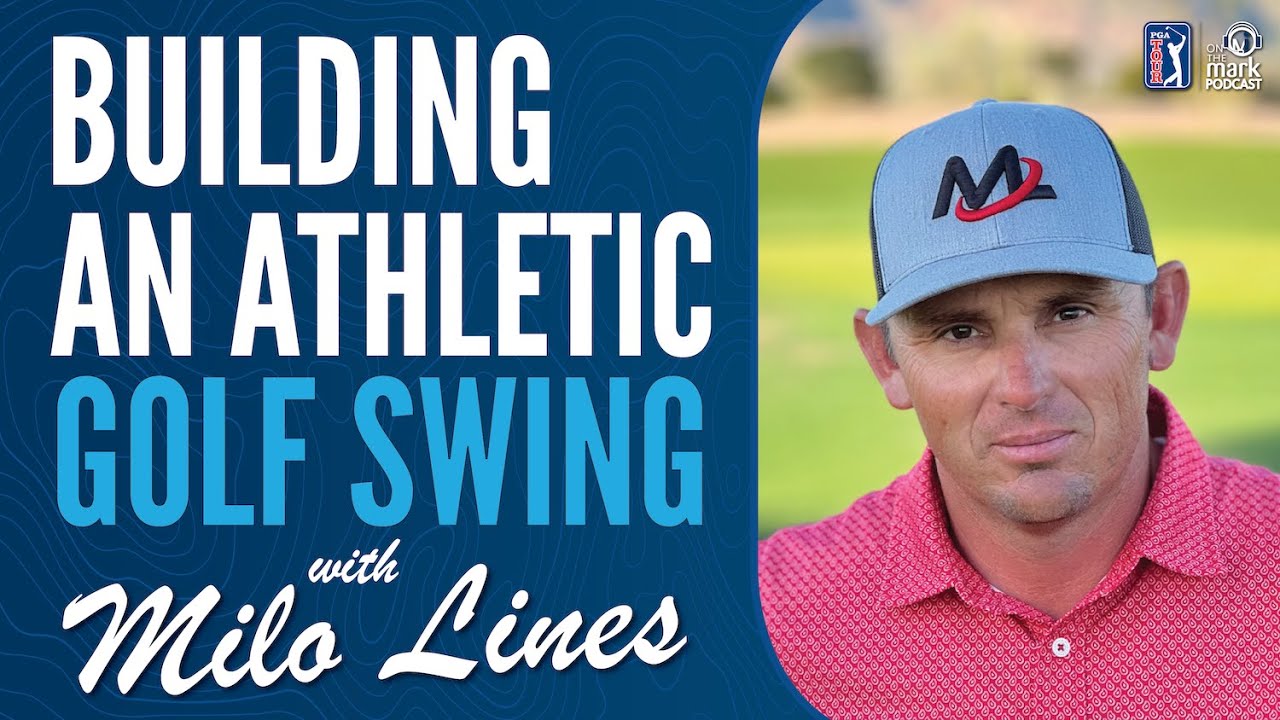
Milo Lines is a PGA Professional, a Golf Digest “Best Teacher in State,” and a former Tour Professional. His philosophy on the golf swing is that there is crossover, especially in sports involving hitting and throwing, with golf and the golf swing. As a teacher his goal is to apply the athletic skills you already have and teach you the skills you need in order to improve as a golfer.
He joins #OntheMark to help you apply your athletic instinct and experiences to make your golf swing more athletic and effective.
Milo shares his “5 Key Elements” to an athletic approach to the golf swing:
ALIGNING – Grip, Aim and Alignment
SEQUENCING – Swing Triggers, Timing, Rhythm and Tempo
WINDING – Turning and Tilting athletically
LOADING – The Athletic approach to the Transition and Change of Direction
UNLEASHING – The Automatic Release of the club thanks to proper Sequencing, Winding and Loading.
Milo also illustrates PGA TOUR examples such as Lee Trevino and Jack Nicklaus as athletic swing models, and teaches you a Drill (Laddering) that will improve your practice and unleash your inner athlete.
______________________
STREAMING: On the Mark is available on Apple Podcasts, Spotify, Stitcher, Google Podcasts and wherever else you listen to podcasts.
Apple Podcast: https://podcasts.apple.com/sz/podcast/building-an-athletic-golf-swing-with-milo-lines/id1096925460?i=1000733756131
______________________
ABOUT ON THE MARK: Mark’s knowledge, insight and experience have made him a sought-after mind on the PGA and European tours. Through his career, he has taught and/or consulted to various Major Champions, PGA Tour winners and global Tour professionals such as: Larry Mize, Loren Roberts, Louis Oosthuizen, Patton Kizzire, Trevor Immelman, Charl Schwartzel, Scott Brown, Andrew Georgiou and Rourke can der Spuy. His golf teaching experience and anecdotal storytelling broadcasting style makes him a popular host for golf outings.
______________________
SOCIAL MEDIA
– Follow Mark on Twitter: https://twitter.com/mark_immelman
– Follow Mark on Instagram: https://www.instagram.com/mark_immelman/
– Follow Mark on Facebook:https://www.facebook.com/markimmelman…
– Follow On the Mark Podcast on Twitter: https://twitter.com/OntheMarkRadio
______________________
WEBSITE: Read top-notch golf content from Mark at https://markimmelman.com
______________________
#golf #MarkImmelman #PGA #PGATour #juniorgolf #golfpro #golftip #golfcoach
[Music] You would think given my name, which is Mark Imlman, which I even I mispronounced, I could have pronounced my next guest’s name properly. And it turns out Milo, I was way too exotic with what I thought your name was. But anyhow, welcome to the show. How are you? I’m doing great, Mark. Milo Lines, as simple as that. You sound like a movie star. I don’t know about that, but it is a simple name. It really is. A lot of people think my name is the name of a dog. Well, I thought it was Milo Lenez, like some Italian stallion kind of thing, you know. Well, espanol could be. Okay, let’s dive in. Um, I’ve been watching you for a while. I really have. Um, you and I, our schedule just didn’t get groove very well, but here we are. and and you came to me with the idea, and we’ve talked about this before with other guests, but I love the way you phrased it. And you talked about how the golf swing is an athletic motion, and you had my ears perk up because I feel like people are being handcuffed by so much information. And then you said that every other sport has some sort of a or can have some sort of a positive influence on the golf swing. And just yesterday, my friend, I was doing a corporate outing and some guy said to me, he goes, “Oh, no, no, my tennis swing’s ruining my golf swing.” And I was like, “No, man. You are miles from the truth. So, please bring us truth there.” Okay. So, in my experience, Mhm. athletic motion crosses over from sport to sport. Yeah. Humans are designed to move in specific ways to be most efficient. And it doesn’t matter what, whether you’re hitting a tennis ball, hitting a baseball, throwing a baseball, or hitting a golf ball, the same principles apply. They’re just applied on slightly different angles with maybe slight adjustments to how you hold the golf club. Mhm. So, a quick example, Raphael Nadal. He’s a He was a heck of a tennis player. I’d say, probably still is. When they when they build a statue after you, then you know you’ve made an impact. Yeah. You’re pretty good. Yeah. He figured out how to play golf in a kind of a different way. He plays golf right-handed and he basically it’s a two-handed backhand. Yes. And his golf swing is very interesting. It’s not what you would design as a normal golf swing, but I believe he’s pretty close to scratch. And he does it utilizing his tennis backhand. Yeah. So, what you’re good at already can be applied directly if you understand how to do it. And that and interesting you would bring him up because for the PGA tour, Rafa was out there at TPC saw grass and they played the stadium course. So the tour sent out some cameras and they sent me the video to analyze and obviously athletic, you know, but if you want to learn how to hit a draw, watching that rougher Nadal golf swing would be right up your alley because like you say, it’s like a top spin two-handed backhand for for him who plays golf righty. For sure. So, he didn’t reinvent the wheel. He just utilized something he already knew how to do, applied it to golf, and off and running he goes. Okay. I love it. And it makes me want to question you, Milo, like what the influences in your because you speak with great authority whenever I look at your social media stuff. And not it’s not just with authority, it’s informational and accurate cuz Lord knows I I see some stuff on social that my eyes want to spout blood. So So I want to know from Milo, who were your influences? How do you come to where you are as a golf instructor now? So growing up, I was an fairly elite level baseball player. I played division one college baseball. Mhm. And in one summer I made the transition from golf or from baseball to golf and became a better than scratch golfer over the course of that summer. You’re kidding me. And wound up with a golf scholarship and switched and played golf. Serious? For real? It’s a true story. It seems almost unbelievable, but yes. That that’s my life. Okay. And I did it because my dad was my main influence. He taught me to play baseball. My dad was a first round draft pick who got hurt. But and he showed me how to apply the same principles that I used in my baseball swing to play golf. And basically immediately my first round I shot 83. I’d never played before really. And I could hit the ball fine. I just had to figure out how to get the ball in the hole. Yeah. Which that’s a whole another can of worms. That’s hard. Okay. I love I love that. And and I want to mine that deeper because at the outset people are going, “This can’t be real.” And then they’re like, “Okay, well, whatever.” But here’s the reality. If you really dig into the into the shadows of this, we live in an era where it’s not just about speed, it’s about information. Lord knows this podcast is wellreceived around the g globe because everyone wants to play better. So, everyone’s seeking out information. But here you are, you get into golf, you’re like, I’m a baseball player. I’m going to use my baseball style stuff and propel this ball forward. It can be people as simple as that. Milo, I’ll let you have the microphone after my observation. It 100% can be if you understand the modifications that need to be made. Mhm. A baseball swing and a golf swing have a lot of similarities, but they have their differences. Yeah. A bat doesn’t have a face, so you don’t have to worry about squaring a face up, but you are propelling it in an athletic way with a lot of speed. So, when you learn how to grip it correctly, how to align your hands correctly so you can square the face, all of a sudden you got this awesome thing and you can hit the ball a long ways. Yeah. Okay. I’m going to ask you this because you’re a baseball player now. As you say that, I can see with some of your demos, I can see the strength coming out of your hips and your legs and your core. And I can see you were obviously a power hitter in baseball by the just the way you deliver your golf swing. But I want to ask you this then because you just talked to me about understanding how to apply the hands correctly through uh out the swing and especially at the strike. Are you like a golf club into the body kind of a person or body out to the golf club kind of a person? Because essentially people sit in two camps and I’m always interested where people come from. U I think it’s a blend of both camps. Thank goodness. All right. Good. Go. So the interesting thing about me and my history is who I’ve worked under. So I was Mike Molasa’s assistant for seven years. So he’s a hands Yes. out to the club kind of guy. Yeah. And your your body will react to what your hands do. And I’d say maybe I see people who it does. If you’re a really good athlete, and for a lot of really good athletes, yes, it does happen that way. You train their hands, their bodies automatically do the right thing, but I coach a lot of regular Joe’s who aren’t that good of athletes, and their bodies need some training. Okay? Their bodies don’t want to work. And so, it’s a blend. You have to figure out who you have in front of you and what medicine to give them to make them better. That is so true, man. Because you know how it is. You got a great social media account and if someone gets themselves lost in there, they’re going to be like, “Oh gosh, this stuff’s sexy as heck. I’m going to do everything.” But you got to understand who you are and what your tendencies are as you go searching for information. Is that where you’re leading us? For sure. And and what you’re capable of doing. So, a lot of people see some of the pretty swings I post on my social media. You know, I coached some of the best amateurs in Arizona and a few guys on tour and they want to swing just like those guys. Well, when you’re very restricted from a mobility standpoint, what you’re capable of might not actually line up to what you’re trying to accomplish. So, you have to understand what you can actually do and how to do what you can do the best you can. That’s the hard part of coaching. Yeah, I’ll say. And we and I hope we’re keeping a lot of golf instructors who watch this accountable because I feel like sometimes we can be a little intellectually lazy as instructors and you kind of get into what I call methodbased stuff. Um, but anyway, you’re not going to do that because you’ve you’ve sent me a beautiful script that I’m going to follow. Um, and I just want to say this people, I feel like if you had to stop the podcast now and just go back and listen to what Milo had to say, you would probably make better decisions for your golf swing development. Anyhow, but let’s make people more athletic, which was your goal. And you got some key elements. You pitched me, Milo, and I’m going to read them to you. Then we can go through them systematically. Uh there was aligning, there was sequencing, there was winding, loading, and unleashing. What a great way of making verbs out of everything we’re going to do. So to me, it’s already talking about action. So let’s talk about aligning uh the key element. Go. So in the aligning phase for my academy, that’s how we attach oursel to the golf club, right? It’s how we aim the face. It’s how we set our body square to that club. Mhm. And how we build a setup so we have good balance and we’re ready to be able to move. Yeah. I I see so many people they go really arai right off the bat, you know, terrible golf grip. The grip’s kind of important. Yeah. How you hold it dictates so many elements down the chain from how you’re going to release it to a lot of different other things. How your body’s going to be able to rotate. Mhm. So that for us is like building block number one. We have to get ourselves attached to the club correctly. We have to get our bodies positioned correctly. Distance from the ball. ball position in our stance and how we’re actually balanced on our feet. I want to say this and I want you to respond, please, positive or negative. Um, so many golfers are in a golf tip sort of a mentality cuz that’s the world in which we live. And they’re like, well, I want to take something from this and go and do it right away and get better. Now, when it comes to aligning, you could do all this stuff well and that might not necessarily turn into better golf shots. But on the other side of that coin, if you don’t do this well, the guarantee is you’re going to have to make modifications and pre mid swing adjustments to somehow apply a club to golf ball. Is that where you go? Yeah. So, the aligning is basically it’s to simplify things. So, you have to make less modifications, less mid swing adjustments, you know, makes the makes makes the whole game a little easier. Mhm. Okay. Well, let’s talk about the grip because to me it’s the tip of the spear. And when I grew up, I’m dating myself, but I’m 55ish. I’m about to be 55. You know, we all learned the Van grip and you were taught that good golf begins begins with a good grip. Now, in the early 2000s, maybe a little later, there’s a cadre of instructors that made that taboo, and they’re like, “Nah, man. You just hold the thing however, and then you understand matchups, which there’s some merit to that.” I I want to know where you fit cuz here on a recent recent show with Randy Smith, I’m I made the contention. I’m like, “Randy, I feel like Scotty can save shots as well as what he does because of how neutral his grip is.” And Randy, the old wy old pro, sort of smiled and he sort of nodded and he goes, “Yeah, you’re right.” Where if he was holding the thing like big Harley-Davidson style, you know, he couldn’t make some of the shots that he does. So, where do you fit on the smiler? I have my preferences. Okay. What are those? My preference is a slightly strong left hand and a neutral right where the right palm more or less matches the face. So, a grip that would be like Ludvig Aberg’s grip would be kind of my textbook. But if you if you did everything he did, you’d be just fine, right? Yeah. I think he’s a pretty good model. But yeah, his grip to me is how I would teach somebody to do it. If I get to teach them from scratch. Okay. Now, if somebody shows up to my tea and they’re an 18 handicap, I’m going to change their grip if it’s bad. Yeah. Because they already stink. I’m not going to make them worse. Mhm. But if some someone’s a tour pro, their whole ability to square the face is already built. Obviously, they’re really good. So, changing their drip might not be where I go. Understood. How about the alignment? Because so many golfers, I call it Advil for the golf swing. Um, their bud will hit a crooked shot and let’s call it Joe hits a slice all day long that has to aim left for the ball to end some out the target. He hits one bad shot and his buddy Pete says, “Yo, Joe, you you’re you’re aiming badly.” So, so where do you fit on the alignment thing? Because this is like chicken and egg to me. So, I’d love to know your take. Generally, I like parallel lines. That’s a generality. There are adjustments I make for players based on mobility and different things. So, if you have difficulty internally rotating into your trail hip, maybe we open your foot up and drop it back a little bit, give you a little bit more room. So there’s Hallelujah. People watching on YouTube just saw me saw me celebrate. Yeah. So I don’t I’m not like somebody who says this is how you have to do it. Yeah. I have my preferences and I’m going to start there generally, but I’m going to watch how you move and see what you’re capable of and I’ll adjust things based on what you can and can’t or can’t do. Yeah. I think the gold there that you just shared is you play around what you’re able to do. Huh. and and and you understand the influence of what you’re doing as opposed to just get up there and say, “Well, I have to stand like this because that guy stands like this.” For sure. Well, one example I like to use, Lee Trevino. So, back in the day, Lee Troino’s stance was, I don’t know, 20 30 degrees open. If you watch him hit golf balls today, it’s not open anymore. Yeah. He’s he’s more closed. Why? He got older. Can’t move as good. He still wants to make that big turn so he can get the ball out of his shadow. So he’s changed his his alignment. Yeah. So I think that’s something that will change based on mobility and flexibility and things like that. Yeah. Um the next key element is sequencing. And I contend that sequencing is kind of like that secret sauce to every good golf swing. and and it’s something that’s weird to kind of teach and how you can have a fundamentally fairly sound golf swing but it’s if it’s out of sequence you know the golf is golf ball’s not going to cooperate very well. So so so this one to me really stands out. So talk about sequencing please. So the sequencing is the glue that holds all athletic motions together. So whether it be throwing a ball which is kind of one of the first things we learn as a kid or hitting a golf ball or hitting a baseball. So, as the the way we shift pressure from side to side, foot to foot, has to precede the motion of the thing we’re going to swing or throw. Yeah. And so that’s what where I start with a lot of people is I teach them how to swing a kettle bell and how you use your mask to get started and then swing the kettle bell back and then your mask goes the other way and then you swing it through. Yeah. And that same principle holds up in golf. holds up. And if I’m hitting a baseball, I kind of I stride forward as my hands go back. Yes. You know what? You know what I love about that too? Because it’s been an issue for me forever as a golf instructor where um the the analogy I would draw. My eldest daughter when she was a little kid was just had a beautiful way with color and we’d give her crayons and she’d make beautiful pictures just blending color, right? But it was always kind of haphazard because she didn’t understand how to color within the lines. And when she eventually knew where the lines were and what they represented, the pictures got infinitely prettier and and then people will someone will go for a lesson and the teacher says, “Well, you got to shift your weight.” But then they never put the lines to it or the boundaries to things. And when you talk about that kettle bell bell thing, you know, you won’t over move on the way back and you won’t over move on the way forward. And you and that’s a part of sequencing is you know knowing when things shift direction as well. It’s not just one way or the other. Yeah. So the timing of it is key. Yeah. So we don’t what one of the things I see from a lot of amateur players is no motion. So they basically become still and then they try to be totally still. That’s almost more poisonous than too much motion. So, one of the things I try to get people to learn how to do is how to have a trigger. So, there’s a little bit of something going on before they start the club. Mhm. Then they they create an early shift, but then they’re they’re shifting back as they’re finishing their their wind out. Yeah. You’re like a godsend because the podcast all the previous podcast of ours was with Kyle Burkshshire and you know how he starts the golf swing. I used to shift back and forth a little bit to get the mass moving. and a longtime friend of mine, and he’s probably listening. So, what’s up, Terry? Terry Rolls has an issue with golf instructors who limit movement and tie people down as opposed to just explain to them how much movement they’re allowed. And and you’re so right. People are like, “Well, I sway too much.” And the next thing they’re just stuck to the ground like that. And every ounce of their athleticism is removed. Yeah. And my number one tagline is swing like an athlete. and athletes are not stagnant. So that’s one of the very first things I try to create for people is the proper athletic flow in motion. And I’m guessing then that once the aligning has taken place, you’re very much an advocate of a little, you know, slight movements in the athlete to keep him or her a little bit more mobile, a little bit more nimble and supple before they swing. Yes. Yeah. Anybody who’s taken a lesson from me knows that there’s no standing still allowed. Well, look, it’s so true. You know, little movements in the feet. Have haven’t you seen ladies, too? How like if you ask them to widen their stance, they never lift their feet off the ground. They just kind of do this little shuffle thing as opposed to lifting their feet up and you laugh. I can see you laughing. Am I wrong? Oh, I’ve seen it in hundreds of them. Yes. Okay. So, sequencing is movement and understanding when you move and how you move in relation to the club. Let’s talk about the sequencing with body and club, too, because I feel like sometimes there’s a disconnect with people. Like they go for a lesson and my teacher told me I need to wind up a little bit more. So, they’re just winding and the club’s not even timed with that movement of the winding. Whereas, like I’ll never forget for as long as I live. Um, first time I met Nick Felder, who’s a gigantic man. I’m not that big. And I look at him and I summon up the courage to ask him some advice and I’m like, Nick, what’s the most important thing in the golf swing? and he looked at me like this quizzically and then he walked away and I was like, “Okay.” And he stopped about 30 yards from me and he had a club in his hand and he’s waiting for me and he’s doing this just waggling back and forth. And I get to him and he doesn’t say this is the secret. He goes, “The club head’s got the furthest journey to move. Make sure it moves the most.” And this is by the Yeah. See, and this is what struck me because this was when Felder was at the height of his powers and everyone thought he was technical, but here’s Felder going, “Well, the golf club head’s journey is a lot bigger than my left shoulder, so I got to time how these two things move over different journeys.” Yeah. Yeah. So, learning how to time the motion of when things load and unload, that’s that’s key. Is it a simple I mean like if you were giving me a lesson right now and I was out of time and I the club wasn’t commensurate with my body, would you just have me swinging back and forth without stopping or is there a drill you’d use to help people feel what we’re talking about? Well, the first thing I would have you do is just waggle the golf club. Okay. While you’re sh like doing the kettle bell swing, so you’re you’re kind of shifting opposite of the club. So you’re learning what it feels like to to create that that dynamic opposition. Yeah, it’s amazing, too. Someone came on the show, forgive me, my 55year-old brain’s failing me slightly, but they were talking about, I think it was the yips, right? And one of the ways that they would cure the yips for someone chipping is they’d actually roll the golf ball towards them and have them hit the thing because then the athlete just kicks in and they’d step and swing, right? Instead of being like stacked and then they got to move stuff. That’s actually a gosh, I hadn’t thought. One of the drills I use for helping people feel how to swing in a more athletic way is I’ll roll them balls slowly and have them step and hit it. Yeah. So, when they step and hit it, all of a sudden they’re like, “Oh, that’s different.” Mhm. They they learn that their their body is going forward while the club and their arms are going backward. But Milo, you but people told me I had to complete my back swing and turn my shoulders. Don’t you hear that then? Oh yeah. Oh yeah. It’s Well, that’s the this is what I my goal with this podcast is to clear up misunderstandings and you’re doing a great job of this because everything sometimes can be so black and white when it comes to information or there’s misunderstanding and then all of a sudden the whole gist of the thing, this athletic motion gets lost on people and they’re paid buku dollars and they don’t get any better. For sure. Right. Let’s go on. Uh, aligning, sequencing, winding. All right. Um, now I’m I’m assuming these are in chronological order. So, you more interested in sequencing than winding. Am I correct in that assumption? Not necessarily more interested. It’s just where I it’s the order I teach them in. Okay. So, I want people before they ever even start to pull the club back, I want them to understand how they’re going to shift math and get the thing going. Okay. Lovely. All right. So, let’s get into winding now. So, once the player has shifted their mass and started to wind up, it’s key that they have symmetry in the way they wind up. Where I see people go wrong is they will turn way too flat or they will tilt. And both of those are not winding the system up. We want to wind up more or less parallel to the plane we’re swinging in. Yeah. So, If I’m bent over, I don’t know, some 45 degrees, I want to wind my body on that 45 degree angle. I’m going to throw you a curveball here because then everyone wants to hit the ball farther. And they’ll watch one other golf swing power guy, power a pining guy or girl, and they’ll be like, well, we got to go into stretch and then compress and then stretch. Because they they’ll talk about lifting in the back swing. But then I see people not just stretching on the angle you talk about. It’s like everything just moves to your point and then next thing the shoulders are all horizontal and their body’s up here somewhere and the ball’s down on the ground and they’ve got they got more chance of seeing the Messiah than hitting the golf ball. Yeah. So in a proper windup there is some amount of stretch. So my trail side is getting elongated. It’s getting stretched tall. But I really don’t want to see the the head going up and down that much in the back swing for golfers. Now log drivers, that’s a whole different ball of wax. We’re we’re trying to get your actual center of mass farther away from the golf ball so it has farther to drop so you can create bigger amounts of force. But all that motion makes hitting the ball straight a little more complicated for the average guy. So I I like it a little more simple. We’re we’re creating a nice wind up with symmetry. I want to to that symmetry thing. Um because the next one after winding is loading and maybe been bad. So I want you to fix me here because I’ve almost maybe lazily. I’ve used both terms kind of in as as not not um independent of each other. I’m like, well, you need to load up in your back swing, but you need to wind up. And I sort of talking the same thing. How do you see loading and winding as they as as as we’re building an athletic golf swing? Yes. So, here’s where we make a on purpose a big differentiation between winding and loading. Okay. For me, I can be wound up but not really loaded. Okay. where the the loading happens is when I change directions in the proper sequence and that creates a a final stretch of the muscles, the tissue that’s going to be unloaded. So when a player throws a ball, they’re not fully loaded until their their body starts to unwind. Now my arm is loaded so it can spring. or in a golf swing, I wind up and when I change directions right there, that change of directions creates a big stretch across the posterior chain here and the anterior chain here. Now, my arm line is loaded, ready to unload. Gosh, you look so powerful when you Folks, you need to watch this on YouTube because when you’re showing that move, when you’re going from winding in the back swing to the transition and the loading phase, it just looks so strong, man. I mean, it’s it’s amazing to me how people’s swings sort of look whimsical and kind of flailing around the place. You’re showing me something that looks athletic when you’re making that move. Well, it’s it’s powerful. When I do it, it’s powerful. I’m I’m small. I don’t know how big you are. I’m like 5 foot n. Yeah, I’m the same. And I can go 193 194 ball speed pretty easy. Okay. I can’t. Maybe I should focus on this. And that’s where that that wind and that last load, that’s what creates all that pent up energy that I can get out. Okay. Well, then Okay. Now, yes. help me with the drill because I am like all over this right now and I’m like what Milo is saying is everything that I’m hankering after because if again I talk about Felo I’m not name dropping here but I’ve talked to legends of the game both on this podcast and off and you know what the common phrase with a lot of them is they’ll all talk about the value of the transition between back and down swing and look go impact is the moment of truth but they all say well the club’s going one way and I’m going backward, then I got to go forward. Now I got to change direction or load as you say. And a lot of folks, they get that thing all confused. Club golfers. Yeah. It’s it just gets messy. They get it backwards. Ruined. Yeah. They get it backwards. Yeah. Yeah. When I watch most club golfers, they create this windup and then as they they change directions, the the the first thing that happens is their hands shoot and so they never create that last load that I’m talking about. So they they wonder why they make 80 mph club head speed and it’s like well because you got everything out of order. Well, I noticed this, right? Because we’re building an athletic swing, but not one of your key elements. Now, and this just occurred to me has got anything to do with hitting. You have aligning, sequencing, winding, loading, unleashing. There’s no hitting there. And everyone gets the swing, they’re like, I got to hit this ball in front of me. That just occurred to me. on purpose. I think part of the problem that most people have, they see that ball sitting still down there, they wind up and they want to hit it. Yeah. And so they get in a hurry to get the club and their hands and everything back to the golf ball. When if you want to hit it hard, you actually need to take the roundabout way. You need to wind up. You’ve got to stretch everything out. Let that club center of mass stay back. So then it unwinds later out into the golf ball, just like the barrel of a bat would. I’m going to use a tr term that you’ll hear from every single one of the PGA Tour professionals and good golfers and they’ll talk about patience and yeah, they’ll talk about patience and maybe being defensive with club selection or target acquisition and stuff, but there’s a certain patience to doing this athletic move correctly, too. And and and yes, and now we’re on to something. Well, at least I’m enlightened. The longer the club gets driver which everyone wants to hit better the more this loading phase this patience of you know creating that proper environment in transition the more important it becomes. Yes, 100%. Which is why the driver is the bugaboo for the vast majority of golfers and for those who are really good it’s probably the easiest club to hit fairly well. Yeah. But but but here’s the thing too because you talked about a little earlier how you know we’re moving side to side but the good golfer or the athletic golfer knows when movement gets stalled and actually goes in the opposite direction. Yes. Now now I want to talk about this because God grinds my gears. There are so many handle pullers in the game nowadays because everyone’s trying to get some shaft lean through contact and these very same handle pullers are hitting the right side of the target as sure as I talk to you if they’re right-hander cuz they’re not stalling at the right time to let the club overtake. You’ve got unleashing coming next. So the load phase but that unleashing is not just hitting like a banshee. It’s actually a slowing down of all this mechanism to transmit the energy to the club. Yes. Am I right? Yes. 100%. So when we unleash the golf club, that’s the point in time where we begin to kind of push back up and extend and the release becomes something that’s more automatic. I see way too many players trying to pull the hands across their middle. In a good golf swing, your hands never go across your middle until the ball’s gone and the club’s unloaded. Same thing hitting a baseball. You don’t pull the bat across you like this. You turn and you you kind of post up on your front leg. It’s like the braking system that spits the energy out into the club head or the bat head. I love the description and I want you to I’m going to mine that with you a little bit too because you’ve said something that I think might have gone missing or people would not really listen. Maybe it went over their heads. You said the hands never pass the middle. Let’s camp there for a little while because there is gold in what you said. Um let’s delve deeper into the hands not passing the middle, please. Okay. So, I need to actually be able to demonstrate a little bit. All right. Audio listeners, you got to go to YouTube because Milo’s about to show us what he’s talking about here. Here, go. So, in a good golf swing, my hands get to about here. So, they they elevate some. They go a little AC, a little to the right of my midline. Yes. I wind up. I stretch. I keep unwinding. And my hands at contact are still to the right of my midline. So, my chest is pointing somewhere left of the ball. My hands are still to the right. Yeah, I’m giving you two hands up. Golfers, you need to listen now. And I’m going to have him say this again. And if you if and we’re going to describe, if not, go to YouTube and watch this. You will hear so many people when they’re looking for shaft lean at contact or they’re looking because they flippers of the golf club or they’re trying to get the lead side, the left arm and the club everything kind of over their left leg at contact. They see this moment in time, right? And so they’re just pulling the arms down in front of them and the handle passes the buttons of the shirt and they’ve hit that spot they think they got to get to. But what you showing me there, Milo, is your hands have not passed the buttons of your shirt at all, but your your left arm’s down your left side. Please do that again. Okay. So, we’ve wound up. We change directions. My left arm is actually staying to the right of my middle. That’s loading. And my body’s turning. So, my buttons are pointing that direction. My arm’s to the right of it. But you can see my hands are over here on my left leg. Yeah. Uh-huh. You don’t ever want to make your hands go across your middle. If you do that, you’re going to be you’re going to struggle. You’re going to hit the ball straight to the right and you’re never going to have any speed. Yeah. How about this? You’re going to have a your health. You’re going to have a share of shanks. You’re going to block a bunch of shots. They’re going to be all wiped and nasty. If you’ve got a lofted club in your hand, you’ll never hit the ball the right distance at all. It’ll go higher and shorter. Yeah. It’s But that’s the misunderstandings that I talked to you about before we went live. Yep. People see the still image and they misinterpret how that is created. Yeah. Exactly right. Exactly right. Um so here we are. Aligning, sequencing, winding, loading, unleashing, folks. It’s worthwhile you watching what Milo was just doing. But here’s the thing, too. Okay. It’s weird as you were demonstrating that and I want to add something to maybe this fits in with sequencing, but in the loading phase where the body’s shifting direction and your arms kind of stay behind you and it’s like your body’s turning into your lead arm, right? Mhm. And then you’re unleashing where you keep going and the arms are trying to overtake but they don’t overtake the buttons of your shirt. Right. Yeah. Um, I don’t think people realize then for the really athletic golfer that through impact that lead wrist which appears firm, it’s a victim of circumstance. And then I watch so many golfers on they have a flipper and the next thing I see the Megan followroughs where they’re halfway through into the finish, the left wrist hasn’t released at all, the club head is still out to the right side of everything. They’re giving up speed all in all in the interest of not flipping where what you show is I don’t think you could flip the club fast enough. You honest if you honestly do what you were doing there in the downswing. Am I right in that assumption? Yeah, I don’t think you could because there’s so much the right word. Okay. There’s so much torque coming from the middle out that the club is not going to overtake you until the ball’s gone. Yeah. Well, that’s a Well, but you played baseball. Now I think of a baseballer. when you guys jack that thing in it head out of the park 300 something 400 feet whatever it is um there’s this big unwind and stuff and then the bat accelerates past everything and they middle one and then the it’s going so fast the bat that the hitter can’t keep the bottom hand on the thing anymore right because it’s just hurtling past so that leads to a point so when we look at the release in a golf swing have you ever noticed that the shaft is almost always bent like the opposite direction. Exactly. The opposite direction. So your hands are actually not keeping up. You can’t if you do it correctly, the unloading of these angles happens faster than you could actually push it. So it it it’s accelerating faster than you can imagine. It’s just it just shoots. It’s so cool. It it’s it’s something that if I I guess now if I had a wish for every golfer, it would be that. But that’s created by a set of circumstances that happened before it. And you’ve walked us through those. It’s Yeah, you got to get all the dominoes in order so when you knock them over, they all fall down correctly. I’m I’m I’m going to go and practice after this now. And I’m going to now go fiddle because I’m a fiddler and I got 3,000 swing thoughts in my head coupled with my own. Okay. Um and here’s what I’m going to likely feel. I’ll feel less handcuffed. I will feel less mechanical. I’m ex ass assuming, and correct me if I’m wrong, I’m going to feel a lot more movement after contact through the bowl. The club head’s going to free up. Am am I right in in what I’m describing to you if I did this analytically on the way down? You’re going to feel like you’re you’re slinging the energy out away from you and you’re going to feel a lot of length, okay, beyond the ball. Well, help me then because then, right, because because this I’ve joked with lots of people. If you’ve listened to this podcast at all, you would have heard me say that one day when I die, my wife, cuz she’ll outlive me, is going to take my ashes and sprinkle them on one of the golf course. And then I want one little plaque that’s only about that big that says to Mark, who spent his whole life teaching bad golfers to hook the ball and good golfers not to hook the ball. Right now, you’re laughing. So, you’re the same way probably. Now, the good golfer or the guys with the inside out path and gals who get the club behind them, it’s out to the right too much. Then they go to some guy or they get on a launch monitor and they see this path is wildly right. Now they’re like, “Well, I got to turn the corner. I got to turn the corner.” They’re pulling on the handle so hard that the next thing their right solid shot is now wiped off to the right hand side. Were you telling me that you’re feeling this club sling away from you, but your body’s rotation is turning, making it turn the corner, and you’re not pulling the handle around you? Am am I right there? Yes. I I would never teach a person to pull the handle around them. I teach them you’re turning the corner and slinging the energy out away from yourself and bracing because that energy wants to get away. So, the club’s trying to get farther away from you as you’re turning to your finish. Yep. How athletic would I mean, think about anything from a forehand in tennis. I can think of a guy bowling when they launch a one down the right center of the alley of the alley, right? Same thing how the arm releases. Yeah. Yeah. Same thing. A submarine pitcher, a home run hitter. I like to think of King Griffy Jr.’s baseball swing. Oh, see all that that extension? That’s what I’m after in my golf swing. Same thing. But the extension can’t come before the body has led it to that place. That’s the Yeah. The the body’s got to get out of the way so that there’s room for that to happen. Oh, that brings up a good point here because if you’re not engaged and proper at a dress and you’re not really engaging your core, if you’re delivering that energy, the club may pull you towards your toes and you might lose a little shape if you’re not careful. Huh. That’s why the the setup has a place. If we don’t get the aligning phase correct, that energy that’s produced by the golf club, it it will suck you in and you’ll see that early extension. You’ll also when we set up incorrectly and we load muscle chains prematurely, they’re going to want to get unloaded prematurely and we’re going to see problems. So, well, well, think about this too, man. and I’ve got stuff all over in my head because there are certain buzz phrases in golf instruction and they come and they go and I’m old enough to have seen a lot of them now they’re coming back where early extension was like the cardinal sin but then I I’ll counter with a point well Jack Nicholas man that guy wasn’t trying to keep his bum behind him but he understood how he worked but but in transition and how he wound up you that guy was as good as anyone there ever was. Oh yeah. So yeah, if you got a real speed that’s happening through there, you’re going to have to work hard to turn away from that speed. So you don’t early extend. Yeah. And his early extension, his his swing was on a more vertical plane. So he was creating an upward motion that matched the was basically creating a parallel force vector to get the speed out. So with that, give us marching orders now because I’m a big one for stealing with one’s eyes and we live in a visual era and there’s Instagram which yours is great people. I’ll let you share the handle in a minute. Um, and I always put up videos of people and I don’t tell people what to look for. I’ll say to them, what do you see? Right? And I’m so a big one for stealing with my eyes. So I’ve mentioned Jack Nicholas. If you had to give people to say, “Okay, now go to the internet and now go search for these swings. These are athletic. These are nice swings to you might not swing like them because you’re a different build, but these are good things to emulate. Who would those be?” Okay. Well, you can’t go wrong with Rory Mroy. He’s he’s not a very big man and he’s very athletic and he sends that golfer. Yeah. He’s like a he’s he’s a Ferrari. He’s athletic. Yeah. Um, yeah, there’s so many golf swings that I love on the tour. Okay. The ones that I love Windham Clark’s golf swing. Yes. He’s very powerful. Well, if you I tend to like faders. Well, well, if you had to talk about the loading phase, Windham Clark is like that on acid. I mean that guy the way he the body lowers in transition. You can see his body is trying to unwind. The arms are behind him. That’s why he leads the face so much. That’s why he can hit that power fade. Yeah. He he he unloads as well as anyone in the game. Yeah. He’s a man after my own heart. That’s kind of what my ball looks like. So I like he’s he swings like an athlete in my vision. But so many of them do, you know. How about this? Uh because because like like Windham. Yeah. If you want to hit a power fade, he’s a good guy for you. Rory releases the club head actively with his hands a lot more. He’s kind of if you want to draw the ball, he’s a good example for you. You love the fade. Um I want to throw one from left field at you here and go how about and you’ll see a thread here like a Luke Donald or Louis Westen or an Ernie else where there’s a little bit it’s athletic but there’s a bit more sling of the club head with a hands down through the bottom. Yeah. So they their bodies don’t get out of the way as good. Yeah. They are a little more hands arms driven type patterns. Mhm. There’s they’re amazing. They’re more tempo based. So the way that they swing the golf club, they need to have very flowing tempo. Mhm. Because if they didn’t, they’re going to have they’re going to lose control of that club face. Well, yeah, but that I sort of led you there a little bit. And you you make a good point about the tempo because even though it’s more languid, the winding and the loading phase, they don’t go away. They’re still there. It’s not as maybe not violence, not the word, but more as like driven and athletic, but it’s still happening. Oh, yeah. It’s still there. It’s just slightly different. It’s not they’re not as loaded as like uh I was just thinking what’s the kid from Australia uh Lee Minu Lee? That’s a swing that’s like a rubber band. He loads that thing and shoots it. Yeah. And he’s long as well. Yeah. Yeah. Absolutely. But this is fantastic stuff and it’s super simple. So you can make some sort of an acronym out of it. Aligning, sequencing, winding, loading, unleashing. and you’ve done a great job of sort of winding the whole thing together to make it athletic. Um, Milo, I want to ask you to leave people with something like this because they’re going to go and practice and my desire is that people would practice productively cuz practice isn’t just hitting balls. So now send us all on our way with a drill or something we can do. I’m thinking of the stepping drill, but something we can do to just make sure that when we’re doing this stuff, once we align properly, that we are doing the right thing for our new found athletic golf swing. Please. Yeah. So, the first drill, once we’ve got good grip, good alignment, I like to start off with just some little steps and just hit some little clippy chip shots where I’m basically I shift, I wind, I shift, I unwind. My hands and arms are just kind of passengers on this train. All right. But I’m learning what it feels like to create the shifts ahead of the motion of the actual club. Gotcha. And then once you can can do that, then we begin to add in levers. So we do the same motion, add in a lever, and hit shots. And you’ll really learn what it feels like. It’s almost like playing catch with somebody. You’re stepping and throwing. You’re stepping and throwing. Very simple. You make it sound simple. Yeah. You make it You make it sound It looks so easy. Um, okay. Now, make sure because I know what people are like. They’ll be like, “Okay, I’ll I’ll clip two away for Milo if I’m lucky. I’m going to be hinging my wrist and levering into the thing up for another three if I’m lucky. Then then I got my driver and I’m going full bore. Please make sure they do this. Please make sure they do this correctly.” They do this a lot, don’t they? Yeah. So for me the most people they they hit two of them like I want and then they’re immediately full speed with a driver. My my way of doing it I call it lading. So I like to building blocks. We’re going to let’s say we hit that first little clippy one 30 yards. Let’s hit the next one 40. Okay. 45 50 55 and work our way out. You’ll probably find a spot where things start to break down for you and you start to do things a little wonky. Yeah. dial the speed back, build it back up again. Over time, you’ll get to where you can swing full and make the motion you’re trying to make. Yeah. And and people, that is productive practice. You don’t have to hit a driver to make your golf. You’re developing your golf swing. If you’re doing this, it’s not hitting your driver. Yeah. Well, that’s just exercise. It’s whacking drivers. You’re not actually Yeah. You’re developing a reflex. Yeah. And that’s what we want eventually. We want the golf swing to basically be on autopilot, but it doesn’t get there that fast and changes don’t happen quickly. Mhm. This is true, man. This has been great stuff. So cool. Building an athletic golf swing with Milo lines. All right. Uh please for the fans because I know they probably want to find more. Where do they go and find you on the internet? Well, I’m everywhere, but my online academy is milolinesgolf.com. All right. So these principles are the the framework for an online program that we’ve built. We’ve got I think we’re we have around 600 members. Okay, cool. At any given point in time that are getting personalized coaching. So we walk people through this. We give them a monthly swing analysis and a practice plan so that they can work this roadmap for themselves. Um you can find me there. So miloinesgolf.com. I’m on YouTube. I think we have 80,000 followers there. That’s just Milo Lines Golf. And then my Instagram is Milo Lines_olf. Fantastic. Yeah, great stuff. You’re doing awesome work. Uh the the truth of it all is the is the attractive thing to me, but the athleticism is another because the great Jack Nicholas, we’ve mentioned him already. He said to me one time, he goes, “You swing the club through the positions. You don’t position the club through the swing.” and everything you’ve talked about now smacks of that observation. Yeah, there’s I I don’t really like positions. I like I like athletic motion and that’s that’s what I’m after. You’re preaching to the choir. Hey, listen. Thanks so much for joining us. Thanks for being so free with all your information. I really appreciate you. My pleasure. [Music] [Music]

16 Comments
Another great episode.
Marcus from GRF Golf would be another great guest for the podcast.
He was a pitcher. Power hitter? Seems like Malaska has a method that takes forever to embrace and is always speaking to same thing only different- and Mike can do it -but few others ever can.Milo is elite golf lite minus hours of anatomy dialogue and tissue autopsy. You can see him working with regular golfers and see improvement…
Liam Robinson is a proponent of the same movement driven swing mechanics. I find it very similar, and freedom giving swing feel. No nonsense approach
Milo is a great instructor.
In swinging a golf club….we want movement. We want motion. People are afraid of motion.
The most important thing in the golf swing is…. 🥁 (Drum roll)…is 'Two-fold'
(1) following the Correct Order of Movement… aka "sequencing"
(2) Tension relationships within the body. Note: You can follow the correct order of movement and utilize proper mechanics. However if you are fraught with tension within the body… You simply can't play.
Bottom Line…. There are many different "ways" to successfully swing a golf club. The two things every one of those golf swings has is following the correct order of movement AKA sequencing and swinging tension free. You can stand on your head and swing it for all I care. But if you do….you have no choice. You must have proper sequencing in your golf swing coupled with a tension free swing motion. Note: I'm talking about tension coming from an incorrect power source (the upper body force created by hands and arms). Yes… There is tension in the golf swing but it is the 'result' ….not an 'action'. That is KEY! It is muscular tension that is created and correctly applied within the system. Note: if you wind up the body correctly on the backswing…..If you do that the downswing will happen automatically by simply transferring weight to the front foot. Wind up correctly… Transfer weight to the left foot.. The whole system will unwind automatically. You don't have to mess with it. Just hold your chin back (Alex Morrison…"Chin it") and the swang will unwind in the correct sequence. You don't have to do anything. Lastly… Ideally, the dominoes that we want to fall in the golf swing are the "result" of doing things correctly. ***You NEVER want to create an action when we don't need to. We want to set up the right circumstances so the Domino's fall in the correct order. That's what we're hunting. We want to allow those dominoes to fall down. We don't want to create an action to force the dominos to fall down by smacking them with our upper body, hands and arms.
Rip Van Winkle here 😴…. I returned to golf a couple years ago after a 20 year hiatus from all things golf. When I woke up from my hibernation I discovered Milo Lines on YouTube. 👏👏👏 🔥👍I've been in golf for 50 plus years.. Just like in all walks of life there are good teachers, average teachers and poor teachers. In my experience Milo is one of the few teachers that when he talks you need to open up your ears and listen. One thing I like about him is how he associates athletic movement in other sports to the golf swing. Good interview 🔥🔥🔥
I think the kettle bell drill talked is so underrated. I saw it with dr kwon when he first started his youtube channel. Its too bad dr kwon does not see to promote it as much anymore.
To this day the kettle bell drill dr kwon teaches was the first time in my golfing life where i finally understood what thw golf swing is and how the down swing starts. It teaches you golf is the same as walking.
I also learned of dr kwon and milo through bebettergolf.
Milo and team are great. I went from a struggling 13hcp to a 4-6hcp in a year.
Milo, you’re the real deal. You’re the only coach I’ve come across who truly practices what he teaches, and it shows. Your explanations actually make sense for the everyday golfer, not just the elite few. It’s refreshing to see someone so authentic and grounded in a sea of overcomplicated instruction. Brilliant work.
I’ve watched a lot of Milo’s videos. It’s obvious his golf swing has its roots in a baseball swing. Watching his instruction it’s my opinion it would require buying into his style and not mixing it with other methods to be successful. I believe it requires more athleticism to swing this way. I have tried it, at my age and back condition it’s not for me, but for younger flexible golfers it’s certainly a viable method. Milo hits it a country mile. It’s good to see that Milo has a personality, he is so serious in his instruction videos I was beginning to wonder. Maybe that’s a reflection of the passion and belief he has in his teaching.
Mark thank you for having me on! I had a lot of fun chatting about this crazy game we both love so much. I also want to thank your audience for listening in and for all the nice comments here.
Mark, please consider having instructor Andrew Emery on your podcast. He is very helpful for amateur golfers.
Great show! Milo and his coaches are fantastic.
Milo's older videos on YT channel when it was golfletics shaped the way I swing, and that's never been superseded. Those comprehensive videos in my opinion are absolute gems to revisit. As a 5ft 7 guy I could also relate to and mimic his movements more easily, and although I don't hit it as far I can outdrive bigger guys or at least keep up with them, and I am able to be competitive for my club in the scratch matchplay leagues around the Scottish capital. Many thanks for the gift Milo.
The challenge with golf is that it is on a tilted plane, and the brain has not yet caught up to make that a natural motion to play golf – for the majority. There is a lot of information out there, and there are many ways to swing a golf club. It is difficult to find a decent golf instructor to find the proper input an individual needs, then there is the other challenge of making sure you practice that input – correctly. Milo is obviously method, and that works for many, but some will struggle as they don't have the same flexibility as Milo. Also interesting that Henry actually swings the club differently to Milo, although teaching the same thing.