
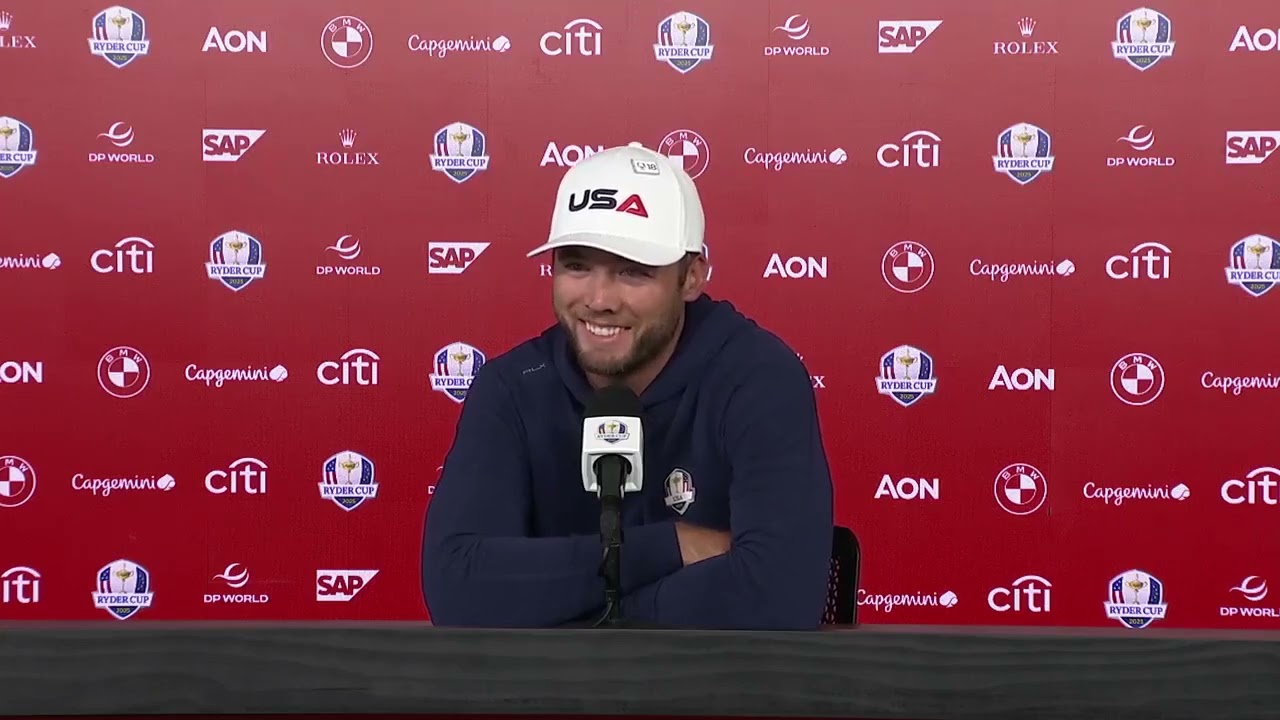
Sam Burns previews his second Ryder Cup — and his first on home soil — breaking down how he’ll feed the New York crowd, why Rome still stings (“losing sucks”), and what makes match play his favorite format (momentum swings, freedom after mistakes). He details his clutch-putting routine for those 5–8 footers, the Bethpage greens with subtle breaks, and how he stays calm but aggressive.
Burns also reacts to Donald Trump attending (“an honor”), explains why the PGA of America stipend matters for his Louisiana hometown charities, and shares fun bits on Coach O, less small talk with Europeans, and prepping for both four-balls and foursomes.
Sam Burns joins us now at the 2025 Ryder Cup. Sam, welcome to your second RDER Cup. Let’s go ahead and jump right into some questions here. Mike 16. Uh, hey Sam. Um, just wanted to ask you about your relationship with with Donald Trump obviously coming tomorrow. Um, I think he said after the BMW championship that you could eat safely in Washington DC now, but I just wanted to expand on your relationship and what it means to you for him coming tomorrow. Yeah, I think it’s uh it’s a huge honor to have our president come to this event and support our team. Um, you know, this is about representing our country and representing the United States of America. And who better to represent that than the president. So, I think we’re all excited right here on three. Cameron, making your writer cup debut a couple years ago in Rome. How much are you looking forward to being able to experience this atmosphere at home this time? Yeah, for sure. Sure. I mean, it’s, you know, it’s obviously very different playing away verse home. Uh, and I I haven’t experienced a Ryder Cup at home yet, but, you know, just these last couple days with having the the support of the fans out here. Um, and then, you know, playing a President’s Cup in Charlotte, pretty similar. So, it’s been great. I think, you know, these these New York fans are very excited to have us here and they love their sports and um you know, we’re going to try to go out there and give them a show and uh play our best and uh hopefully kind of feed into that support. How much of what happened in Rome has kind of been on your mind or maybe even a sour taste in your mouth over the past couple of years? Yeah, I think as you know, as competitors, um you know, losing’s never fun. um you know it doesn’t matter what what sport or what game whatever it is you know losing sucks in general um and so I think you know for me and and for us um you know we we want to use that those memories as fuel this week and um you know as we prepare just I think everyone that was on that team or watched uh you know vividly remembers what that feels like and so you know you you don’t want that feeling again. go over to nine. Starting with Dylan, what do you love so much about match play? You’ve had a bunch of success. Well, I think for one, it’s it’s such a different style than what we typically are used to week in and week out. Um, you know, it’s either me and someone else against two other people or you against the person standing on the tea, you know, with you. And so, I think it’s just a totally different different animal. Um, and it’s, you know, a lot of times like if you make a mistake on a hole, you make a big number on a hole, the worst thing that can happen is you lose one hole. Um, and I think that’s the really cool part of match play is, you know, things can happen um, you know, in a weird way that you typically don’t see in stroke play. And so I think, you know, you see big swings in matches or pivotal moments in matches, uh, where you can really use momentum. Um, so stuff like that. I think I enjoy that part of it. Did you see coach O out here this week? Of course. Yeah. Do you guys have a relationship? Uh, a little bit. Um, I’ve seen him a few times. um you know since our time at LSU, but um it was great seeing him out here and you know he obviously loves being out with the fans and kind of spurring them on. Um he’s a perfect perfect person for that. Go ahead. Hey Sam. Uh, obviously uh being a being a good putter requires technical skills, but I’m wondering like weeks like this, how much of um the guys who really thrive, how much how much of it is managing your nerves over, you know, those sort of five to eight footers? Yeah, I think uh for me personally, you know, I try to approach it the same as any other putt. Um, you know, for me, I try to first off read it the the correct way. Um, and then, you know, I try to keep putting as simple as possible. I think there’s so many things that happen after you hit a putt that out of your control that, you know, whether it hits a spike mark or an imperfection in the green or the wind blows it, there’s just so many things that can happen. So for me, you know, I try to read it, start it on the line I want to with the right speed and after that whatever happens happens. Um, and I think that’s the best way to approach putting for myself. But that element of like controlling the jitters, I mean, I imagine you guys all feel it no matter how good a putter you are. I mean, is there anything you do in particular that sort of helps you manage that piece of it? Yeah, sure. I think, you know, for starters, you know, making sure that you, you know, putt when you’re ready to putt. Um, I think sometimes things can happen kind of quickly and so just making sure you’re kind of settled in and um, you know, not rushing it or or making sure you take the appropriate amount of time to to kind of settle into your routine. Um, but yeah, there’s definitely nerves, there’s definitely excitement. Um, and it’s just, you know, kind of settling yourself down and realizing that, you know, a sixfooter is a six-footer. Um it’s it’s a lot more difficult to do uh when you’re out there, but I think that’s the kind of simplest form of of doing that. Dan, go ahead. Yeah, there’s been a lot of talk about the money this week and and the stipend. What What do you make of this notion that if guys are getting paid or then somehow it’s, you know, it’s not as pure or they’re not playing for their country in some way? Yeah, I to be honest, um you know, my personal opinion is I’m extremely grateful. um that the PJ of America is doing this. I live in a small town in Louisiana um and that that that amount of money um in that community um for those charities is going to go a long ways. And so for me personally uh it’s going to have a huge impact on on our community. Um and I I’m just extremely grateful that we get that opportunity. And then yesterday Luke Donald said in the he said, you know, we’re not here for prize money. Did you guys take that as sort of a subtle jab? I mean, to be honest, like for us, you know, being able to to steward that money in our own communities at home, um, you know, I think that’s a great thing and I think uh the PJ of America given this opportunity for us to do that uh is really special. Up to Mike Five. Uh, hey Sam, over here. Uh, having played in a RDER Cup before, how different are those interactions with the Europeans that you’re playing with as opposed to maybe a guy or two that you’re playing with on in a normal PGA Tour event? Yeah, there’s probably a little less a lot less small talk. Um, you know, I think in a normal week, you know, a normal PGA tour round, um, you know, time between shots, you’re usually talking about something, you know, families and kids or, you know, whatever it is. But um this week I think you’re just kind of a little more focused on um you know either talking with your your teammate or uh whoever you’re playing with um your caddy. Uh you’re just a little more focused on kind of your your little bubble. Was there a lot of chirping involved the the the last time in Rome? Yeah. Um not necessarily. Not that I really recall. We’ll finish up way up top there. 16. Hi Sam. U back on the topic of uh putting with you know black typically having um very subtle breaks. There’s not a ton of undulation on them. Just curious any insight into your green reading process if that changes things or your final thought you know before pulling the trigger on maybe it’s straight a little bit of break. How do you you know what’s the last thought in your head there? Uh I would say the last thought is I mean you know for me it’s it’s committing to a line that I’ve read. I think the worst thing you can do in putting is kind of be unsure. Um because a lot of times if you’re unsure, you don’t really make a good stroke or don’t really have good speed. Um so really it’s just committing to that line, trying to make a good stroke, and then being able to accept the result. Thank you. Thanks for your time, Sam. We appreciate it.

1 Comment
My man sam